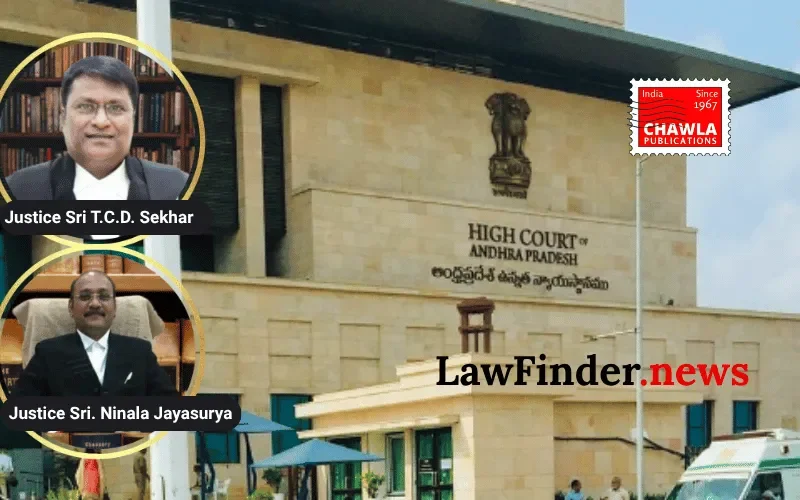
Court holds that reassessment proceedings under Sections 148 and 148A must follow faceless, automated allocation scheme; Legislature cannot nullify High Courts' judgments without curing defects in law.
In a landmark judgment dated October 12, 2026, the Andhra Pradesh High Court (Division Bench comprising Justices Ninala Jayasurya and T.C.D. Sekhar) struck down Section 147A of the Income Tax Act, 1961, inserted retrospectively by the Finance Act, 2026 (effective from April 1, 2021) as unconstitutional. The Court set aside all reassessment notices and orders issued by Jurisdictional Assessing Officers (JAOs) under Sections 148 and 148A of the Income Tax Act, holding that these proceedings violated statutory schemes mandating faceless and automated reassessment procedures.
The case arose from a batch of writ petitions challenging the constitutional validity of Section 147A, which retrospectively clarified that for Sections 148 and 148A, "Assessing Officer" means an officer other than the National Faceless Assessment Centre (NFAC) or any assessment unit. This amendment was introduced to override High Courts' rulings that reassessment proceedings must be conducted through faceless, technology-driven mechanisms as per Section 151A and related schemes notified by the Central Government.
The petitioners contended that the notices issued by JAOs were without jurisdiction since the scheme mandated issuance of such notices through automated allocation and faceless procedures, eliminating personal interface and ensuring transparency. They argued that the retrospective insertion of Section 147A was a legislative overreach, violating the doctrine of separation of powers by nullifying judicial decisions without removing the legal basis of those decisions. The retrospective amendment was said to unjustly take away the petitioners' vested rights to faceless assessment, violating Articles 14, 19(1)(g), and 265 of the Constitution.
The Revenue, represented by the Additional Solicitor General of India, defended the amendment as a clarificatory provision to remove litigation and provide procedural certainty. It was argued that reassessment under Section 147 must be faceless, but proceedings under Sections 148 and 148A - the pre-assessment inquiry stage - remain under the jurisdiction of JAOs. The Revenue maintained that the amendment was within legislative competence and not violative of constitutional provisions, and that the Income Tax Act, 1961 was not repealed at the time the amendment received Presidential assent.
The High Court meticulously analyzed the legislative history, statutory provisions (Sections 120, 124, 127, 130, 135A, 144B, 148, 148A, 151A, and the Finance Act, 2026), and the scheme notified on March 29, 2022, which mandated faceless reassessment and automated allocation of cases through the NFAC. The Court emphasized that the scheme expressly included issuance of notices under Section 148 through faceless, automated means and that JAOs' issuance of notices contravened this scheme, rendering such actions without jurisdiction.
The Court further held that retrospective insertion of Section 147A without amending the scheme under Section 151A to remove the legal basis of earlier judgments was impermissible. It relied on authoritative Supreme Court decisions such as Shri Prithvi Cotton Mills Ltd. v. Broach Borough Municipality, State of Tamil Nadu v. M. Rayappa Gounder, Madras Bar Association v. Union of India, and others to affirm that legislature cannot nullify judicial decisions by mere declaratory amendments without curing the defects identified by Courts. Such legislative acts would violate the basic structure of the Constitution, particularly the doctrine of separation of powers and rule of law.
Additionally, the Court observed that the Finance Act, 2026, which inserted Section 147A, came into force on April 1, 2026, while the Income Tax Act, 1961 was repealed on the midnight of March 31, 2026, raising doubts on the legal sanctity of inserting provisions retrospectively into a repealed Act. The Court ruled that such insertion lacked legal validity.
Accordingly, the Court declared Section 147A unconstitutional and quashed all reassessment proceedings initiated by JAOs under Sections 148 and 148A. The Court directed that reassessment proceedings must be conducted strictly in accordance with the faceless scheme and automated allocation prescribed under Sections 144B and 151A of the Income Tax Act.
This judgment reinforces the primacy of procedural mandates laid down by the legislature and upheld by Courts for faceless assessment, ensuring transparency, efficiency, and elimination of arbitrariness. It also underscores the constitutional limits on retrospective amendments that seek to override judicial pronouncements without addressing their foundational legal defects.
Bottom Line:
Income Tax - Reassessment, Section 147A of Income Tax Act, 1961 inserted by Finance Act, 2026 with retrospective effect from 01.04.2021 held unconstitutional - Court held that under Section 151A read with Notification No.18/2022, proceedings for issuance of notice under Section 148 and connected reassessment process were required to be undertaken through automated allocation and in faceless manner - Legislature cannot nullify judgments of High Courts without removing basis of decisions - Since scheme under Section 151A remained unamended, retrospective insertion of Section 147A validating jurisdiction of Jurisdictional Assessing Officer was impermissible - Notices/orders issued by Jurisdictional Assessing Officers under Sections 148A and 148 held without jurisdiction and set aside.
Statutory provision(s):
Income Tax Act, 1961 Sections 120, 124, 127, 130, 135A, 144B, 147, 148, 148A, 151A; Finance Act, 2026 Section 9 (insertion of Section 147A); General Clauses Act, 1897 Section 5.



