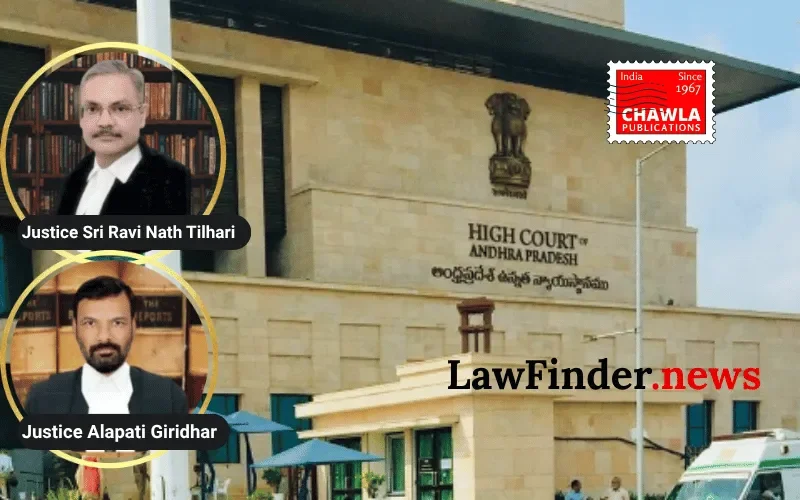
Court Emphasizes Habeas Corpus Petition Maintainability Depends on Detention Status at Time of Hearing, Rejects Illegal Detention Claim and Compensation Demand
The Andhra Pradesh High Court, in a recent double bench judgment dated September 30, 2026, dismissed a writ petition filed under Article 226 of the Constitution of India seeking a writ of Habeas Corpus for the production and release of Sri Kosire Venkataram Reddy, who was alleged to have been illegally detained by the police. The petitioner, Konda Vijaya Lakshmi, had contended that her husband was detained without lawful authority and was not produced before the Magistrate within the statutory 24-hour period, making the detention illegal and warranting compensation for violation of fundamental rights under Articles 21 and 22 of the Constitution.
The Court thoroughly examined the facts, statutory notices under the Bharatiya Nagarik Suraksha Sanhita, 2023 (BNSS), and the submissions of both parties. It was undisputed that the detenu appeared before the Investigating Officer on March 10, 2026, pursuant to a notice under Section 35(3) BNSS, and was released on March 11, 2026, at around 5:30 p.m. The respondents argued that the detenu was not in continuous custody but had been served a fresh notice under Section 94 BNSS to appear again on March 11, 2026, and was released after appearing.
The Court relied heavily on precedents from the Supreme Court of India, notably the ruling in Serious Fraud Investigation Office v. Rahul Modi (2019), which clarified that in habeas corpus proceedings, the legality of detention is to be examined with reference to the date of hearing or the return, not the date of filing the petition. Thus, since the detenu was no longer in custody at the time of consideration, the petition had become infructuous and was not maintainable.
Further, the Court held that disputed questions of fact, such as whether the detenu was released on March 10 or remained in custody continuously, cannot be adjudicated in writ jurisdiction, which is not a forum for roving inquiries or detailed fact-finding requiring evidence like electronic records or CCTV footage. The petitioner's claim of illegal detention was unsubstantiated by clear material.
On the issue of compensation, the Court reiterated the principle from Bhim Singh v. State of J&K and subsequent rulings that compensation for violation of fundamental rights can only be awarded upon a specific finding of illegal detention. Since no such finding was possible on the facts, the claim for compensation was rejected. However, the petitioner was left free to pursue any other legal remedies available under law.
This judgment underscores the procedural and substantive thresholds in habeas corpus petitions, emphasizing that such petitions are maintainable only when the detenu is actually in custody at the time of judicial scrutiny, and that compensation claims require clear proof of unlawful detention.
Bottom Line:
Habeas Corpus - Petition becomes not maintainable when detenu is released during pendency and is not in detention on the date of consideration - In absence of clear material proving illegal detention, disputed questions of fact regarding custody cannot be adjudicated in writ jurisdiction - Compensation for violation of Articles 21 and 22 can be granted only upon a specific finding of illegal detention.
Statutory provision(s):
Articles 21, 22, 226 of the Constitution of India; Sections 35(3), 94 of the Bharatiya Nagarik Suraksha Sanhita, 2023; Sections 196(1)(a), 299, 356(1) of the Bharatiya Nyaya Sanhita, 2023; Section 67 of the Information Technology Act, 2000
Konda Vijaya Lakshmi v. State of Andhra Pradesh, (Andhra Pradesh)(DB) : Law Finder Doc Id # 2999882