Court emphasizes balance between public interest and constitutional right to property under Article 300A, orders detailed examination of procedural compliance in land acquisition for Seed Access Road project.
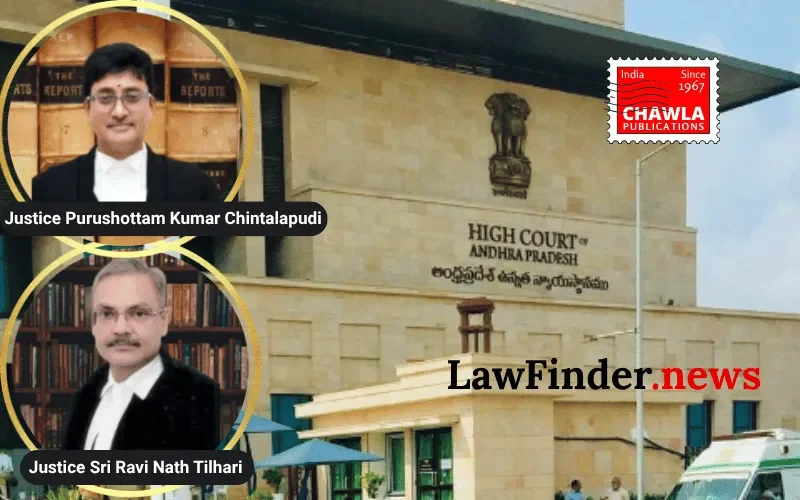
In a significant judgment delivered on July 30, 2026, the Andhra Pradesh High Court in a Division Bench comprising Justices Ravi Nath Tilhari and Purushottam Kumar Chintalapudi addressed the contentious issue of land acquisition for public infrastructure within the Capital City Region. The case arose from writ appeals filed by Chodisetty Nirmalatha and others challenging the legality and procedural compliance of land acquisition notifications issued under the Right to Fair Compensation and Transparency in Land Acquisition, Rehabilitation and Resettlement Act, 2013 ("LA&RR Act, 2013").
The appellants contested the preliminary notification issued under Section 11 of the LA&RR Act, 2013, as well as subsequent notifications and actions, alleging violations of mandatory procedural safeguards, lack of administrative sanction, absence of proper survey, and failure to conduct rehabilitation and resettlement (R&R) as mandated. They contended that these lapses rendered the acquisition illegal, and sought interim relief restraining the State from dispossessing them pending final adjudication.
The State respondents, represented by the Advocate General, argued that the acquisition concerned a small residual portion of land (approximately 2.725 cents out of a total requirement of around 281 acres) necessary for completing the Seed Access Road, a key public infrastructure project. The majority of land required for the project had already been acquired through a Land Pooling Scheme (LPS). The State maintained that all procedural requirements under the Act were complied with, including prior notifications, consideration of objections, and issuance of awards with compensation. They emphasized the overriding public interest served by the project.
The Single Judge initially declined to grant interim relief, noting the public importance of the project and the substantial acquisition already completed. However, recognizing the validity of certain procedural objections and the need for a detailed examination, the Court directed the filing of counter-affidavits and reserved the final adjudication for the writ petitions. It also granted interim protection to the appellants in Writ Appeal No.849, maintaining status quo on possession pending final decision. In Writ Appeal No.850, where possession had already been taken, interim relief was denied.
The Division Bench upheld the approach of the Single Judge, emphasizing that the constitutional right to property under Article 300A of the Constitution of India is inviolable and any deprivation, however small the portion of land, must strictly follow the procedure prescribed by law. The Court acknowledged the primacy of larger public interest but stressed that this does not permit bypassing statutory safeguards. The learned Judges refrained from expressing opinions on the substantive merits at the interlocutory stage, reinforcing that the writ petitions and interim relief applications must be decided after thorough examination of all pleadings.
The Court directed the respondents to file counter-affidavits promptly and for the interim relief applications to be decided expeditiously within one week thereafter. It also urged cooperation by all parties and discouraged adjournments to facilitate early resolution. The judgment balances the State's need to proceed with vital infrastructure development and the protection of individual property rights, reinforcing the principle that lawful procedure is paramount in land acquisition cases.
This decision aligns with precedents such as Premji Nathu v. State of Gujarat (2012), Dhanjaya Reddy v. State of Karnataka (2001), and Dalpat Kumar v. Prahlad Singh (1993), emphasizing procedural compliance and judicial scrutiny in acquisition matters. The judgment also references recent rulings that outline principles governing land acquisition, rehabilitation, and compensation.
The case highlights ongoing tensions in urban development projects between public interest and individual rights, underscoring the judiciary's role in ensuring that acquisition processes are transparent, lawful, and just.
Bottom Line:
Right to Property - Interim relief in land acquisition cases - Judicial discretion to balance public interest and individual rights under Article 300A of the Constitution of India.
Statutory provision(s):
Right to Fair Compensation and Transparency in Land Acquisition, Rehabilitation and Resettlement Act, 2013 Sections 11, 19, 21, Article 300A of the Constitution of India
Chodisetty Nirmalatha v. State of Andhra Pradesh, (Andhra Pradesh)(DB) : Law Finder Doc Id # 2954810