Court finds prima facie evidence of custodial violence, tampering with CCTV footage, and disappearance of dead body; directs independent investigation and disciplinary action against police officials.
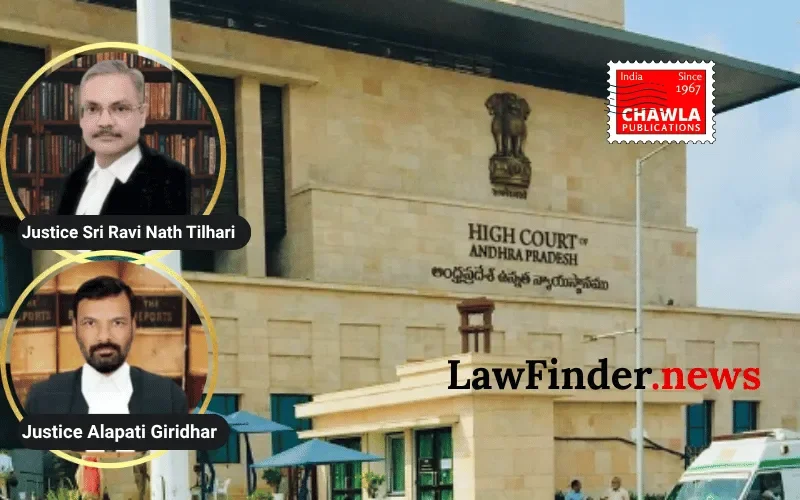
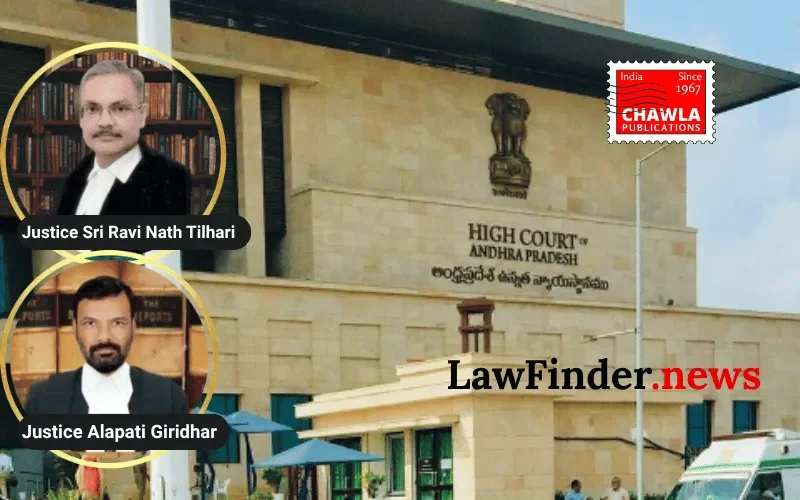
In a significant judgment delivered on October 16, 2026, the Andhra Pradesh High Court (Division Bench comprising Justices Ravi Nath Tilhari and Alapati Giridhar) directed the Central Bureau of Investigation (CBI) to take over the probe into the custodial death of Gade Sai Krishna, aged 25, who was allegedly subjected to custodial violence by police officials of Krishnalanka Police Station, Vijayawada. The Court further ordered the State Government to pay Rs. 25,00,000 as compensation to the mother of the deceased, Gade Vijaya Lakshmi, under Article 226 of the Constitution, recognizing the gross violation of fundamental rights under Articles 21 and 22.
The case arose when Sai Krishna, who had several pending criminal cases and non-bailable warrants (NBWs) against him, was apprehended by a police team on May 6, 2026, at Markapuram and taken into custody at Krishnalanka Police Station. Despite lawful apprehension, he was not produced before the Magistrate within the prescribed time under the Bharatiya Nagarik Suraksha Sanhita (BNS), 2023, nor was his release ordered. The petitioner's repeated efforts to ascertain his whereabouts were met with contradictory responses from police officials, raising suspicions of concealment.
Investigations, including those by a Special Investigation Team (SIT) constituted by the State, revealed that Sai Krishna was subjected to custodial torture, sustained injuries, and died in custody. Shockingly, the original CCTV hard disks containing recordings of the period of custody were removed and replaced with unauthorized disks, thereby destroying crucial electronic evidence. The dead body remains untraced despite exhaustive efforts by the police to locate it.
The High Court, after meticulously analyzing the extensive material including witness statements, medical evidence, call detail records (CDRs), and forensic reports, held that this constituted a grave instance of custodial violence and custodial death involving multiple police personnel, including the then Inspector and Station House Officer (SHO) S.S.V.V. Nagaraju, who was suspended and arrested. The Court noted the serious institutional failure and the likelihood of bias in the ongoing State police investigation, emphasizing the need for an independent probe to restore public confidence.
Citing landmark Supreme Court precedents such as State of West Bengal v. Committee for Protection of Democratic Rights (2010), Pooja Pal v. Union of India (2016), and Rubabbuddin Sheikh v. State of Gujarat (2010), the Court underscored the constitutional obligation of High Courts to ensure fair and impartial investigations, especially where allegations implicate police officials. It ruled that the mere filing of a charge-sheet by the SIT did not preclude the transfer of investigation to the CBI in exceptional circumstances like the present.
Regarding compensation, the Court relied on the principles established in Nilabati Behera v. State of Orissa (1993) and subsequent judgments, holding that monetary compensation in writ jurisdiction under Article 226 is a public law remedy for violation of fundamental rights that cannot be denied merely because civil remedies exist. It acknowledged that no amount can compensate for the loss of life but deemed Rs. 25,00,000 as appropriate to apply balm to the wounds of the grieving mother.
The Court also reiterated mandatory safeguards for arrest and detention as laid down in D.K. Basu v. State of West Bengal (1997), Arnesh Kumar v. State of Bihar (2014), Mihir Rajesh Shah v. State of Maharashtra (2026), and Vihaan Kumar v. State of Haryana (2025). These include informing the person of grounds of arrest, informing relatives, maintaining arrest memos and custody records, conducting medical examination, and timely production before Magistrate. The judgment sternly reminded police authorities that custodial death is a crime and that disciplinary proceedings must be initiated against erring personnel.
The High Court directed the Director of CBI to register a regular criminal case and conduct an expeditious investigation under the supervision of a senior officer. The State Government was ordered to transmit all records to CBI immediately and to pay the compensation amount to the petitioner within four weeks.
This judgment sends a clear message that custodial violence and deaths are unacceptable and that the judiciary will actively ensure independent investigation, accountability, and compensation to victims' families, reinforcing the rule of law and fundamental rights protections in India.
Bottom Line:
Habeas corpus - Custodial violence and custodial death - Where detenue was apprehended by police, not produced before Magistrate, prima facie assaulted in custody, CCTV evidence was tampered with and body remained untraced, High Court directed CBI investigation and awarded Rs.25,00,000 compensation to mother under Article 226 for violation of Articles 21 and 22.
Statutory provision(s): Articles 21, 22, 226 of the Constitution of India, Sections 127(4), 127(6), 103(1), 238, 305, 316(5), 61(2) read with 3(5) of Bharatiya Nagarik Suraksha Sanhita, 2023; Sections 3 of Prevention of Damage to Public Property Act, 1984; Sections 65, 66 of Information Technology Act, 2000
Gade Vijaya Lakshmi v. State of Andhra Pradesh, (Andhra Pradesh)(DB) : Law Finder Doc Id # 2999038