Court says second writ petition under Article 226 cannot reopen issues already available in earlier case; only changed circumstances or truly new grounds can justify a fresh challenge.
The Andhra Pradesh High Court has dismissed a fresh habeas corpus petition filed by Bommali Ashajyothi challenging the same preventive detention order and its confirmation, holding that a second writ petition under Article 226 is not maintainable on grounds that were already available when the first petition was decided.
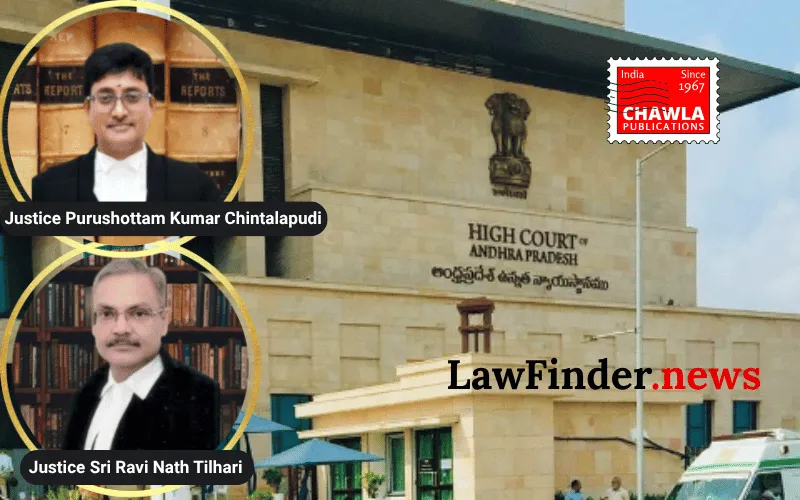
A Division Bench of Justices Ravi Nath Tilhari and Purushottam Kumar Chintalapudi held that while the doctrine of res judicata or constructive res judicata does not strictly apply to habeas corpus matters, the principle of finality does. The Court said a litigant cannot be permitted to file successive petitions before the same High Court on the same detention order by omitting some available grounds in the first round and trying again later.
The petitioner had challenged the detention order passed by the District Magistrate, Parvathipuram Manyam District, dated 21 August 2025, and the confirmation order dated 17 October 2025. However, the same detention orders had already been challenged earlier in W.P. No. 25077 of 2025, which was dismissed on merits by a coordinate bench on 5 February 2026.
Before the Court, counsel for the petitioner argued that the present petition was based on different grounds that had not been raised earlier. Reliance was placed on Supreme Court and High Court precedents, including T.P. Moideen Koya, Srikanth, and the Andhra Pradesh High Court decision in Sookam Sreenivasulu, to submit that habeas corpus petitions are not barred by res judicata.
The State opposed the petition, contending that no new circumstances had arisen after the earlier decision and that the present challenge was only a repackaging of issues that were already available. Accepting this argument, the Court examined the law on successive habeas corpus petitions and noted that the Supreme Court has repeatedly held that a fresh petition may be entertained only if there are changed circumstances or if a new ground becomes available after the earlier decision.
The Bench relied heavily on T.P. Moideen Koya, where the Supreme Court had clarified that a subsequent habeas corpus petition may lie on new grounds or changed circumstances, but not on grounds that were already available earlier. The Court also referred to the principle laid down in Srikanth that the substance of the plea matters, not its form. Mere cosmetic changes in wording would not convert an old ground into a new one.
Distinguishing Sookam Sreenivasulu, the High Court said that case turned on different facts, where the later petition involved grounds that had not been addressed earlier. In the present case, however, the grounds were not new in substance and were available even at the time of the earlier writ petition.
The Bench observed that allowing such repeated petitions would enable a detenu to “take a chance again” after failing in the first round, which would undermine the finality of judicial decisions. The Court therefore held that the earlier judgment dated 5 February 2026 had attained finality and could not be reopened by a coordinate bench on grounds that were available but not urged earlier.
Accordingly, the writ petition was dismissed as not maintainable, with no order as to costs.
Bottom Line :
Preventive detention - Successive habeas corpus petition under Article 226 challenging same detention order is not maintainable on grounds which were available at the time of earlier writ petition - Though res judicata or constructive res judicata does not apply to habeas corpus petitions, principle of finality of earlier judgment applies - Fresh petition under Article 226 would lie only on changed circumstances or on new grounds becoming available after earlier decision.
Statutory provision(s): Articles 21, 22, 32, 136, 226 of the Constitution of India, 1950
Bommali Ashajyothi v. State of Andhra Pradesh, (Andhra Pradesh)(DB) : Law Finder Doc id # 2987080