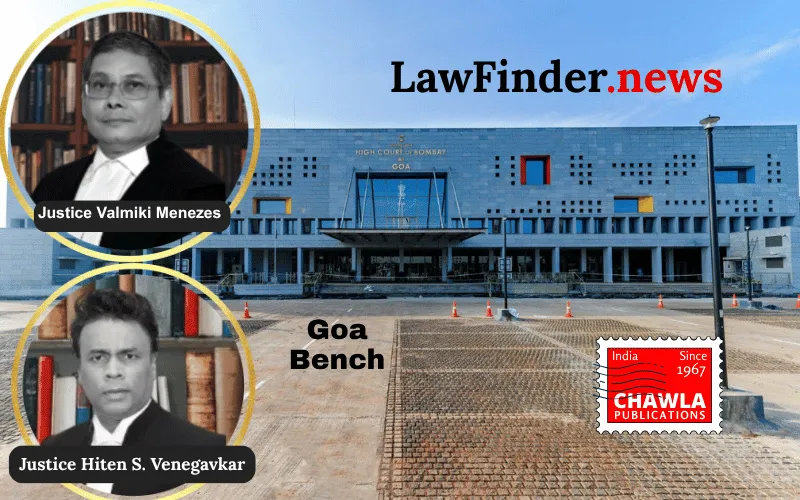
Court balances constitutional mandate of timely municipal elections under Article 243U with legislative changes, preserving amended law while mandating compressed election schedule to ensure democratic restoration by January 2027
In a landmark judgment delivered on August 25, 2026, the Bombay High Court (Goa Bench, Division Bench of Justices Valmiki Menezes and Hiten S. Venegavkar) addressed a complex constitutional controversy involving the Goa Municipalities (Amendment) Ordinance, 2026 and the overdue elections to eleven Municipal Councils in Goa. The Court upheld the constitutional validity of the Ordinance promulgated on April 22, 2026, which amended the statutory framework governing municipal elections, including the composition, delimitation, and reservation of wards, but simultaneously imposed a strict and detailed timetable to ensure that the elections' overdue under Article 243U of the Indian Constitution' are completed by January 4, 2027.
Background:
The controversy arose when elections to the eleven Municipal Councils, whose five-year terms ended between March and May 2026, were not held within the constitutionally mandated period under Article 243U of the Constitution of India. Instead, Administrators were appointed to these Councils. Before elections could be conducted, the Governor promulgated the Goa Municipalities (Amendment) Ordinance, 2026, introducing population-based criteria for determining the number of councillors and a detailed reservation process involving empirical inquiry for Other Backward Classes (OBCs). This amendment came after the State Election Commission had already initiated election preparations based on the earlier statutory regime.
Several writ petitions challenged the Ordinance and the delay in elections, alleging that the constitutional mandate for timely elections was being defeated. Petitioners contended that the Ordinance, promulgated after the elections had become due or overdue, unlawfully prolonged administration through appointed officials and violated Articles 14, 213, and 243U of the Constitution. The State defended the Ordinance's validity and argued that the elections must be held under the new law.
Key Legal Issues:
The Court examined multiple interconnected constitutional questions, including:
1. The mandatory nature of Article 243U, which requires municipal elections to be completed before expiry of the five-year term, and whether any delay is permissible.
2. The scope of legislative power under Article 243ZA(2) to enact laws governing municipal elections, and the interplay between legislative amendments and the constitutional election timetable.
3. The limited judicial review of Ordinance-making power under Article 213, and whether the Governor's promulgation of the Ordinance was constitutionally valid.
4. The constitutional bar under Article 243ZG against challenging delimitation laws, and the extent of judicial review over administrative orders.
5. Whether the State Election Commission could disregard the amended law and complete elections under the prior legal regime.
6. The harmonization of constitutional provisions concerning duration, composition, reservation, and the election process, including the requirement of contemporaneous empirical inquiry for OBC reservation.
7. Institutional responsibilities of the State Government, Legislature, State Election Commission, and Goa State Commission for Backward Classes to ensure preparedness and coordination to prevent avoidable delays.
Judgment Highlights:
- The Court held that Article 243U imposes a mandatory constitutional deadline: Municipal Councils shall continue for five years and no longer, and elections must be completed before expiry. Ordinary administrative delay or lack of preparedness do not justify postponement.
- Legislative power under Article 243ZA(2) and Ordinance-making power under Article 213 remain exercisable even after the election deadline has matured, but such laws do not create a fresh constitutional term. Both the constitutional election timeline and the operative statutory regime must be harmoniously implemented.
- The Goa Municipalities (Amendment) Ordinance, 2026 was validly promulgated under Article 213, with relevant material justifying immediate action.
- Article 243ZG prevents judicial review of the validity of the delimitation and reservation laws themselves but does not bar review of administrative or statutory orders made under the law.
- The State Election Commission cannot disregard the operative amended law and conduct elections under the previous regime, even though preparations had commenced under the earlier law.
- The Commission was justified in discontinuing the earlier delimitation exercise because the statutory basis changed from voters to population, affecting the number and configuration of wards.
- The Court emphasized the constitutional principle of "non-manipulability of the electoral calendar," holding that the constitutional election date fixed by Article 243U cannot be displaced by successive legislative or administrative delays. Institutions must organize their functions with foresight so that elections are held timely.
- The Goa State Commission for Backward Classes, responsible for empirical inquiry into political backwardness, was directed to commence concurrently the municipality-wise empirical inquiry based on existing data and complete residual ward-specific work within seven days after final delimitation.
- The Court fixed a detailed, binding timetable with specific outer limits for each stage of the election process, including delimitation objections, final delimitation, empirical inquiry, draft and final reservation, statutory waiting periods, and the election program, to ensure elections are completed by January 4, 2027.
- Government consultation periods were compressed but must be completed within the statutory timelines and not add additional delay.
- The Court rejected the alternative prayer to conduct the elections under the previous legal regime, holding that such a direction would amount to judicial suspension of valid legislation without declaring it unconstitutional.
- Administrative convenience, proximity to forthcoming Legislative Assembly elections, or shortage of personnel cannot justify further postponement of municipal elections.
- The State Election Commissioner, Chief Secretary of Goa, and Member Secretary of the Goa State Commission for Backward Classes were directed to personally supervise compliance with the timetable.
Impact:
This judgment clarifies the constitutional interplay between the mandatory periodicity of municipal elections and the State's legislative competence to amend electoral laws. It underscores that constitutional mandates of timely elections are inviolable but must be harmonized with valid statutory changes. The decision also reinforces institutional responsibilities for advance planning and coordination to prevent avoidable delays in democratic governance.
The Court's detailed timetable ensures that elections to the eleven Municipal Councils in Goa, overdue since March-May 2026, will be completed by January 4, 2027, thereby restoring elected local self-governance in compliance with constitutional and statutory requirements.
Bottom Line:
The Court exercised limited judicial review of the Ordinance under Article 213 and upheld the constitutional mandate of timely elections under Article 243U, harmonizing it with legislative competence under Article 243ZA and delimitation law protected by Article 243ZG.
Statutory provision(s):
Articles 14, 213, 243P, 243R, 243T, 243U, 243ZA, 243ZG of the Constitution of India; Goa Municipalities Act, 1968 (Sections 9, 10, 11); Goa Municipalities (Amendment) Ordinance, 2026
Nimesia Faleiro v. State of Goa, (Bombay)(Goa)(DB) : Law Finder Doc Id # 2969241