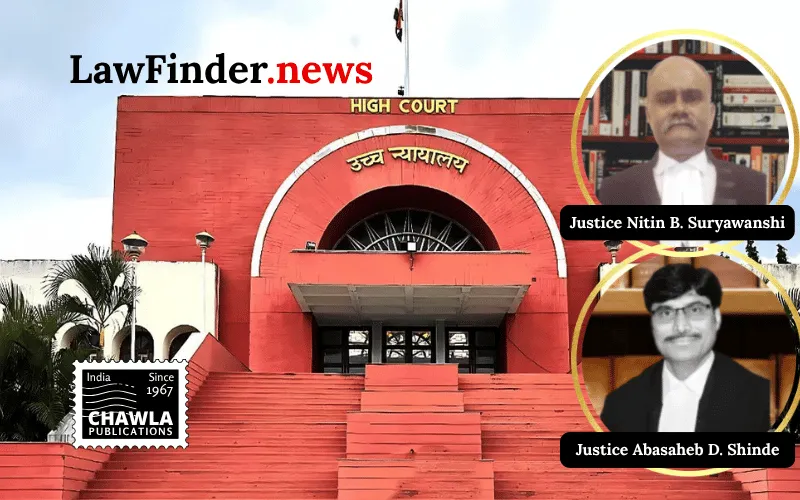
Extended Limitation Period Not Invocable Without Allegations of Fraud; Revenue Cannot Take Contradictory Stands in Identical Cases, Rules Bombay High Court
In a significant judgment delivered on September 3, 2026, the Bombay High Court (Aurangabad Bench) dismissed the appeal filed by the Commissioner of Central Excise, Aurangabad, against M/s Millennium Beer Industries Ltd. regarding a hefty service tax demand relating to the manufacture and sale of alcoholic beverages. The Court reiterated the sacrosanct nature of the principle of consistency in revenue matters and emphasized that the extended limitation period under the Central Excise Act, 1944 cannot be invoked without specific allegations of mala fide conduct such as fraud, collusion, or suppression of facts.
Background:
The case arose from a show-cause notice issued by the Revenue on December 19, 2012, demanding Rs. 21,92,03,724/- along with interest and penalty from Millennium Beer Industries for service tax allegedly payable for the period between September 23, 2009, and November 15, 2011. The demand arose out of services rendered by Millennium under an agreement with M/s United Breweries Ltd. (UBL) for manufacturing alcoholic beverages on their behalf.
Following adjudication, the demand was confirmed by the Revenue. Millennium Beer Industries challenged the order before the Customs, Excise and Service Tax Appellate Tribunal (CESTAT), which allowed their appeal on the ground that the demand was barred by limitation. The Revenue then filed this appeal before the High Court.
Core Issues:
The Revenue contested the limitation defense by arguing that the extended period of limitation should apply due to the merger/amalgamation of companies effective from April 1, 2010. It also sought to challenge the Tribunal’s acceptance of the appointed date of amalgamation instead of the certificate of incorporation date (November 16, 2011) as the relevant date for imposing liability.
The Respondent contended that the facts and period of demand were substantially identical to another case involving M/s SAB Miller Breweries Pvt. Ltd., where the Revenue accepted the Tribunal’s decision. Thus, the Revenue was estopped from taking a different stand in Millennium’s case. The Respondent further argued that the extended limitation period could not be invoked in the absence of specific allegations of fraud or collusion.
Court’s Reasoning:
The Bench comprising Justice Nitin B. Suryawanshi and Justice Abasaheb D. Shinde carefully examined the facts and precedents, particularly highlighting:
1. Principle of Consistency:
The Court relied on Supreme Court precedents including Birla Corporation Ltd. v. Commissioner of Central Excise (2005) 6 SCC 95 and Union of India v. Kaumudini Narayan Dalal (2001) 10 SCC 231, underscoring that the Revenue cannot take inconsistent stands on identical facts in different cases. Allowing such contradictory positions would cause confusion and violate principles of fairness and equity.
2. Limitation Period and Extended Period Invocation:
The Court analyzed Section 11A of the Central Excise Act (analogous to Section 28 of the Customs Act) which permits invoking an extended limitation period only upon specific allegations of fraud, collusion, willful misstatement or suppression of facts. Referring to the Supreme Court’s decision in Uniworth Textiles Ltd. v. Commissioner of Central Excise (2013) 9 SCC 753, the Court held that the show-cause notice must explicitly state such allegations to extend limitation. Since the Revenue failed to prove any mala fide conduct on the part of the Respondent, the extended period could not be invoked.
3. Substantial Question of Law:
Under Section 35G of the Central Excise Act, an appeal to the High Court lies only if a substantial question of law is involved. The Court found no substantial question of law in the Revenue’s appeal, as the Tribunal’s finding of limitation was a factual conclusion supported by evidence and not perverse or erroneous.
4. Date of Amalgamation:
The Court accepted the Appellate Tribunal’s view that the appointed date of amalgamation (April 1, 2010), as approved by the Board for Industrial and Financial Reconstruction (BIFR), was the relevant date for service tax liability and not the date of certificate of incorporation issued by the Registrar of Companies (November 16, 2011).
Conclusion:
The Bombay High Court dismissed the Revenue’s appeal, affirming the Appellate Tribunal’s decision that the demand was barred by limitation and reinforcing the principle that the Revenue cannot adopt contradictory legal positions in cases with identical facts. The judgment sends a clear message that tax authorities must act fairly and consistently and cannot arbitrarily invoke extended limitation periods without proper and specific allegations.
Implications:
This judgment is a landmark on the application of the principle of consistency in tax litigation and limits the Revenue’s ability to invoke extended limitation periods without concrete evidence of fraud or suppression. It also clarifies the correct approach to dates relevant for service tax liability in cases of corporate amalgamations.
Bottom Line:
Revenue cannot take inconsistent stands in cases with identical facts, and the principle of consistency must be upheld in tax matters.
Statutory provision(s):
Central Excise Act, 1944 Sections 11A, 35G; Finance Act, 1994 Sections 75, 76, 77, 78