Court Rules Suspension Orders Lacked Adequate Legal Basis and Reasoning; Upholds Principle of Non-Arbitrariness and Legitimate Expectation of License Holders
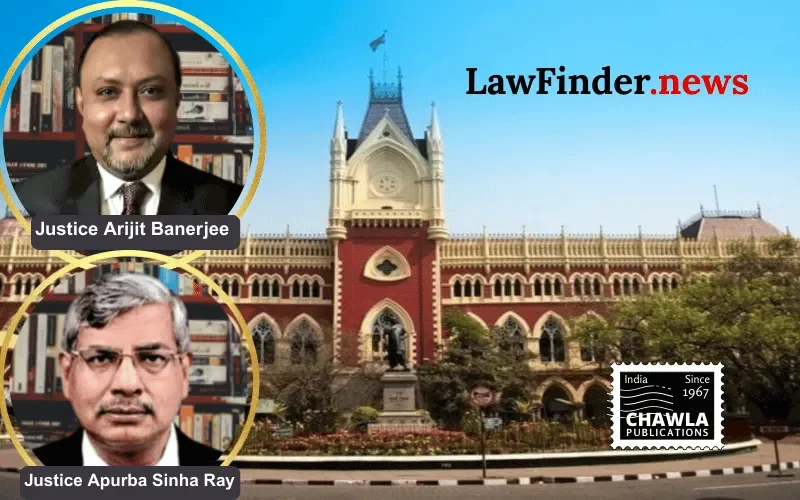
In a significant judgment delivered on November 13, 2026, the Division Bench of the Calcutta High Court, comprising Justices Arijit Banerjee and Apurba Sinha Ray, ruled in favour of appellants whose temporary liquor licenses were suspended during and even after the 2019 General Election in West Bengal. The Court held that such suspension orders, especially their prolonged continuance beyond the election period, were legally unsustainable due to a lack of adequate reasons and procedural fairness.
The appeals stemmed from a batch of writ petitions challenging the suspension and non-renewal of temporary liquor licenses granted under Rule 4(q) of the West Bengal Excise Rules, 2003. The licenses, initially granted for six months beginning January 1, 2019, were suspended by an order dated March 2, 2019, citing the General Election and instructions from the Election Commission. However, the suspension continued even after the election concluded on May 23, 2019, and after the appellants' licenses were due to expire in August 2019.
The appellants contended that there was no breach or default on their part to justify the suspension. They argued that once the suspension order was rescinded on August 22, 2019, their licenses should have been restored for the remaining period without reopening eligibility or imposing fresh conditions. They also challenged the State's subsequent notifications issued in December 2019, which discontinued the category of license under Rule 4(q) without appropriate statutory procedure, thereby affecting their rights.
The Court examined whether the suspension order was authorized under Sections 26 and 42 of the Bengal Excise Act, 1909, and whether election-related closure provisions permitted suspension beyond the prescribed period. It also scrutinized the State's power to discontinue the relevant license category and the principle of legitimate expectation invoked by the appellants.
Key findings of the judgment include:
1. Lack of Proper Authority and Reasons for Suspension:
The suspension order was issued by the Excise Commissioner without citing the legal provision or rule under which it was issued. The Bengal Excise Act vests the power to suspend or cancel licenses primarily with the Collector of the District. No cogent reasons were provided for prolonging the suspension beyond the election, violating principles of natural justice and fairness.
2. No Fundamental Right but Legal Right Cannot Be Arbitrarily Withdrawn:
While trade in liquor is not a fundamental right under Article 19(1)(g) of the Constitution, a license granted after fulfilling statutory conditions creates a legal right or privilege. Such right cannot be curtailed arbitrarily or without just cause, consistent with the principle of non-arbitrariness under Article 14.
3. Doctrine of Legitimate Expectation:
The appellants had a legitimate expectation to continue their business during the license tenure after compliance with conditions and payment of fees. Failure to consider this expectation amounted to arbitrariness, though it is not an enforceable right per se.
4. Differential Treatment of License Categories:
The Court observed that the category under Rule 4(q) was discontinued by the State while other categories continued to operate. Such differential treatment without adequate basis was arbitrary and required judicial scrutiny.
5. Restoration of Licenses for Balance Period:
Considering the unjustified prolonged suspension and absence of default by the appellants, the Court directed the State to allow the appellants to run their shops from December 15, 2026, to complete the balance period of their six-month licenses so they could clear the stock.
6. Pending Applications and Representations to be Decided Promptly:
The appellants were granted liberty to file fresh applications under Rule 9(1)-F of the West Bengal Excise Rules for regular licenses, and the authorities were directed to dispose of pending representations within three months.
7. Suspension Notifications Kept in Abeyance:
The notifications discontinuing the Rule 4(q) license category were ordered to be kept in abeyance till the balance license period ended for the appellants involved in these appeals.
The Court emphasized that the State's power to regulate the liquor trade must be exercised fairly, transparently, and in accordance with established legal principles to avoid arbitrariness and unjust deprivation of lawful rights. The judgment thus reiterates the constitutional mandate that administrative actions must be just, fair, and reasonable, even in the realm of excise licensing.
The appeals MAT 812 of 2024, MAT 847 of 2022, and MAT 418 of 2023 were accordingly allowed in part, with no order as to costs.
Bottom Line:
Temporary liquor licenses cannot be suspended or denied renewal without assigning adequate reasons. State authorities must exercise their power with fairness and reasonableness, adhering to established legal principles.
Statutory provision(s):
Bengal Excise Act, 1909 Sections 26, 30, 31, 37A, 42, 85, 86; West Bengal Excise Rules, 2003 Rule 4(q), Rule 9(1)-F; West Bengal Excise (Closure of Retail Licensed Premises on Special Occasion, viz. Election) Rules, 1998; Constitution of India Articles 14, 19(1)(g), 21
Barun Malakar v. State of West Bengal, (Calcutta)(DB) : Law Finder Doc Id # 3102196