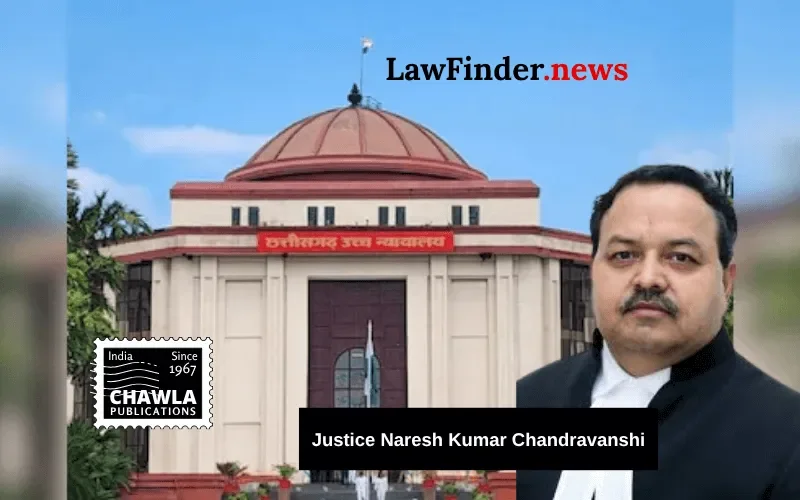
Court Emphasizes Need for Clear Instigation and Proximity to Suicide Act, Setting Aside Conviction under Section 306 IPC
In a significant judgment delivered on September 28, 2026, the Chhattisgarh High Court acquitted the appellants, Smt. Lakhapatiya Bai and others, who were earlier convicted for abetment to suicide under Section 306/34 of the Indian Penal Code (IPC). The appellants were sentenced to rigorous imprisonment for 10 years along with fines by the Second Upper Sessions Judge, Sarguja, for allegedly instigating the late Ku. Anita Ravi to commit suicide.
The prosecution's case was predicated on the allegation that on April 13, 2009, the appellants, distant relatives of the deceased, objected to the presence of the deceased and her fiance, Abhay Kumar Bhaskar, at his house and assaulted them physically. It was contended that this harassment caused the deceased to feel insulted and led to her suicide by consuming poison on April 18, 2009.
However, upon appeal, the High Court meticulously examined the evidence and legal principles governing abetment to suicide. The Court underscored that conviction under Section 306 IPC requires proof of clear mens rea - the deliberate intention to instigate or abet suicide - and that such instigation must be in close proximity to the act of suicide.
The Court observed that although it was established that the appellants and the deceased had a quarrel and physical altercation, there was no evidence to suggest that the appellants intended to provoke or instigate the deceased to take her life. The five-day gap between the alleged assault and the suicide weakened the causal link. Moreover, the suicide note's authenticity was supported by family members despite the non-examination of the handwriting expert, but it did not establish instigation by the appellants.
Citing several precedents, including recent Supreme Court rulings, the Court emphasized that mere harassment, beating, or insult, without a direct or indirect act aimed at encouraging suicide, does not amount to abetment. The Court further clarified that a victim's personal emotional state or hypersensitivity is insufficient to hold the accused liable unless there is demonstrable instigation.
Therefore, the High Court set aside the conviction and sentence, acquitting the appellants of the charges under Section 306/34 IPC. The Court also ordered the continuation of the appellants' bail bonds for six months under the provisions of Section 481 of the Bharatiya Nagarik Suraksha Sanhita, 2023.
This judgment reaffirms the stringent threshold required to establish abetment to suicide and protects individuals from conviction based solely on circumstantial harassment or emotional distress inflicted on the victim.
Bottom Line:
To establish the offence of abetment to suicide under Section 306IPC read with Section107 IPC, there must be direct or indirect instigation, in close proximity to the commission of suicide, along with clear **mens rea** to abet the act. Mere harassment or beating, without evidence of intentional instigation, cannot constitute abetment.
Statutory provision(s):
Section 306 IPC, Section 107 IPC, Section 374 CrPC, Section 481 Bharatiya Nagarik Suraksha Sanhita, 2023
Smt. Lakhapatiya Bai v. State of Chhattisgarh, (Chhattisgarh) : Law Finder Doc Id # 2987591