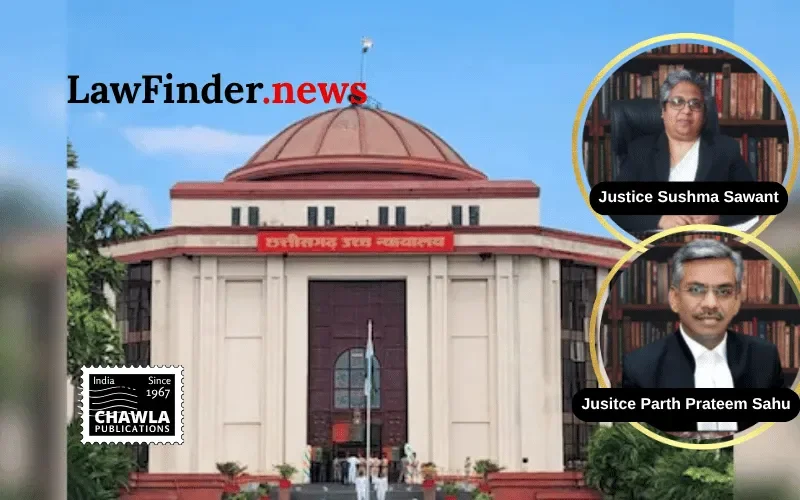
Divorce granted citing mental cruelty; wife allowed to separately claim alimony under Section 25 of Hindu Marriage Act after Family Court's refusal due to lack of prior application or evidence
In a significant judgment dated September 24, 2026, the Chhattisgarh High Court (Division Bench comprising Justices Parth Prateem Sahu and Sushma Sawant) affirmed the Family Court's divorce decree in the case of Smt. Ekta Vishwas v. Devashish Vishwas, holding that the conduct of the wife constituted mental cruelty towards the husband. However, the Court declined to award permanent alimony to the wife in the appeal, as no claim or evidence was presented before the Family Court on this issue. The wife was granted liberty to file a separate application under Section 25 of the Hindu Marriage Act, 1955 for permanent alimony.
The matrimonial dispute arose from a brief conjugal life post-marriage on February 17, 2016, followed by allegations and counter-allegations of cruelty, illicit relationships, and desertion. The husband, a government employee, alleged that the wife neglected household duties, quarrelled with his parents, and maintained an extramarital relationship. The wife denied these allegations and countered with claims of harassment by the husband's family, the husband's own extramarital affairs, and even an alleged miscarriage caused without her consent.
The Family Court, after examining oral evidence of both parties and their witnesses, found the wife's conduct to amount to cruelty, primarily mental cruelty, and granted divorce to the husband on these grounds. The appellate Court noted the absence of documentary evidence but accepted the husband's version based on consistent oral evidence and adverse inferences drawn from the wife's cross-examination, including suggestions of an apology related to the alleged illicit relationship.
Importantly, the Court reiterated the principle that the concept of cruelty under Section 13(1)(ia) of the Hindu Marriage Act is not rigid but depends on the facts and circumstances of each case, citing precedents such as Ravi Kumar v. Julmidevi (2010) and Roopa Soni v. Kamalnarayan Soni (2023). It observed that cruelty may arise from acts, words, omissions, or even silence and must be judged contextually.
Regarding permanent alimony under Section 25 of the Hindu Marriage Act, the Court emphasized that the quantum of alimony depends on multiple factors including the income and property of both parties, their needs, conduct, and standard of living. Since the wife had neither applied for alimony before the Family Court nor led any evidence, the appellate Court declined to entertain her claim for the first time in appeal. The wife was, however, given the option to initiate separate proceedings for alimony, which the competent court must consider fairly and in accordance with law.
This judgment clarifies the approach towards matrimonial cruelty and alimony claims, underscoring the necessity for proper pleadings and evidence at trial and the discretionary nature of cruelty and alimony determinations.
Bottom Line:
Hindu Marriage Act - Divorce on ground of cruelty - Mutual allegations regarding illicit relationships and conduct of parties - Family Court decree of divorce affirmed - Permanent alimony not granted in appeal when no application or evidence for alimony was filed before Family Court - Wife given liberty to file separate application under section 25 of Hindu Marriage Act.
Statutory provision(s):
Hindu Marriage Act, 1955 Sections 13(1)(ia), 25; Family Courts Act, 1984 Section 19(1)
Smt. Ekta Vishwas v. Devashish Vishwas, (Chhattisgarh)(DB) : Law Finder Doc Id # 2985176