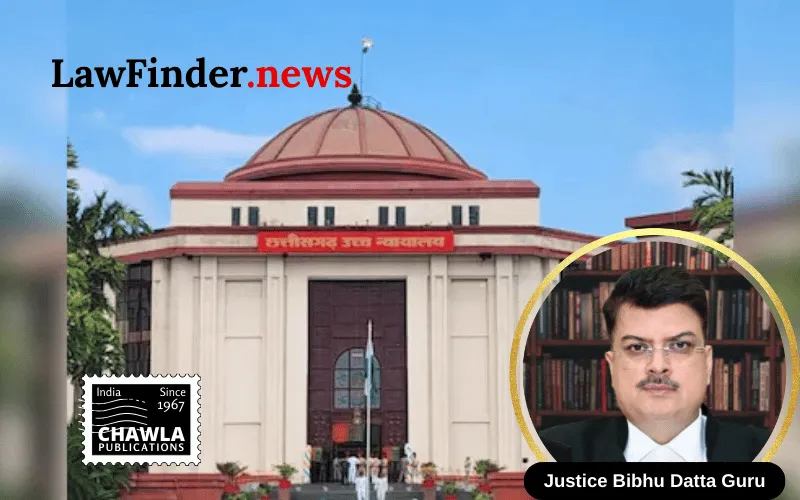
Court Emphasizes Objective and Holistic Assessment of Criminal Antecedents Before Termination in Government Service
In a landmark judgment delivered on September 9, 2026, the Chhattisgarh High Court set aside the termination order of Mr. Hira Prasad Yadav, an Assistant Professor of Commerce, whose service was terminated by the Department of Higher Education, Government of Chhattisgarh for non-disclosure of his criminal antecedents in the verification form. The Court held that termination of service on the ground of non-disclosure of criminal antecedents must be based on an objective and comprehensive consideration of all relevant factors rather than a mechanical or arbitrary exercise of power.
The petitioner, Mr. Yadav, was appointed as Assistant Professor in 2018 after being selected through a regular recruitment process. It was revealed that two criminal cases had been registered against him in 1994 when he was about 17 years old and studying in Class XI. Both cases resulted in acquittals by 1997. The petitioner did not disclose these cases in the verification form submitted at the time of appointment, contending that the omission was inadvertent. He later submitted an affidavit in 2021 disclosing the criminal cases and the acquittals.
The Government terminated his services in 2025 citing suppression of criminal antecedents. The petitioner challenged this order through a writ petition under Articles 226 and 227 of the Constitution of India.
Justice Bibhu Datta Guru, presiding over the matter, underscored that the power to verify antecedents and take action for non-disclosure is undisputed but must be exercised reasonably and with due regard to the facts. The Court referred extensively to Supreme Court precedents, including the recent judgment in Ravindra Kumar v. State of U.P. (2024), which emphasizes a fact-sensitive and balanced approach to suppression of criminal antecedents.
The Court noted several critical factors: the petitioner’s young age at the time of the alleged incidents, the fact that both criminal cases ended in acquittal more than two decades before his appointment, his subsequent academic achievements (M.Com., M.Phil., and Ph.D. in Commerce), and his uninterrupted service for over six years before the termination order. These factors, along with the petitioner’s explanation and subsequent disclosure, required objective consideration before deciding suitability for government service.
It was observed that the termination order failed to reflect any meaningful or cumulative evaluation of these circumstances and instead proceeded mechanically on the basis of non-disclosure alone. The Court highlighted that mere non-disclosure does not automatically disqualify a candidate or warrant termination without a holistic assessment of the antecedents in their factual context.
Consequently, the Court quashed the termination order dated February 17, 2025, and directed reinstatement of Mr. Yadav with continuity of service for seniority purposes. However, the petitioner was not entitled to any back wages for the period of termination.
This judgment reinforces the principle that government authorities must balance the need for integrity in public service with fairness to individuals, recognizing that youthful indiscretions that have been legally resolved long ago should not lead to disproportionate penalties. It serves as an important precedent for cases involving suppression of criminal antecedents in public employment across India.
Bottom Line:
Termination of service for non-disclosure of criminal antecedents in verification form must be based on objective consideration of all relevant factors, including the nature and vintage of the cases, age of the individual at the time of the alleged incidents, acquittals, and subsequent conduct.
Statutory provision(s):
Articles 226, 227 and 311 of the Constitution of India, Indian Penal Code Sections 324, 147, 323, 399, 402, 34
Hira Prasad Yadav v. State of Chhattisgarh, (Chhattisgarh) : Law Finder Doc Id # 2976025