The Court quashes the Bank of Maharashtra's decision, citing violation of Articles 14 and 15(1) of the Indian Constitution.
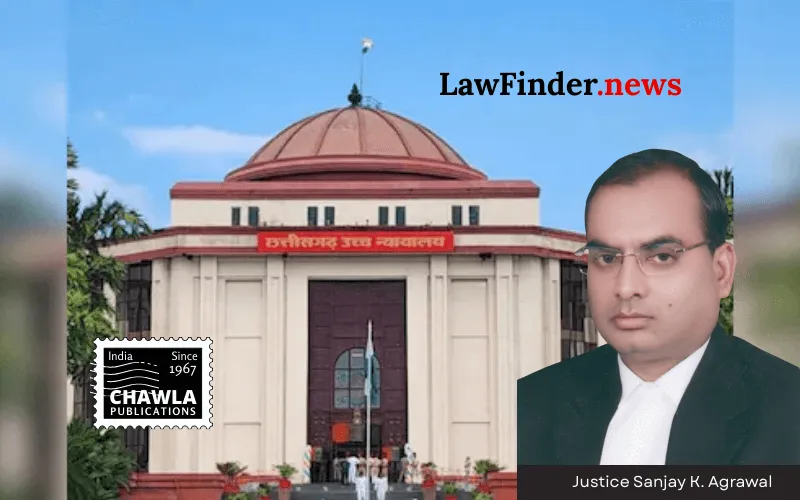
Raipur, July 16, 2026 - In a landmark ruling, the Chhattisgarh High Court has set a precedent by allowing a married daughter to be considered for a compassionate appointment, a decision that could impact employment policies across the nation. Justice Sanjay K. Agrawal delivered the judgment in favor of Afifa Khan, also known as Devangi Choudhary, who had petitioned against the Bank of Maharashtra for rejecting her application for a job on compassionate grounds after the death of her father, Dewashish Choudhary, a Deputy Manager at the bank.
The bank had denied her application solely on the basis of her marital status, assuming that she was dependent on her husband rather than her deceased father. This decision was contested by Khan, represented by Advocate Mr. Navin Shukla, who argued that such rejection violated her constitutional rights under Articles 14, 15, and 16(2), which prohibit discrimination on grounds of sex and ensure equality before the law.
The court observed that the exclusion of married daughters from compassionate appointments based on marital status is rooted in gender stereotypes and lacks rational justification. Justice Agrawal emphasized that marriage does not sever a daughter's relationship with her parental family nor does it imply non-dependence. He cited the Supreme Court judgment in Kulsum Nisha v. State of U.P., which similarly ruled against such gender-based discrimination.
The court found that the bank's policy did not explicitly exclude married daughters and that the bank's decision was based on an incorrect presumption of dependency on the husband. Justice Agrawal highlighted that the criteria for dependency should be based on factual circumstances rather than marital status, and the assumption that a married daughter is automatically non-dependent on her parental family is both arbitrary and unconstitutional.
The court ordered the Bank of Maharashtra to reconsider Khan's application within 30 days, in light of the Supreme Court's decision and the current judgment. This ruling underscores the judiciary's commitment to upholding constitutional values of equality and non-discrimination, particularly in employment policies that affect women.
Bottom line:-
Compassionate appointment cannot be denied to a married daughter solely on the ground of her marital status, as it violates Articles 14 and 15(1) of the Constitution of India.
Statutory provision(s): Articles 14, 15(1), and 16(2) of the Constitution of India.