Court emphasizes burden of proof lies on Will’s propounder; sale agreement based on unproven Will restrained pending partition
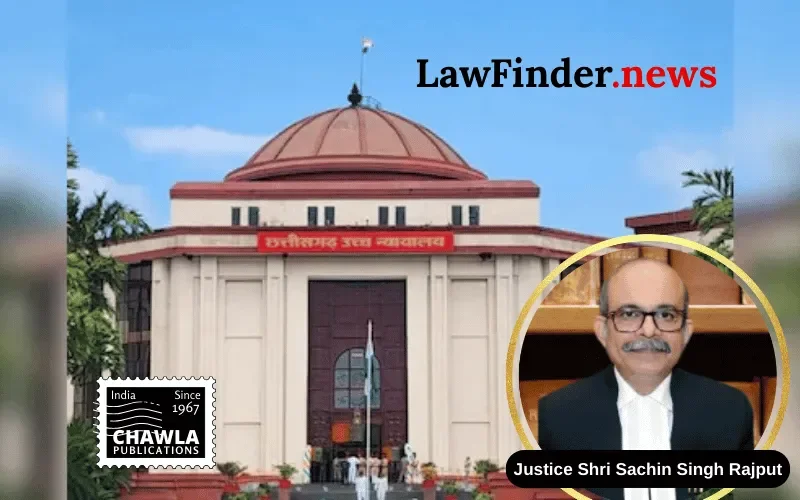
In a significant verdict delivered on November 16, 2026, the Chhattisgarh High Court, presided over by Mr. Sachin Singh Rajput, J., allowed the second appeal filed by Bhula @ Bhagwati Thakur, holding that she is entitled to a half share in the ancestral property of her maternal grandmother, Smt. Shanti Bai. The Court set aside the earlier judgments of the trial and first appellate courts which had dismissed her suit based on the validity of a Will dated October 6, 1999, allegedly executed by Smt. Shanti Bai in favor of her brother, Manharan Singh Thakur.
The dispute arose after the death of Smt. Shanti Bai, who was the sole owner of the property located in Village Hirapur (Jarway), Raipur, comprising eight Khasra numbers totaling approximately 3.428 hectares. With the death of her only daughter, Rukhmani Bai—mother of the appellant and respondent No.1—the question of succession became contentious. The appellant contended that no valid Will was executed by Smt. Shanti Bai, and as legal heirs under the Hindu Succession Act, both siblings were entitled to equal shares.
Manharan Singh Thakur had obtained mutation of the property in his name based on the unregistered Will without notifying or obtaining consent from the appellant. Further, he entered into a sale agreement with respondent No.2, raising concerns about the appellant’s deprivation of her rightful share. The appellant contested the Will’s validity, alleging forgery, and sought declaration, partition, and injunction against the sale.
The lower courts upheld the Will primarily because the appellant failed to prove forgery. However, the High Court clarified that the burden of proving the due execution and attestation of a Will lies squarely on the propounder of the Will, not the opposing party. The Court extensively referred to Section 63 of the Indian Succession Act, 1925, and Section 68 of the Indian Evidence Act, 1872, which mandate that at least one attesting witness must be produced to prove a Will’s execution.
In this case, the propounder (respondent No.1) failed to call any attesting witness or provide cogent evidence to prove the Will’s execution. Mere failure by the appellant to prove forgery does not validate the Will. The Court emphasized that the proximity of the Will’s date to the testator’s death, while relevant, is insufficient to establish its authenticity.
Consequently, the Court held that in the absence of a duly proved Will, succession must be determined in accordance with Sections 15 and 16 of the Hindu Succession Act, 1956. The appellant was declared entitled to half the property share, and respondents No.1 and No.2 were restrained from proceeding with the sale agreement dated October 7, 2005.
This ruling reinforces the principle that testamentary documents must meet strict evidentiary standards and the importance of the burden of proof resting with the party asserting ownership through a Will. It also safeguards legal heirs’ rights in ancestral property disputes and prevents unauthorized alienation based on unproven testamentary instruments.
Bottom Line:
The burden of proving the validity, due execution, and attestation of a Will lies on the propounder of the Will. The mere failure of the opposing party to prove forgery does not automatically validate the Will.
Statutory provision(s):
Hindu Succession Act, 1956 - Sections 15, 16; Indian Succession Act, 1925 - Section 63; Indian Evidence Act, 1872 - Section 68; Civil Procedure Code, 1908 - Section 100
Bhula @ Bhagwati Thakur v. Manharan Singh Thakur, (Chhattisgarh) : Law Finder Doc Id # 3129921