Court Quashes Award of Compensation to Married Daughter as She Does Not Qualify as a "Dependant" Under the Act; Clarifies Interest on Compensation Payable from Date of Accident
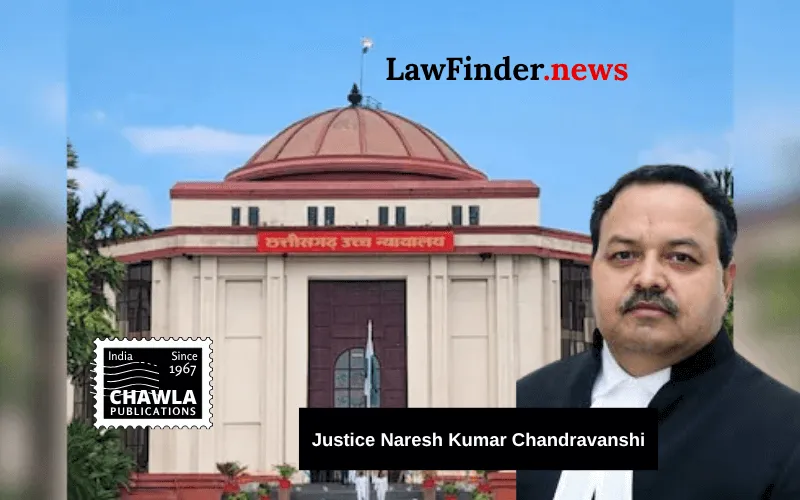
In a significant judgment delivered on September 2, 2026, the Chhattisgarh High Court clarified the scope of "dependant" under the Employees' Compensation Act, 1923, holding that a married daughter does not qualify as a dependant entitled to claim compensation unless she falls under specific statutory exceptions. The court set aside a compensation award of Rs. 6,12,360/- granted to Smt. Nanda Soni, a married daughter, for the death of her father, Padum Bahadur Soni, who died in a factory accident while employed with M/s Suraj Pulses Industries.
Background:
The deceased employee, Padum Bahadur Soni, suffered fatal injuries on April 26, 2015, when a boundary wall collapsed at the factory premises. His wife, Suraji Bai Soni, originally filed a claim for compensation under Section 22 of the Employees' Compensation Act, 1923. However, the Original Claimant died during the pendency of the claim. Subsequently, her married daughter, Smt. Nanda Soni, was substituted as the claimant by the Labour Court despite objections from the employer.
Legal Issues:
The employer contested the substitution and the subsequent compensation award on the ground that the married daughter did not qualify as a "dependant" under the Act. The key legal questions were whether a married daughter is entitled to claim compensation as a dependant and the correct rate and date for payment of interest on the compensation amount.
Court's Analysis:
The court meticulously analyzed Section 2(1)(d) of the Employees' Compensation Act, 1923, which defines "dependant" to include widows, minor legitimate or adopted sons, unmarried daughters, widowed mothers, and certain other relations under specific conditions. Crucially, the definition excludes married daughters unless they are minor or widowed minors, which was not the case here.
The court relied on precedents including the Division Bench decision in Amarsai Amar Singh Netam v. M/s N.C. Nehar and the Full Bench decision of the Madras High Court in B.M. Habeebullah Maricar v. Periaswami, which uniformly hold that married daughters are not statutory dependants under the Act for claiming compensation.
Further, the court explained that the right to claim compensation is personal to statutory dependants and does not survive to non-dependants by way of substitution. Since the original claimant (the widow) died before the award was passed, the married daughter could not claim compensation as a legal heir.
Regarding interest on compensation, the court cited Supreme Court judgments including Ajay Kumar Das v. Divisional Manager, holding that interest is payable at 12% per annum from the date of the accident, not from the date of filing the claim or the date of award. The Labour Court's award of interest at 10% from the date of application was held to be contrary to the statutory mandate.
Decision:
The High Court allowed the employer's appeal and quashed the compensation award in favor of the married daughter, holding the award legally unsustainable. The appeal for enhancement of interest and imposition of penalty filed by the claimant was dismissed as academic in light of the primary finding. The court ordered that any compensation amount deposited with the Labour Court be returned to the employer.
Significance:
This judgment reinforces the strict interpretation of the definition of "dependant" under the Employees' Compensation Act, 1923, clarifying that married daughters are excluded from compensation claims unless meeting narrow exceptions. It also reiterates the legal principle that interest on compensation runs from the date of accident, ensuring timely payment to rightful claimants.
Bottom Line:
Under the Employees' Compensation Act, 1923, a married daughter does not qualify as a "dependant" unless specifically falling under the exceptions mentioned in Section 2(1)(d). Compensation awarded to a person not statutorily recognized as a "dependant" is legally unsustainable.
Statutory provision(s):
Employees' Compensation Act, 1923 Section 2(1)(d), Section 4A(3)
Nanda Soni v. M/s Suraj Pulses Industries, (Chhattisgarh) : Law Finder Doc Id # 2978353