Court confirms life imprisonment and rigorous terms for five accused, citing overwhelming evidence including victim testimony, electronic data, and forensic reports
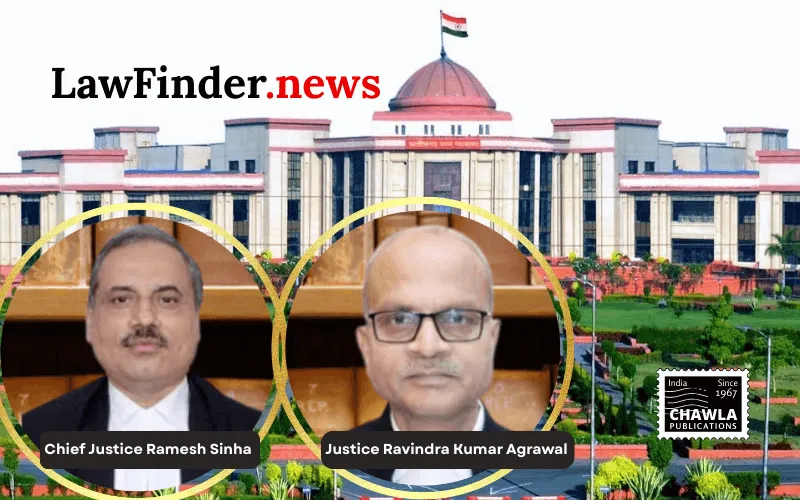
In a landmark judgment dated May 15, 2026, the Chhattisgarh High Court, in a Division Bench comprising Chief Justice Shri Ramesh Sinha and Justice Ravindra Kumar Agrawal, dismissed appeals filed by five accused persons convicted for the kidnapping of a minor child, Virat Saraf, for ransom. The Court upheld the conviction and sentences awarded by the First Additional Sessions Judge, Bilaspur, reaffirming the robust prosecution case built on a complete and unbroken chain of evidence.
The accused—Nita Saraf, Rajkishore Singh, Anil Singh, Satish Sharma, and Harekrishna Kumar—were found guilty under Sections 120B (criminal conspiracy), 363 (kidnapping), 364A (kidnapping for ransom), 365 (kidnapping or abducting with intent secretly and wrongfully to confine), and 368 (wrongful confinement for ransom) of the Indian Penal Code.
The prosecution’s case, supported by extensive testimony and material evidence, revealed a premeditated conspiracy among the accused to kidnap the minor victim, Virat Saraf, initially targeting another child but altering plans when the first target was unavailable. The kidnapping was executed on April 20, 2019, when the accused forcibly took Virat from a public place near his home, gagged him, and transported him in a white Wagon-R car.
Key evidence included:
- Testimony of the victim Virat and several eyewitnesses identifying the accused.
- CCTV footage from multiple locations clearly showing the movement of the Wagon-R vehicle and the kidnapping incident.
- Recovery of the victim from a locked room in accused Rajkishore Singh’s house, with incriminating articles such as the victim’s footwear and clothing seized.
- Electronic evidence comprising call detail records (CDRs), tower locations, IMEI number tracking, intercepted conversations, and voice recordings, all supported by certificates under Section 65-B of the Indian Evidence Act, establishing communication and coordination between the accused.
- Forensic fingerprint analysis linking accused Anil Singh to the Wagon-R car used for the kidnapping.
- Memorandum statements of the accused and consequential recoveries, including vehicles, mobile phones, and ransom-related materials.
The Court meticulously examined the essential ingredients of Section 364A IPC, emphasizing that the prosecution proved not only kidnapping but also ransom demand coupled with threats to cause death or hurt. The ransom calls demanding Rs. 6 crores were recorded, with voice analysis confirming the identity of the caller as accused Rajkishore Singh.
The defense challenged the admissibility and sufficiency of various evidence pieces, including the electronic data and test identification parades, pointing to minor procedural irregularities and inconsistencies. However, the Court held that such lapses were trivial and did not undermine the integrity of the core evidence. The Court further highlighted established jurisprudence that minor contradictions or investigation lapses do not fatally affect the prosecution case if the evidence is otherwise reliable and complete.
Rejecting the appeals, the Court affirmed the sentences: life imprisonment for the offence under Section 364A and rigorous imprisonment ranging from seven to fourteen years for other offences, with all sentences to run concurrently. The judgment underscores the judiciary’s firm stance against kidnapping for ransom, especially involving minors, emphasizing the protection of vulnerable citizens and societal security.
The Court directed the jail authorities to inform the convicted persons of their right to appeal before the Supreme Court with legal assistance and transmitted the judgment and records to the trial court for compliance.
Bottom line:-
Kidnapping for ransom - Criminal conspiracy to kidnap minor child for ransom - Evidence of victim, witnesses, CCTV footage, test identification parade, recovery of victim and incriminating articles, memorandum statements, call detail records, tower locations, IMEI linkage, voice recordings and scientific examination including fingerprint analysis - Complete and unbroken chain of circumstances - Conviction under Sections 120B, 363, 364A, 365 and 368 IPC confirmed.
Statutory provision(s): Indian Penal Code Sections 120B, 363, 364A, 365, 368; Indian Evidence Act Section 65-B; Code of Criminal Procedure Section 374(2)
Nita Saraf v. State of Chhattisgarh, (Chhattisgarh)(DB) : Law Finder Doc id # 2899768