Court holds mere acquittal in criminal case under Section 498A IPC does not establish matrimonial cruelty; allows additional documents on record for fair adjudication
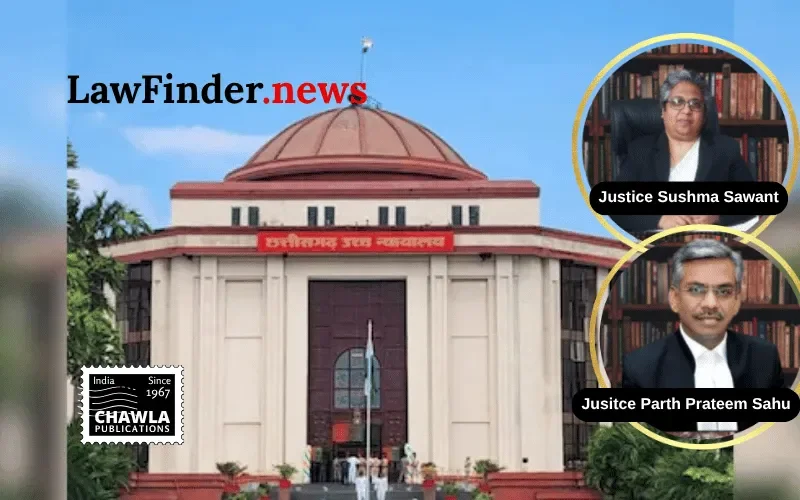
In a significant judgment delivered on September 29, 2026, the Chhattisgarh High Court (Division Bench of Justices Parth Prateem Sahu and Sushma Sawant) dismissed the appeal filed by Lokesh Sinha seeking divorce from his wife, Smt. Kusumlata Sinha. The Family Court's original dismissal of the husband's petition under Section 13 of the Hindu Marriage Act, 1955 was upheld after a detailed examination of the grounds of cruelty, desertion, and adultery.
Background and Pleadings:
Lokesh Sinha and Kusumlata Sinha were married on March 23, 2010, as per Hindu rites. The husband alleged that the matrimonial relationship soured from the beginning and accused the wife of cruelty, desertion (leaving the matrimonial home on November 22, 2010), and adultery (claiming she married another man, Devashigyan Nayak, while still married to him). He also contended that the wife had falsely implicated him in a dowry harassment case under Section 498A IPC, for which he was eventually acquitted. On these grounds, he sought a decree of divorce.
The wife denied all allegations of cruelty, prior illicit relationships, desertion, and adultery. She asserted that she was forced to leave the matrimonial home due to harassment by the husband and his family and had sought restitution of conjugal rights which was pending before another Family Court.
Procedural History and Evidence:
During the trial, both parties submitted various documents and witnesses. The husband filed applications under Order XLI Rule 27 of the Code of Civil Procedure (CPC) to produce additional documents including judgments and order sheets from related criminal and civil proceedings, which were allowed by the High Court on appeal despite not being produced in the trial court.
Key Findings of the High Court:
1. Admissibility of Additional Documents:
The Court allowed the parties to place certified copies of judgments, compromise petitions, and order sheets on record under clause (b) of Order XLI Rule 27 CPC, noting their authenticity was undisputed and relevance to the adjudication of the matrimonial dispute.
2. Cruelty:
The appellant relied heavily on his acquittal in the Section 498A IPC case to claim the wife's allegations were false and amounted to cruelty. The Court observed that mere acquittal in criminal proceedings does not establish the falsity of allegations nor negate cruelty in matrimonial proceedings. Matrimonial cruelty is assessed on the preponderance of probabilities based on evidence within matrimonial proceedings. The Court noted that the wife had compromised the criminal case on the assurance of resumption of cohabitation, but the husband reneged on this promise, lending support to the wife's claim of cruelty.
3. Desertion:
Evidence did not establish that the wife left the matrimonial home without just cause. In fact, the wife had convened a social meeting seeking reconciliation, which the husband refused. Furthermore, the wife had sought restitution of conjugal rights with an order passed against the husband, indicating the fault lay with him. Hence, desertion was not proved.
4. Adultery and Second Marriage Allegation:
The husband's claim that the wife had illicit relations and remarried was not substantiated. The purported second marriage resulted in a Section 9 petition for restitution of conjugal rights, which was withdrawn at the first hearing. The husband failed to confront the wife with this evidence or provide a credible explanation about his knowledge of these facts. The Court found this to be a fabricated attempt to create evidence against the wife.
5. Credibility of Witnesses:
Witnesses produced by the husband admitted lack of personal knowledge of the matrimonial discord, relying only on hearsay, while the wife and her father testified to her version of events. The Court held the husband failed to discharge the burden of proof on the grounds pleaded.
6. Overall Conclusion:
The High Court affirmed the Family Court's judgment and decree dismissing the divorce petition, holding that the appellant had failed to prove cruelty, desertion, or adultery. The appeal was dismissed with costs.
Significance:
This judgment reiterates that matrimonial cruelty must be evaluated independently from criminal proceedings and on the basis of civil standards of proof. The Court's liberal approach to admitting relevant documents in appeal ensures comprehensive adjudication. The ruling also clarifies that acquittal in a Section 498A case does not automatically translate into absence of cruelty in matrimonial disputes. The judgment safeguards the principle that dissolution of marriage is a serious step requiring cogent evidence.
Bottom Line:
Hindu Marriage Act - Divorce - Husband failed to prove cruelty, desertion or adultery against wife - Mere acquittal in criminal case under Section 498A IPC does not by itself establish matrimonial cruelty - Additional documents at appellate stage can be taken on record under Order XLI Rule 27 CPC where relevant for proper adjudication.
Statutory provision(s):
Hindu Marriage Act, 1955 Section 13; Family Courts Act, 1984 Section 19; Code of Civil Procedure, 1908 Order 41 Rule 27; Indian Penal Code Sections 498A, 34, 307; Code of Criminal Procedure Section 98.
Lokesh Sinha v. Smt. Kusumlata Sinha, (Chhattisgarh)(DB) : Law Finder Doc Id # 2996585