Court rules that minimum educational qualification alone does not guarantee right to written exam; objective shortlisting criteria permissible amid large applicant pool
In a significant judgment delivered on October 12, 2026, the Chhattisgarh High Court dismissed writ petitions challenging the introduction of a graduation-percentage screening criterion in recruitment advertisements for various posts in the district judiciary. The petitioners, Anil Kumar and Sudhir Toppo, had contended that once candidates possessed the minimum educational qualification prescribed for posts such as Stenographer Grade-3, Assistant Grade-3, and Peon, they should be allowed to appear in the written examination without any further screening.
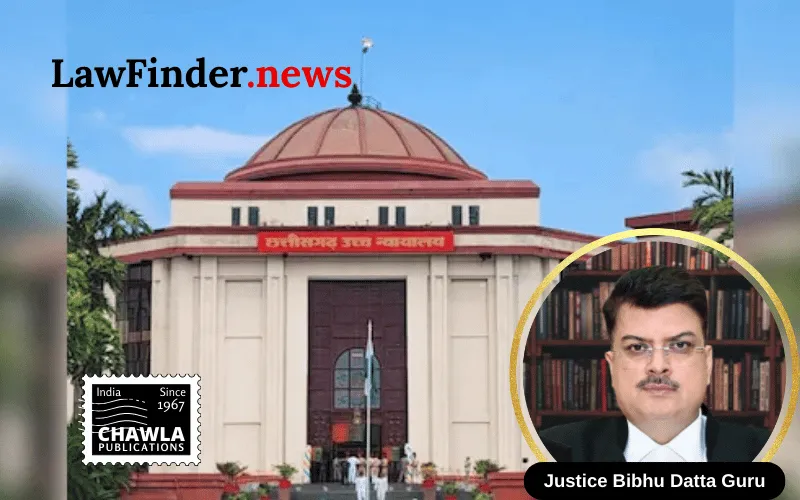
The Court, presided over by Mr. Bibhu Datta Guru, J., held that mere possession of the minimum qualification entitles a candidate only to consideration under the recruitment rules and does not confer an indefeasible right to be called for every stage of selection. Noting the substantial number of applications received against the limited vacancies, the Court recognized the practical necessity of adopting an objective and rational shortlisting mechanism to ensure a manageable and expeditious recruitment process.
Relying on the Supreme Court precedent of B. Ramakichenin @ Balagandhi v. Union of India (2008), the Court affirmed that selection authorities may validly resort to shortlisting candidates on rational grounds such as minimum marks or percentage criteria, even if not explicitly provided in the rules or advertisement, provided such criteria are not arbitrary, discriminatory, or selectively applied.
The petitioners argued for a selection process wherein all candidates meeting the minimum qualifications be allowed to appear in the written examination, with shortlisting only after evaluating performance. However, the Court rejected this contention, clarifying that the method adopted by the recruiting authority cannot be substituted by the Court unless it is shown to be unlawful or unfair.
The judgment emphasized that adopting a screening criterion like the graduation percentage is permissible when it is uniformly applied and justified by the large volume of applicants. The Court also dismissed the petitioners' reliance on recruitment procedures followed in other districts, observing that different recruitments may be governed by distinct rules and circumstances.
As a result, the High Court upheld the validity of the screening criterion and dismissed both writ petitions, thereby allowing the recruitment process in the district judiciary to proceed with the graduation percentage as a legitimate shortlisting parameter.
Bottom Line:
Service Law - Direct recruitment in district judiciary establishment - Mere possession of minimum educational qualification does not confer indefeasible right to be called for written examination - Where applications are disproportionately large, recruiting authority may adopt rational and objective shortlisting criterion such as minimum graduation percentage, provided it is uniformly applied and not contrary to governing rules or advertisement - Challenge to screening clauses rejected in absence of proof of arbitrariness, discrimination or violation of Rules, 2023.
Statutory provision(s):
Chhattisgarh District Judiciary Establishment (Recruitment and Conditions of Service) Employees Rules, 2023 - Rules 6, 8, 16(3)
B. Ramakichenin @ Balagandhi v. Union of India, 2008 (1) SCC 362 (precedential case law)
Anil Kumar v. State of Chhattisgarh, (Chhattisgarh) : Law Finder Doc Id # 2996403