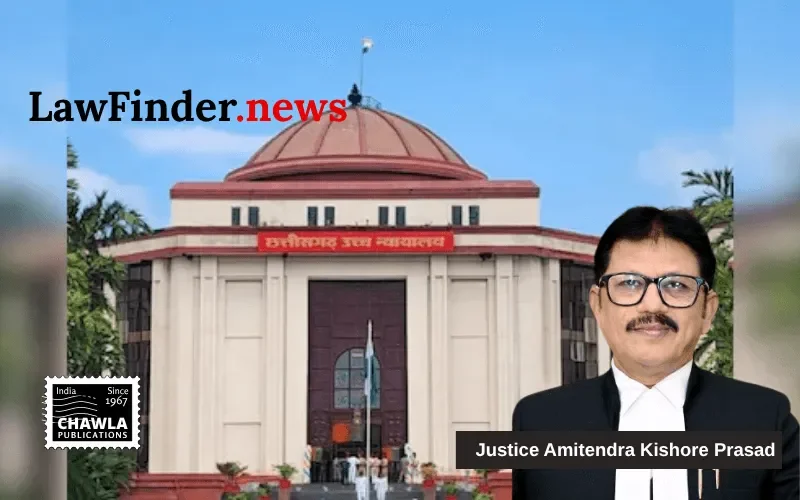
Court Rules Railway Project Acquisition Under Railways Act, 1989 for Public Purpose; Incidental Benefit to Private Entity Shree Cement Ltd. Does Not Invalidate Acquisition
In a significant judgment dated October 27, 2026, the Chhattisgarh High Court dismissed multiple writ petitions challenging the acquisition of agricultural land for a Special Railway Project under the Railways Act, 1989. The acquisition pertains to the establishment of linear railway connectivity from Hathbandh Railway Station (East Cabin) to Khaparadih Village, facilitating the Gati Shakti Multi-Modal Cargo Terminal (GCT) under the South East Central Railway zone.
The petitioners, primarily agriculturists from several villages in the Balodabazar-Bhatapara district, contended that the acquisition was not for a genuine public purpose but was instead intended to benefit a private company, Shree Cement Limited, which is the proposed terminal operator. They further alleged that their objections under Section 20-D of the Railways Act were summarily rejected without proper inquiry or detailed reasoning, violating statutory safeguards and principles of natural justice.
The Court, presided over by Justice Amitendra Kishore Prasad, comprehensively examined the statutory framework and facts. It observed that the acquisition formed part of a larger government-approved railway infrastructure project conducted under Chapter IV-A of the Railways Act, 1989, pursuant to the Government's Gati Shakti policy aimed at enhancing multimodal cargo connectivity.
Rejecting the petitioners' claim that the project's benefit to Shree Cement Ltd. converted the acquisition into a private one, the Court emphasized that incidental or consequential benefits to a private entity do not negate the public purpose of the project. The land and railway infrastructure acquired vest absolutely with the Central Government and Indian Railways, and the private terminal operator holds no proprietary interest in the land.
The Court also addressed objections regarding the proposed alignment of the railway line. Petitioners argued that an existing railway corridor serving UltraTech Cement could be utilized to avoid acquisition of their lands. The Court held that selection of railway alignment involves technical, engineering, and administrative considerations beyond judicial interference unless there is evidence of mala fide, arbitrariness, or violation of statutory procedure. The alternative alignment proposed by the petitioners was found to involve technical complications such as passing through waterlogged areas necessitating costly infrastructure, justifying the authorities' choice.
On procedural grounds, the Court noted that the petitioners had been given an opportunity to object under Section 20-D, which were duly considered after an earlier court order mandating such consideration. Although the order rejecting objections was brief, the Court found no evidence of non-application of mind or procedural impropriety sufficient to warrant judicial interference. The statutory right to object is to ensure objections are heard and considered, not to guarantee their acceptance.
Furthermore, the Court underscored that acquisition for infrastructure projects necessarily involves deprivation of private property, which is constitutionally permissible under Article 300-A if done by authority of law and accompanied by compensation. The hardship faced by landowners is to be addressed through statutory remedies rather than by stalling public infrastructure projects.
The judgment also referenced a recent Karnataka High Court decision upholding a similar Gati Shakti Multi-Modal Cargo Terminal acquisition, reinforcing the validity of such projects even when private operators benefit incidentally.
In conclusion, the Chhattisgarh High Court held that the acquisition proceedings were lawful, the objections were duly considered, and no grounds existed to quash the acquisition or direct a fresh inquiry. The writ petitions were dismissed, and the interim stay on acquisition proceedings was vacated. The petitioners remain entitled to pursue statutory remedies regarding compensation under the Railways Act.
This ruling affirms the legal principles that government infrastructure projects, including those involving public-private operational partnerships, constitute public purpose when ownership and control rest with the government, and that judicial review is limited in technical and policy matters like railway alignment unless statutory violations are demonstrated.
Bottom Line:
Railways Act, 1989 - Acquisition for Special Railway Project/Gati Shakti Multi-Modal Cargo Terminal - Mere incidental benefit to private terminal operator does not take away public purpose of project - Where objections under Section 20-D were invited, hearing was afforded and objections were considered, acquisition cannot be quashed merely because objections were rejected or because landowners suggest an alternative alignment.
Statutory provision(s):
Railways Act, 1989 - Sections 2(37A), 20A, 20D, 20E, 20F, 20G; Constitution of India, Articles 226 and 300-A
Bedram Verma v. Union of India, (Chhattisgarh) : Law Finder Doc Id # 3003439