Court Rules Commission’s Powers Are Recommendatory, Not Adjudicatory, Emphasizing Limits in Handling Private Monetary Claims
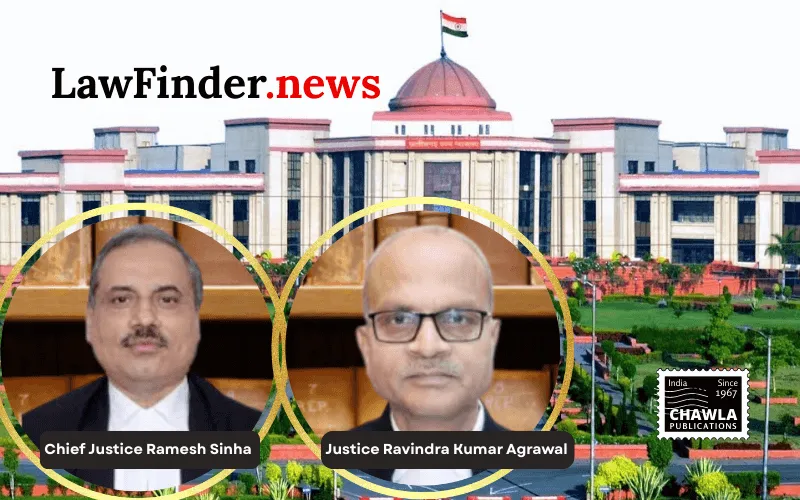
Raipur, September 2, 2026 – The Chhattisgarh High Court, in a recent judgment delivered by a Division Bench comprising Chief Justice Mr. Ramesh Sinha and Justice Ravindra Kumar Agrawal, has upheld the quashing of proceedings initiated by the Chhattisgarh State Backward Classes Commission that directed recovery of money in a private commercial dispute. The judgment clarifies the statutory limits of the Commission, emphasizing that it possesses only advisory and recommendatory powers and cannot pass executable orders for monetary recovery between private parties.
The case arose when appellant Dushyant Prakash Nag, a citizen of India, entered into an agreement with a private respondent for the purchase of a Preet Harvester Machine for Rs.21,00,000. Despite paying the full amount through demand drafts, the appellant did not receive the booked model. Instead, a different model’s documents were handed over, and the appellant’s repeated assurances from the seller failed. After unsuccessful efforts with local police, and alleged assault to force a compromise, the appellant approached the Chhattisgarh State Backward Classes Commission seeking relief.
The Commission, upon inquiry, found in favor of the appellant and recommended that the compensation claimed be recovered from the seller and paid to the appellant through the Collector of District Durg. However, the respondent challenged this order before the High Court via a writ petition, which was allowed by the Single Judge, quashing the Commission's proceedings on June 17, 2026.
The appellant’s intra-court appeal contended that the Commission’s decision was merely recommendatory and did not constitute an executable order. The appellant further argued that if any part of the recommendation exceeded jurisdiction, the Court should have modified or remitted the matter rather than quashing it entirely.
The State and the private respondent opposed the appeal, submitting that the Commission’s statutory mandate under the Chhattisgarh State Backward Classes Commission Adhiniyam, 1995, confined it to advisory roles, and it lacked jurisdiction to adjudicate private commercial disputes or order monetary recovery.
The Division Bench thoroughly examined Section 9 of the Adhiniyam and related statutory provisions. It held that while the Commission is empowered to monitor welfare programs and safeguard backward classes’ interests, it does not have the authority of a Civil Court to adjudicate private disputes or enforce monetary judgments. The Court relied on the Supreme Court precedent from All India Indian Overseas Bank Scheduled Castes and Scheduled Tribes Employees Welfare Association v. Union of India (1996) 6 SCC 606, which clarified that investigatory powers do not convert a Commission into a Civil Court with adjudicatory jurisdiction.
The Court emphasized substance over form, stating that merely labeling the Commission’s order as a “recommendation” does not change its effect. Since the Commission’s direction effectively determined a monetary liability and ordered recovery, it was adjudicatory and beyond the Commission’s statutory powers.
Regarding the appellant’s plea for modification or remand, the Court observed that once the Commission acts beyond its jurisdiction, the entire proceedings are liable to be set aside. Partial modification was not warranted.
Accordingly, the Division Bench dismissed the intra-court appeal, affirming the quashing of the Commission’s order. The judgment reinforces the principle that statutory bodies must act within the scope of powers granted by their enabling statutes and cannot encroach upon judicial functions reserved for courts.
This ruling serves as a significant precedent delineating the limits of the Chhattisgarh State Backward Classes Commission’s powers, protecting private parties from unauthorized monetary recovery orders by non-judicial bodies.
Bottom Line:
Chhattisgarh State Backward Classes Commission - Jurisdiction and scope of powers - Commission cannot adjudicate private commercial disputes or pass executable orders directing recovery of money, as its powers are recommendatory and advisory in nature.
Statutory provision(s):
Chhattisgarh State Backward Classes Commission Adhiniyam, 1995 - Section 9; Civil Procedure Code (powers of Civil Courts referenced); Constitution of India - Part III (Fundamental Rights)
Dushyant Prakash Nag v. State of Chhattisgarh, (Chhattisgarh)(DB) : Law Finder Doc Id # 2971958