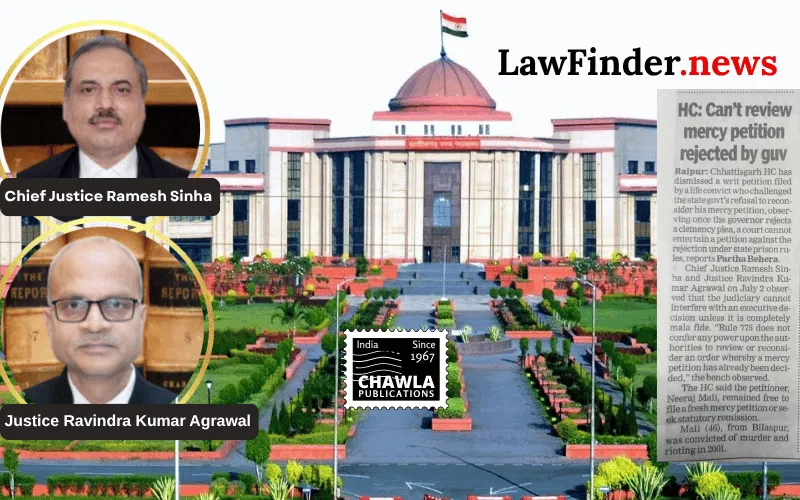
Court Affirms Limited Scope of Judicial Review Over Clemency Powers Under Article 161 of the Constitution
In a significant ruling, the Chhattisgarh High Court dismissed a writ petition challenging the rejection of a mercy petition filed under Article 161 of the Indian Constitution by Neeraj Mali, a life convict. The bench, comprising Mr. Ramesh Sinha, Chief Justice, and Justice Ravindra Kumar Agrawal, upheld the decision of the Governor of Chhattisgarh, emphasizing the limited scope of judicial review over the exercise of clemency powers by constitutional authorities.
The petitioner, Neeraj Mali, had been convicted for offenses under Sections 302 and 148 of the Indian Penal Code and was serving a life sentence. After exhausting his legal remedies, including appeals to the Supreme Court, Mali submitted a mercy petition seeking pardon and remission of his sentence. This petition was processed and eventually rejected by the Governor on March 24, 2023.
Subsequently, an application for reconsideration of the rejected mercy petition was submitted by the petitioner's wife, citing changed circumstances and the long period of incarceration already undergone by Mali. However, this request was declined by the authorities on July 9, 2025, as the Chhattisgarh Prisons Rules, 1968, do not permit reconsideration of a rejected mercy petition under Rule 775.
The court, while dismissing the writ petition, noted that the constitutional powers under Article 161 are distinct from statutory remission provisions and are not contingent upon the completion of fourteen years of actual imprisonment. The bench clarified that the scope of judicial review is confined to examining whether the decision suffers from mala fides, arbitrariness, or non-application of mind. In this case, the court found that the Governor's decision was made after considering all relevant aspects, including the nature of the offense and the period of incarceration.
The judgment also highlighted that the power of clemency under Article 161 is vested exclusively in the constitutional authority, and the court cannot substitute its decision for that of the Governor. The court's decision reaffirms the principle that judicial intervention in matters of clemency is permissible only in cases of manifest arbitrariness or procedural impropriety.
Bottom Line:
Mercy petition under Article 161 of the Constitution - Rejection of mercy petition and subsequent request for reconsideration - Reconsideration of rejected mercy petition is not permissible under Rule 775 of the Chhattisgarh Prisons Rules, 1968 - Limited scope of judicial review over the exercise of clemency powers by constitutional authorities.
Statutory provision(s): Article 161 of the Constitution of India, Rule 775 of the Chhattisgarh Prisons Rules, 1968, Section 433A of the Criminal Procedure Code, Section 57 of the Indian Penal Code.
Neeraj Mali @ Golu v. State of Chhattisgarh, (Chhattisgarh)(DB) : Law Finder Doc id # 2933916