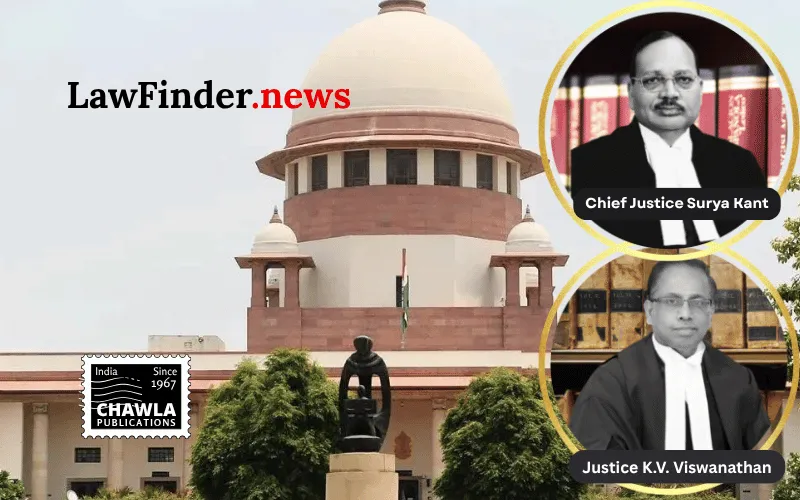
New Delhi, Oct 10 Chief Justice of India Surya Kant on Saturday said names of 'children in conflict with the law' must be kept out of the news and off the internet, and the phrase describes a circumstance, not an identity.
He was speaking after inaugurating the National Annual Stakeholders' Consultation on "Ten Years of the Juvenile Justice (Care and Protection of Children) Act, 2015: Progress, Challenges and Priorities for the Next Decade" organised by the Juvenile Justice Committee of the Supreme Court in association with UNICEF.
The CJI said 10 years is a short time for a statute, but it is more than half of a childhood.
The 2015 Act, he said, makes a wager that a child given a second chance is far more likely to become a productive member of society than one branded as a criminal.
"The journey truly ends only when the past no longer casts a shadow over the future. For that, we must destroy old records on time, and keep the names of 'children in conflict with law' out of the news and off the internet, where they can linger for years," he said.
"Rehabilitation that ends at the gate of an institution is not rehabilitation at all, for reintegration means restoring a young person's place in family, school and community without stigma," the CJI said.
He said a 15-year-old brought before a Juvenile Justice Board in January 2016, when this Act came into force, would be aged about 25 today, and the first promise the Act made to that 15-year-old minor lies in the words it uses.
"This is no mere courtesy, because the phrase 'child in conflict with law' describes a circumstance, not an identity," he said.
The CJI said circumstance is usually a difficult one, for the stories of these young people so often speak of schooling cut short, families under strain, and poverty. Most of them come before the law for the first time.
"Very often, the child in conflict with the law today was, only a little earlier, a child in need of care and protection we failed to provide in time. Our answer to such a predicament is restoration, not retribution," the CJI said.
He said the right to be heard means little unless someone is there to speak with the child and for the child.
He said that is why NALSA's child-friendly legal services scheme of 2024 provides for a lawyer at the police station and a legal services clinic at every Juvenile Justice Board.
"Yet many Boards still have no such clinic, and without this, the preliminary questions regarding the child's care and well-being may be taken without any adequate representation," Justice Kant said.
He also urged legal services institutions to consider creating a separate wing of trained defence counsel for children, so each has a dedicated lawyer from the first hour, and the same lawyer continues to assist, from the police station to the final order and into rehabilitation.
The CJI said between apprehension and the Board's final order, a child in conflict with law would meet a police officer, a probation officer, the Board, a lawyer and, perhaps, the staff of an observation home, "each of whom must see not only the offence, but the child behind it".
"Regular training through our judicial and police academies, bringing these persons together with psychologists, would teach them not only about adolescence, trauma and poverty, but also how to work with one another. After all, those who work together should not be trained in separate rooms," the CJI said.
He stressed regular, independent evaluation that can say, with due care for privacy, how many young people returned to school, found work and never came before a Board again.
Speaking at the inaugural session, apex court judge Justice B V Nagarathna said this consultation is an occasion to take stock of this "seminal piece" of legislation and what these past 10 years have meant for the children for whom the law exists.
"On a more general note, it may not be out of place to mention that it is, as adults, our duty to understand the anxieties of our children. We cannot be dismissive of their concerns, lest they feel alienated and rejected," she said, adding, "All children are ours and their distress is ours too".
She said the Juvenile Justice Board is not intended to be a "miniature criminal court" and its role is anchored in a different philosophy, one which recognises that children possess capacities for development and change, and that the response of the justice system must take that developmental reality seriously.
Justice Nagarathna said an India Justice Report study in November 2025 found that in the year ending in October 2023, 55 per cent of cases before the Boards across 18 states and two Union Territories were pending.
"More than 55,000 children were awaiting decisions, and out of 1,00,904 cases before 362 Boards during that period, 45,097 were disposed of. The same study reported that 24 per cent of responding Boards -- 111 out of 470 -- were functioning without the full bench of a principal magistrate and two social worker members. These figures relate to 2023," she said.
Justice Nagarathna said the Act is ultimately a law about the future.
"When a child breaks the law, the law must not break the child," she said.