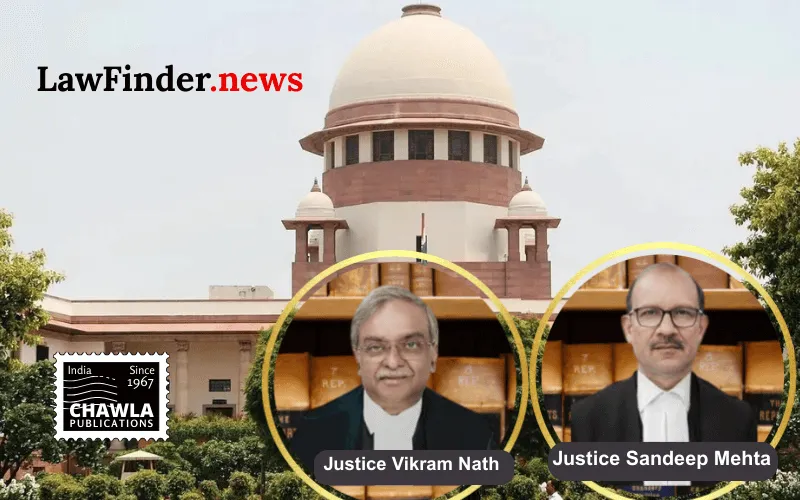
Supreme Court Mandates Flexibility in Custodial Interrogation Conditions for Effective Investigation, Apex Court Modifies High Court's Restrictions, Emphasizes Balance Between Investigative Needs and Constitutional Safeguards
In a landmark decision, the Supreme Court of India has modified the conditions imposed on the custodial interrogation of police officer Suda Suresh Veera, emphasizing the need for flexibility in the investigative process while upholding constitutional safeguards for the accused. The judgment came in response to an appeal by the State of Andhra Pradesh, challenging the High Court's restrictions on police custody conditions.
The case revolves around the alleged custodial death of Gade Sai Krishna, with Veera, a police inspector, accused of illegal detention, custodial torture, and tampering with evidence. The Supreme Court addressed several key issues, including the need for effective police custody, the right of the accused to access legal counsel, and the role of videography in ensuring transparency during interrogations.
The Supreme Court's decision underscored the legislative intent behind the Bharatiya Nagarik Suraksha Sanhita, 2023 (BNSS), which provides a framework for police custody that allows for the flexibility needed in complex investigations. The Court criticized the lower court's imposition of an absolute non-extendable limit on police custody, deeming it contrary to legislative intent and detrimental to the investigative process.
The judgment also addressed the accused's right to legal representation during interrogation, clarifying that while the accused is entitled to meet an advocate, continuous presence throughout the interrogation is not guaranteed. The Court emphasized that this provision must be balanced with the need for effective interrogation.
On the issue of videography, the Supreme Court upheld the importance of continuous audio-visual recording of interrogation sessions to protect both the accused and the investigating agency from allegations of coercion or impropriety. However, it deemed the requirement for uninterrupted videography during the accused's transit impractical.
The Supreme Court's ruling allows the Special Investigation Team (SIT) greater autonomy to conduct the interrogation at designated facilities in Vijayawada, rather than confining it to the Central Prison, Rajamahendravaram. This decision acknowledges the investigative need to visit crime scenes and reconstruct events crucial for uncovering the truth in custodial death cases.
The judgment is a significant step in balancing investigative needs with constitutional protections, ensuring that the rights of the accused are safeguarded while enabling the police to conduct thorough investigations. The Supreme Court's directives aim to uphold the integrity of the judicial process and reinforce the principles of justice enshrined in the Indian Constitution.
Bottom Line:
Custodial interrogation safeguards under the Bharatiya Nagarik Suraksha Sanhita, 2023 (BNSS) and rights of accused during police custody were comprehensively examined, emphasizing the balance between investigative autonomy and constitutional protections.
Statutory provision(s): Bharatiya Nagarik Suraksha Sanhita, 2023 Section 187, Section 38; Bharatiya Sakshya Adhiniyam, 2023 Section 63
State of Andhra Pradesh v. Suda Suresh Veera, (SC) : Law Finder Doc id # 2948557