Court says prosecutrix’s version was contradicted by medical, forensic and documentary evidence; benefit of doubt given to accused Shahbuddin.
The Delhi High Court has set aside the conviction of Shahbuddin in a case involving allegations of kidnapping, wrongful confinement, rape and criminal intimidation, holding that the prosecution failed to prove its case beyond reasonable doubt.
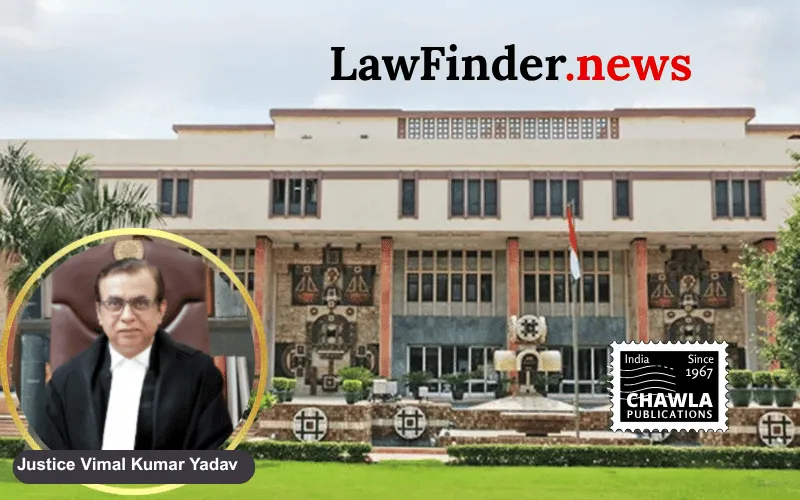
A single-judge bench of Justice Vimal Kumar Yadav allowed the appeal against the trial court’s judgment and sentence, and acquitted Shahbuddin of offences under Sections 363, 366, 368, 376 and 506 of the Indian Penal Code.
The prosecution had alleged that on May 24, 2010, the prosecutrix was forcibly taken from a market in Shahdara, transported in a TSR, taken by train to Pilakhwa in Uttar Pradesh, confined for four days and sexually assaulted. However, the High Court found serious inconsistencies in the testimony of the prosecutrix and other witnesses regarding the date, time and manner of the alleged incident.
The Court noted that while the prosecutrix claimed she was abducted on May 24, 2010 at around 5:00 PM, her brother stated it occurred around 6:30 PM, and her sister-in-law was unsure whether it happened on May 24 or 25. The Court also observed contradictions about whether the prosecutrix was taken while returning from the market or while buying vegetables, and whether the market was crowded.
A key factor in the acquittal was the earliest medical history recorded in the MLC, where the prosecutrix reportedly stated that she had left home due to parental pressure, returned on her own, and had not faced any physical or sexual assault. The Court held that this version, recorded before her statements under Sections 161 and 164 CrPC, carried significant evidentiary value.
The bench also relied on the forensic report, which found no blood or semen on the prosecutrix’s clothes or other exhibits. This, the Court said, directly contradicted her claim that her clothes were soaked with blood during the alleged assault.
On the issue of age, the Court found that the school admission register alone could not conclusively prove that the prosecutrix was a minor. The principal admitted that the date of birth entry was based only on oral disclosure by the parents, while the complainant himself had mentioned a different date of birth in his complaint and admitted uncertainty. No ossification test was conducted.
The Court further held that the conduct of the prosecutrix during the alleged journey through public places, railway platform and train — where she did not raise an alarm or seek help despite the presence of public persons and railway personnel — created a strong probability that she had accompanied the accused voluntarily.
Referring to Supreme Court precedents on the “sterling quality” standard for the sole testimony of a prosecutrix, the High Court said such testimony must be wholly reliable and consistent with surrounding evidence. In this case, it was not.
Accordingly, the Court concluded that the prosecution had failed to establish kidnapping, wrongful confinement, rape or criminal intimidation beyond reasonable doubt, and granted Shahbuddin the benefit of doubt.
Bottom Line :
Sole testimony of prosecutrix can sustain conviction in rape/kidnapping case only when it is wholly reliable and of sterling quality - Where earliest medical history showed that prosecutrix had absconded due to parental pressure and denied sexual/physical assault, FSL negatived blood/semen, age was not conclusively proved, and her conduct during travel through public places created serious doubt about forcible taking, accused was entitled to benefit of doubt and acquittal.
Statutory provision(s): Sections 363, 366, 368, 376, 506 of the Indian Penal Code, 1860, Section 374 Cr.P.C., Section 161 Cr.P.C., Section 164 Cr.P.C., Section 313 Cr.P.C.