Court refuses to exempt athlete from uniform eligibility criteria, citing fairness to other athletes and importance of performance-based selection process, while reserving judgment on validity of maternity exclusion policy
In a significant judgment on sports law and women's rights, the Delhi High Court has declined to grant interim relief to a competitive wrestler seeking exemption from eligibility criteria for the 2026 Senior World Wrestling Championships selection trials. The court, however, acknowledged the larger question of balancing motherhood with sporting careers, reserving its final opinion for substantive adjudication.
The petitioner, Vinesh Phogat, had challenged the Circular dated 07.09.2026 issued by the Wrestling Federation of India (WFI), which prescribed eligibility criteria based on participation in specified competitions held during 2025-2026. The petitioner had remained absent from competitive wrestling during 2024-2025 due to pregnancy, childbirth, and post-partum recovery, during which period she had duly informed sporting and anti-doping authorities of her sabbatical.
Background and Procedural History
The case traces back to an earlier writ petition (W.P.(C) 6766/2026) challenging the Asian Games Selection Policy dated 25.02.2026. A Division Bench of the Delhi High Court, by judgment dated 22.05.2026 in LPA No. 399/2026, had made prima facie observations that the Asian Games Selection Policy was "completely arbitrary, discriminatory and exclusionary in nature" and that "motherhood could not have operated to prejudice a woman in her career." Pursuant to that order, the petitioner participated in the Asian Games Selection Trials held on 30.05.2026 in the 53 kg weight category and reached the semi-final stage.
However, the WFI subsequently issued a show cause notice (SCN) dated 17.06.2026 to the petitioner for alleged misconduct during those very selection trials. The pendency of these disciplinary proceedings became a crucial factor in the present judgment.
Court's Reasoning on Eligibility Criteria
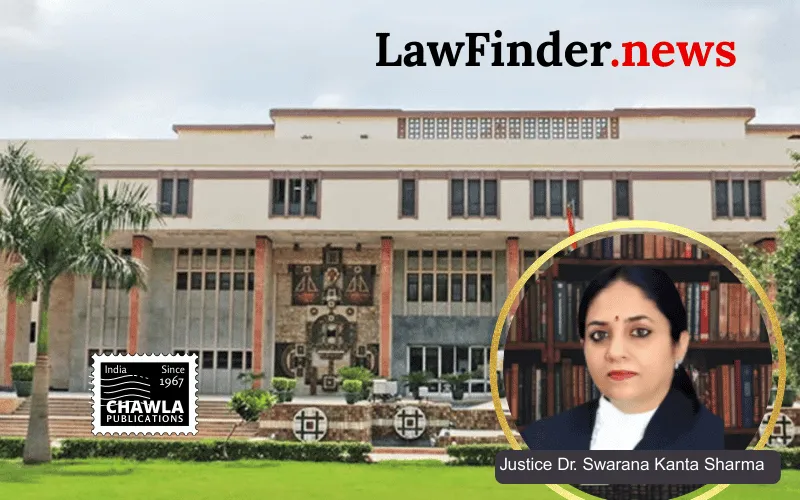
Justice Dr. Swarana Kanta Sharma, while hearing the interim application (CM APPL. 61231/2026), noted that the eligibility criteria prescribed under the Circular dated 07.09.2026 applies uniformly to all athletes seeking to participate in the selection trials for the 2026 Senior World Wrestling Championships scheduled for October-November 2026 in Astana, Kazakhstan.
The court observed: "The criteria prescribed under the Circular dated 07.09.2026 applies uniformly to all athletes. An athlete who has not participated in the prescribed competitions, for whatever reason, would not fall within the eligibility categories specified by respondent no. 1."
The Petitioner's Arguments
The petitioner's counsel argued that the circular perpetuates an exclusionary framework already found to be prima facie arbitrary and discriminatory by the Division Bench. It was contended that:
1. The petitioner's absence from prescribed qualifying competitions was due to pregnancy and post-partum recovery, not lack of sporting ability
2. The petitioner had demonstrated her return to competitive wrestling by reaching the semi-final in the Asian Games Selection Trials on 30.05.2026
3. The petitioner did not seek automatic selection but only an opportunity to participate in the trials
4. WFI could not rely on non-participation in the Gonda Senior Open Ranking Tournament when it had itself prevented her participation through the first SCN
WFI's Counter Arguments
The respondent (WFI) submitted that:
1. The petitioner had no vested right to participate without satisfying the uniform eligibility criteria
2. The criteria are applied uniformly to all athletes and cannot be relaxed for the petitioner
3. The earlier Division Bench order granted relief in the context of that specific case and did not confer continuing exemption
4. Several qualifying competitions were held after the petitioner's sabbatical ended, yet she had not participated
5. The petitioner had been afforded repeated opportunities to respond to the disciplinary proceedings but had failed to appear at three scheduled meetings
Court's Key Findings
The court noted that the petitioner had not approached the court immediately after the direction to conclude the first SCN on 06.07.2026. Instead, the present petition was filed only on 01.09.2026, after the impending selection trials scheduled for 14.09.2026 were announced.
Justice Sharma emphasized that granting an interim exemption would create an exception only in the petitioner's favor from uniform criteria applicable to all athletes. The court stated: "Permitting the petitioner to participate by granting her a special dispensation would not only be unfair to other athletes across the country who may have a similar grievance against the policy but are not before this Court, but would also have the effect of opening a Pandora's box, with other athletes seeking similar exceptions from the prescribed eligibility criteria."
Constitutional Balance: Individual Rights vs. Collective Interests
The court recognized the national interest dimension, observing: "The interest of the country in ensuring that its representatives are selected through a fair, uniform and performance-based process is of paramount importance."
The judgment also acknowledged the broader issue concerning women athletes: "This Court is also conscious that the larger question as to how motherhood and maternity are to be balanced against the demands of a sporting career, and whether an athlete ought to require to choose between motherhood and pursuing her career, merits careful consideration."
Reserved Judgment on Policy Validity
Significantly, Justice Sharma clarified that the court's refusal of interim relief does not reflect on the validity of the selection policy itself. The court explicitly stated: "However, at this interim stage, this Court is not inclined to grant an interim exemption from the eligibility criteria... The petitioner's circumstances relating to pregnancy, childbirth and post-partum recovery would require consideration while examining the validity of the policy."
The court reserved its opinion on whether a selection policy ought to provide an appropriate mechanism for athletes returning to competitive sport after pregnancy and childbirth, and whether the absence of such a mechanism renders the policy arbitrary or discriminatory.
Implications
This judgment presents a nuanced approach to sports law, recognizing both the need for uniform selection criteria and the legitimate concerns of women athletes navigating maternity. While declining interim relief, the court has kept open the question of whether the underlying selection framework adequately addresses maternity-related absences, promising detailed examination during final adjudication.
The case highlights the tension between individual athlete rights, fairness to similarly situated athletes, and the state's interest in ensuring merit-based international sporting representation. It also underscores the absence of structured maternity return protocols in Indian sports administration, an issue that requires policy-level intervention.
The substantive writ petition remains pending, and the court's final judgment on the validity and inclusiveness of the selection policy addressing maternity-related absence will have significant implications for women athletes across Indian sports.
Bottom Line:
Maternity and sporting career - Court declined interim relief to a wrestler seeking exemption from eligibility criteria for selection trials, citing the importance of uniform and performance-based criteria applicable to all athletes.
Statutory Provision(s)
Articles 14, 15, 19(1)(g), and 21 of the Constitution of India (Right to Equality, Freedom from Discrimination, Freedom to Practice Profession, and Right to Life and Personal Liberty); Sports Code of India; United World Wrestling (UWW) Anti-Doping Rules; International Testing Agency (ITA) Eligibility Guidelines
Vinesh Phogat v. Wrestling Federation of India, (Delhi) : Law Finder Doc Id # 2975933