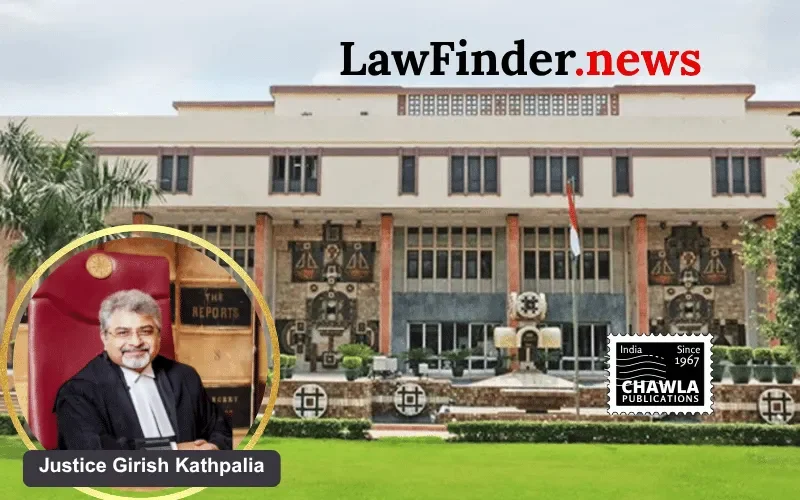
Court mandates trial courts to deliver final judgments within 30-45 days and orders on miscellaneous applications within 15 days, emphasizing timely justice under Bharatiya Nagarik Suraksha Sanhita, 2023
In a significant judgment delivered on November 17, 2026, the Delhi High Court underscored the critical importance of timely pronouncement of orders and judgments in criminal cases. Justice Girish Kathpalia, presiding over the matter of Karan Kapoor v. State (Govt of NCT of Delhi), issued directions to ensure that trial courts adhere to strict timelines for delivering decisions, thereby safeguarding public confidence in the justice delivery system.
The petitioner, Karan Kapoor, approached the High Court seeking directions to the trial court to expedite the decision on his application under Section 175(3) of the Bharatiya Nagarik Suraksha Sanhita, 2023 (BNSS). The petitioner contended that despite arguments being concluded thrice, the trial court had repeatedly deferred the pronouncement of orders, with the latest date for order pronouncement set nearly three months later, on January 28, 2027.
The Court observed that the delay was not attributable to usual pendency issues such as witness availability or forensic report delays, but rather due to the trial court’s repeated adjournments and mechanical listings citing “clarifications” without substantive cause. Justice Kathpalia expressed concern over the practice of lengthy postponements after conclusion of arguments, emphasizing that it undermines the integrity and credibility of the criminal justice process.
Notably, while procedural criminal law does not prescribe a specific timeframe for pronouncement of orders on miscellaneous applications, the Court drew guidance from Section 258(1) BNSS, which mandates that final judgments in Sessions Courts must be pronounced within 30 days of conclusion of arguments, extendable to 45 days for recorded reasons. The Court reasoned that the same principle of expeditious justice must apply to all orders, including those on miscellaneous applications before both Sessions Courts and Magistrate Courts.
Accordingly, the High Court granted the petition and directed the trial court to decide and pronounce its order on the petitioner’s application within 15 days from the date of the judgment. The Court further ordered that copies of this judgment be circulated to all Principal District & Sessions Judges in Delhi to ensure that all courts handling criminal matters comply with the prescribed timelines, thereby fostering faith in the criminal justice system.
This ruling highlights the judiciary’s proactive stance in implementing the provisions of the newly enacted Bharatiya Nagarik Suraksha Sanhita, 2023, which seeks to streamline criminal procedure and enhance efficiency in the dispensation of justice. Timely pronouncement of orders and judgments is vital not only for the interests of the parties involved but also for maintaining the public’s trust in the legal system.
The Delhi High Court’s directive serves as a clarion call to courts across the capital to eliminate avoidable delays, recognizing that justice delayed is justice denied. By mandating that miscellaneous application orders be pronounced within 15 days and final judgments within 30 to 45 days, the Court has set a precedent that balances judicial thoroughness with the imperative for prompt justice.
Bottom Line:
Timely pronouncement of orders or judgments by trial courts in criminal cases is crucial for maintaining public confidence in the justice delivery system. Orders on miscellaneous applications must be pronounced within a reasonable time, ideally not exceeding 15 days after arguments conclude.
Statutory provision(s):
Bharatiya Nagarik Suraksha Sanhita, 2023 Section 175(3), Section 258(1)
Karan Kapoor v. State (Govt of NCT of Delhi), (Delhi) : Law Finder Doc Id # 3129670