Court rejects claim of oral gift and adverse possession by long-time occupant; says permissive occupation as caretaker cannot mature into ownership
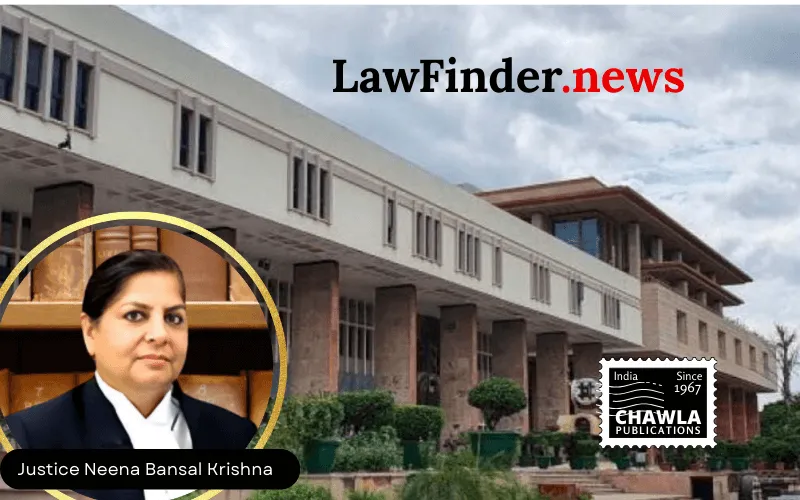
The Delhi High Court has dismissed an appeal filed by Smt. Chandrawati Shah challenging a trial court decree that had granted possession of a Shahdara property to Smt. Rajinder Kaur. Justice Neena Bansal Krishna held that the defendant failed to prove her claim of ownership through an alleged oral gift and also failed to establish adverse possession over the suit property.
The dispute concerned property bearing No. 1/2494, Moti Ram Marg, Mukherjee Marg, G.T. Road, Shahdara, Delhi, which the plaintiff claimed to have purchased in 1988 through a receipt, General Power of Attorney and Agreement to Sell. According to the plaintiff, the defendant and her husband had originally been domestic helpers and later continued in the premises only as caretakers with permission, without any right, title or interest.
The defendant, however, argued that the property had been orally gifted to her and her late husband decades ago out of love and affection, and that she had been in continuous possession for nearly 40 years. She also challenged the plaintiff’s title, relying on the Supreme Court’s ruling in Suraj Lamp & Industries Pvt. Ltd. v. State of Haryana to contend that GPA-based documents do not confer ownership.
Rejecting this defence, the High Court held that an oral gift of immovable property is not valid under Section 123 of the Transfer of Property Act, 1882, which requires a registered instrument signed and attested in the prescribed manner. The Court noted that the defendant produced no written gift deed, no mutation record, and no contemporaneous evidence to support the alleged transfer. The defendant herself admitted that there was no documentary proof of ownership in her favour.
The Court further observed that the defendant’s own version showed that she had entered the property through the plaintiff and her family while assisting them in domestic work. Relying on settled law, including Maria Margarida Sequeria Fernandes v. Erasmo Jack de Sequeria, the Court held that long permissive occupation by a caretaker, servant or domestic help does not create ownership rights.
On the plea of adverse possession, the Court found that it had not even been properly pleaded in the written statement and was raised only at the stage of final arguments before the trial court. There was no evidence of when the possession became hostile, what act amounted to hostile assertion, or when the plaintiff became aware of such hostility. The Court reiterated that adverse possession requires clear pleading and proof of hostile, continuous and open possession for the statutory period.
The Court also upheld the trial court’s finding that the plaintiff had a better right to the property. While the GPA, Agreement to Sell and Receipt did not amount to a registered conveyance, the Court said they were still relevant circumstances when read with electricity, municipal and water records. These documents, along with the defendant’s own case that her claim flowed from the plaintiff, supported the plaintiff’s superior right to possession.
On the issue of mesne profits, the trial court had awarded Rs.1,00,000 as damages. However, during the appeal, the plaintiff stated that she was no longer interested in recovering the amount, and the monetary relief was treated as given up.
Ultimately, the High Court dismissed the appeal and upheld the decree for possession. It also noted that possession of the suit property had already been delivered to the plaintiff in execution proceedings on 26.11.2024.
Bottom Line :
Possession suit - Defendant claiming oral gift and adverse possession - Oral gift of immovable property is invalid without registered instrument under Section 123 of Transfer of Property Act - Long permissive possession as caretaker/domestic help does not create ownership rights - Plea of adverse possession must be specifically pleaded and proved with hostile animus - Plaintiff held to have better title and entitled to possession; however, mesne profits though awarded by Trial Court were later given up by plaintiff.
Statutory provision(s): Section 96, Code of Civil Procedure, 1908; Section 123, Transfer of Property Act, 1882; Order VII Rule 11, Code of Civil Procedure, 1908; Order VIII Rule 1A(3), Code of Civil Procedure, 1908; Section 151, Code of Civil Procedure, 1908
Chandrawati Shah v. Rajinder Kaur, (Delhi) : Law Finder Doc id # 2983513