Court Holds Writ Jurisdiction under Article 226 Cannot Be Used for Personal Grievances Against Private Entities; Petitioner Advised to Pursue Legal Remedies
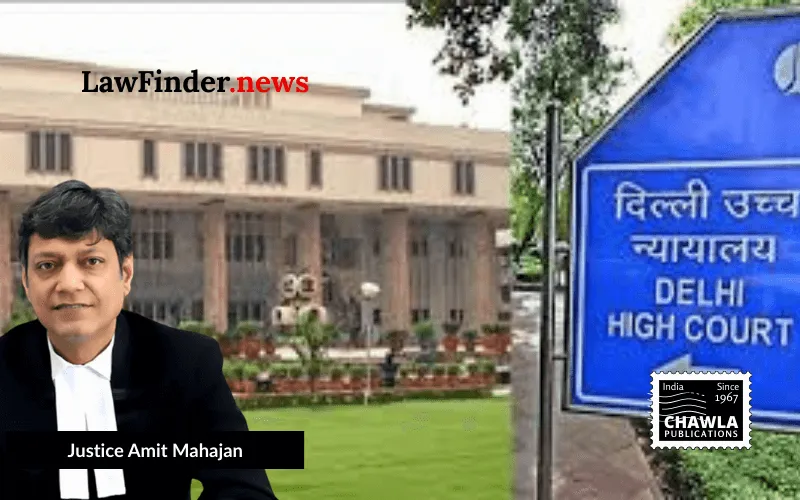
In a recent judgment delivered on September 29, 2026, the Delhi High Court, presided over by Justice Amit Mahajan, dismissed a writ petition filed by Pushpendra Singh Parmar seeking directions to the Institute of Company Secretaries of India (ICSI) authorities to act on his representations against UC Web Mobile Private Limited. The petitioner alleged that the company was engaged in illegal activities, including hacking the IRCTC system, inciting communal riots, and cyber terrorism. He further contended that the company had unlawfully obtained his confidential emails and misused them to harass him by initiating contempt proceedings.
The petitioner approached the High Court under Article 226 of the Constitution of India, requesting the court to direct the authorities to investigate the company's alleged wrongdoing and take appropriate action. However, the Court observed that the dispute was primarily a personal grievance between the petitioner and the private company and did not warrant invoking the extraordinary writ jurisdiction.
Justice Mahajan emphasized that Article 226 is an exceptional remedy designed to address public law issues and cannot be used as a forum for ventilating individual disputes or for collateral purposes against adversaries. The Court noted that mere non-response from authorities to representations does not entitle a litigant to seek writ relief. The judgment clarified that such grievances must be resolved through appropriate civil or criminal proceedings against the private entity.
Consequently, the Court dismissed the petition but granted liberty to the petitioner to pursue suitable legal action against UC Web Mobile Pvt. Ltd. in accordance with the law. This ruling reinforces the principle that writ jurisdiction is not a substitute for regular legal remedies in disputes involving private parties.
Bottom Line:
Writ jurisdiction under Article 226 of the Constitution is extraordinary and cannot be invoked for ventilating personal disputes or seeking action on representations arising out of an individual grievance against a private party merely because no response was received from the authority.
Statutory provision(s):
Constitution of India, 1950 Article 226