Court Balances Stringent Bail Restrictions under UAPA with Right to Speedy Trial and Personal Liberty; Issues Strict Conditions for Bail to Safeguard Public Order
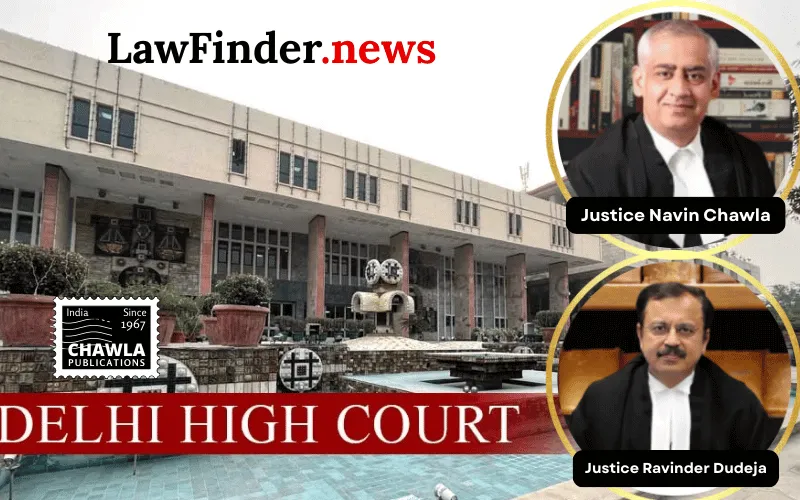
In a significant judgment delivered on September 14, 2026, the Delhi High Court (Division Bench comprising Justices Navin Chawla and Ravinder Dudeja) granted bail to Mohammad Saqib @ Saqib Iftekar, an accused in a high-profile terror conspiracy case registered by the National Investigation Agency (NIA) under the Unlawful Activities (Prevention) Act (UAPA), Indian Penal Code (IPC), and Explosive Substances Act. The accused had been in judicial custody for nearly eight years since December 2018, and the trial is still far from completion.
The appellant was charged with grave offenses including criminal conspiracy (IPC Sections 120B, 121, 121A, 122), and multiple sections of UAPA (Sections 17, 18, 18B, 20, 38, 39), involving links with terrorist organizations ISIS and Jaish-e-Muhammad, procurement of arms, and conspiracy to wage war against the Government of India.
Despite the seriousness of the charges, the court took note of the prolonged incarceration and significant delay in trial proceedings - out of 120 prosecution witnesses, statements of only 40 had been recorded. The court emphasized the constitutional right to a speedy trial under Article 21 of the Constitution and reiterated that statutory bail restrictions under Section 43D(5) of the UAPA do not oust the power of constitutional courts to grant bail in cases of prolonged detention.
The court carefully examined the prosecution material and witness testimonies, including those of key witnesses who failed to implicate the appellant as a core conspirator but rather as a peripheral participant. It observed that the alleged role of the appellant, though serious, did not justify further prolonged pre-trial detention in light of the delay.
The judgment extensively referenced Supreme Court precedents, notably Union of India v. K.A. Najeeb (2021), Gulfisha Fatima v. State (2026), and Syed Iftikhar Andrabi v. NIA (2026), which outline a balanced approach where courts must weigh the nature of allegations against the right to personal liberty and speedy trial. The court noted that while UAPA offenses attract stringent bail conditions, these cannot result in arbitrary or indefinite detention violating fundamental rights.
Accordingly, the court set aside the trial court's order rejecting bail and granted bail with stringent conditions to ensure the integrity of the trial and public order. Conditions include personal bond with sureties, surrender of passport, restrictions on travel and communication, prohibition on contacting witnesses or public statements regarding the case, and mandatory reporting to the NIA branch office.
The court clarified that its observations were limited to the bail context and should not prejudice the trial's merits. The judgment serves as a crucial reaffirmation that even in cases involving national security, the constitutional right to liberty and speedy justice remain paramount.
Bottom Line:
Bail under UAPA - Prolonged incarceration and delay in trial may justify grant of bail, even in cases involving grave allegations under UAPA, subject to adequate safeguards.
Statutory provision(s):
Section 43D(5) of Unlawful Activities (Prevention) Act, 1967; Sections 120B, 121, 121A, 122 of Indian Penal Code, 1860; Sections 17, 18, 18B, 20, 38, 39 of Unlawful Activities (Prevention) Act, 1967; Sections 4 and 5 of Explosive Substances Act, 1908; Article 21 of Constitution of India