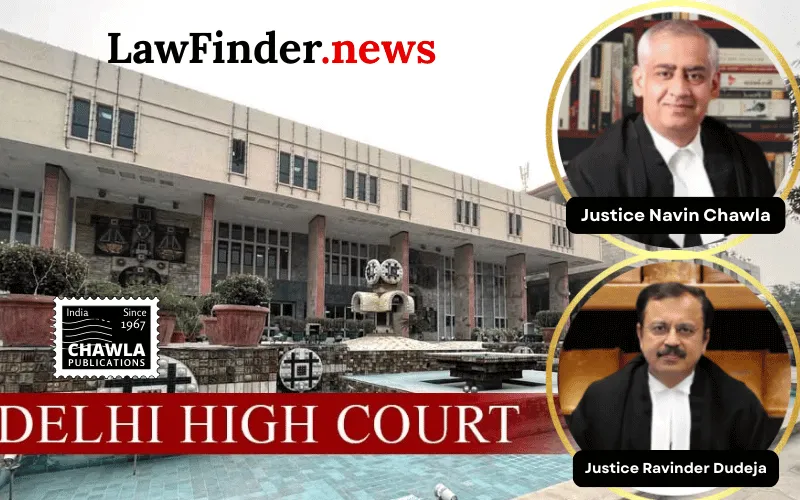
Despite Stringent Bail Conditions under UAPA Section 43D(5), Court Balances Right to Speedy Trial and National Security, Imposes Strict Bail Conditions to Mitigate Flight Risk and Trial Interference
In a landmark judgment delivered on September 18, 2026, the Delhi High Court (Division Bench comprising Justices Navin Chawla and Ravinder Dudeja) granted bail to Jagtar Singh Johal, a UK national accused in multiple cases registered under the Unlawful Activities (Prevention) Act, 1967 (UAPA), after he had spent over eight years in custody. The court's decision comes amid prolonged delays in the trial process, with over 160 witnesses yet to be examined.
Jagtar Singh Johal, the appellant, faced serious charges including conspiracy, murder, and terrorism-related offences across seven different criminal appeals linked to cases registered in Punjab. The charges include sections of the Indian Penal Code (IPC) such as Sections 120B (criminal conspiracy), 302 (murder), and various sections of the UAPA (Sections 16, 17, 18, 18A, 18B, 20, 21, and 23). The appellant was alleged to be a key conspirator and member of the Khalistan Liberation Force (KLF), a banned terrorist organization.
The appellant's counsel argued that despite repeated Supreme Court orders to expedite the trial, only 40 witnesses had been examined, with approximately 123 witnesses still to be heard, making the conclusion of the trial unlikely in the near future. Reliance was placed on precedent Supreme Court judgments, including Union of India v. K.A. Najeeb and Gulfisha Fatima v. State, which emphasize the constitutional right to a speedy trial under Article 21 of the Constitution of India and the courts' power to grant bail even under stringent statutory provisions when the trial is unreasonably delayed.
The appellant also highlighted a prior acquittal by the Additional Sessions Judge, Moga, Punjab, in a related case based on similar allegations, which had attained finality and was not challenged by the prosecution. The High Court of Punjab and Haryana's earlier order granting bail to the appellant on similar grounds was also brought to the fore.
The prosecution, represented by the Additional Solicitor General, submitted that the stringent conditions under Section 43D(5) of the UAPA apply, which restrict bail when the accused is prima facie guilty, and that the appellant posed a flight risk given his foreign nationality. It was also argued that the appellant's release could jeopardize the trial due to threats to witnesses and possible tampering with evidence.
The Court undertook a detailed analysis of the interplay between the constitutional right to personal liberty under Article 21 and the restrictive bail regime under Section 43D(5) of the UAPA. Referencing recent Supreme Court rulings, including Khuram Parvez v. NIA and Syed Iftikhar Andrabi v. NIA, the court observed that while UAPA imposes stringent bail restrictions, constitutional courts retain jurisdiction to grant bail where prolonged detention becomes unconscionable due to trial delays, especially when a substantial part of the prescribed sentence has been served.
The Court noted the trial's slow progress despite multiple Supreme Court directions, the death of one protected witness, and the non-recording of another protected witness's statement even after two years. It also emphasized that the appellant was not implicated in the core violent acts and weapons seizures, except for carrying GBP 3,000 from the UK to France, allegedly for the terrorist outfit.
Balancing the gravity of the offences with the appellant's prolonged incarceration and the right to a fair and speedy trial, the Court allowed the bail plea but imposed stringent conditions to address concerns about flight risk and trial integrity. Conditions include execution of a substantial personal bond, surrender of passport, restrictions on communication and social media activity, prohibition on contacting witnesses, regular reporting to the Investigating Officer, and non-participation in activities prejudicial to public order.
The Court also clarified that any breach of these conditions would enable the prosecution to seek cancellation of bail.
This judgment underscores the judiciary's commitment to upholding constitutional safeguards even in cases involving serious national security concerns, reiterating that "bail is the rule and jail is the exception," and emphasizing the need for expeditious trials.
Bottom Line:
Bail granted under UAPA despite stringent conditions under Section 43D(5) of the Act, considering prolonged incarceration of more than 8 years and delay in trial conclusion.
Statutory provision(s):
Section 43D(5) of the Unlawful Activities (Prevention) Act, 1967; Sections 16, 17, 18, 18A, 18B, 20, 21, 23 of UAPA; Sections 120B, 302, 34, 379, 416 of the Indian Penal Code; Sections 25, 27 of the Arms Act, 1959; Article 21 of the Constitution of India