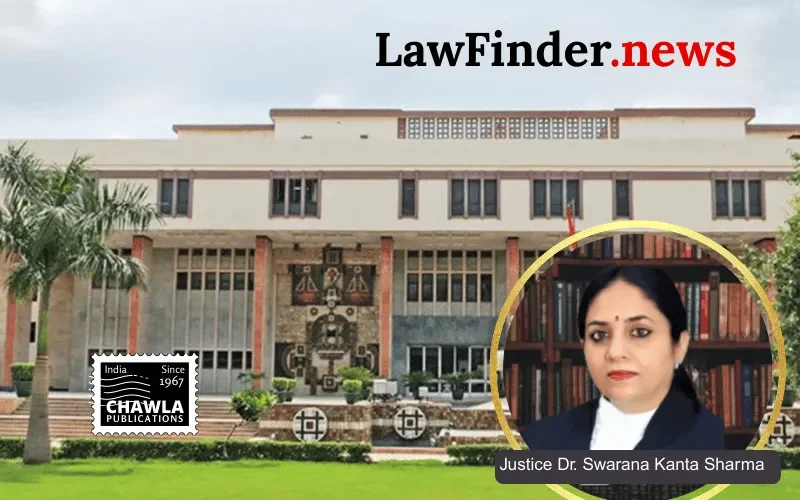
Court adopts pragmatic approach allowing video-conferencing for 71-year-old witness with health issues, balancing fair trial rights with witness protection under Delhi's Video Conferencing Rules
In a significant judgment dated October 27, 2026, the Delhi High Court, presided over by Justice Dr. Swarana Kanta Sharma, allowed the cross-examination of a 71-year-old key witness, Smt. Krishna Sen, through video conferencing due to her age-related health issues and residence outside Delhi. The Court emphasized the need for a balanced approach that safeguards the witness's well-being while preserving the opposing party's right to a fair trial.
The application was filed by the petitioner, Gopal Chandra Bose, seeking permission to conduct the cross-examination of PW-6, Smt. Krishna Sen, remotely. The witness, residing in Uttarakhand, had already traveled to Delhi thrice for cross-examination scheduled on November 5, 2024, February 10, 2025, and July 24, 2025. However, the cross-examination could not be completed on any of these dates due to reasons not attributable to her-illness of the respondent's counsel, court leave, and petitioner's counsel's unavailability respectively.
Recognizing that further physical travel would impose undue hardship on the elderly witness suffering from health problems and on medical advice to rest, the Court relied on the High Court of Delhi Rules for Video Conferencing for Courts, 2021 ("2021 Rules"), and the Electronic Evidence and Video Conferencing Rules, 2025 ("2025 Rules"). The 2021 Rules allow video conferencing for witnesses unable to physically attend due to sickness or physical infirmity or where attendance would cause undue delay or expense. Though the 2021 Rules have been repealed by the 2025 Rules, a saving clause ensures the continued applicability of the 2021 Rules to pending proceedings like this one. The 2025 Rules similarly empower courts to authorize video conferencing in such circumstances.
Justice Sharma noted that cross-examination is a fundamental aspect of a fair judicial process, and any modification to the mode of examination must not compromise fairness or effectiveness. The Court held that video conferencing can be a suitable mode, provided appropriate safeguards are implemented. These include verifying the identity of the witness, ensuring voluntary appearance without prompting, testing audiovisual equipment beforehand, limiting presence at the remote location, proper handling and showing of documents, authenticating the deposition, and prohibiting unauthorized recordings.
The Court allowed the cross-examination to proceed via video conferencing from a convenient facility in Uttarakhand or, if health conditions prevent travel to such a facility, from the witness's residence under supervision. The petitioner was directed to coordinate with the authorities to arrange the video conferencing and bear initial expenses. Both parties were instructed to cooperate fully to prevent technical disruptions and to ensure the cross-examination is completed efficiently on the fixed date.
This decision reflects the Delhi High Court's pragmatic and humane approach in adapting court procedures to contemporary realities, particularly accommodating vulnerable witnesses while upholding the principles of natural justice. It also reinforces the legal framework provided by the 2021 and 2025 Video Conferencing Rules, setting a precedent for future cases involving elderly or infirm witnesses.
Bottom Line:
Examination and cross-examination of an elderly witness through video conferencing can be permitted where the witness is suffering from age-related health issues, resides outside Delhi, and repeated physical appearances could not result in completion of cross-examination; Court can adopt a pragmatic approach and impose safeguards to protect the opposite party's right of effective cross-examination.
Statutory provision(s):
High Court of Delhi Rules for Video Conferencing for Courts, 2021 Rule 8.15, Rule 8.12; Electronic Evidence and Video Conferencing Rules, 2025 Rules 13(8), 13(9), Rule 27(2)(a)
Gopal Chandra Bose v. State, (Delhi) : Law Finder Doc Id # 3003903