Court says notional interest on terminal benefits and family pension cannot be used to deny humanitarian relief; Punjab and Sind Bank directed to appoint widow within two months.
The Delhi High Court has set aside the rejection of a widow’s request for compassionate appointment by Punjab and Sind Bank, holding that the bank wrongly inflated her family income by adding notional interest on terminal benefits and by treating family pension and welfare society pension as disqualifying income.
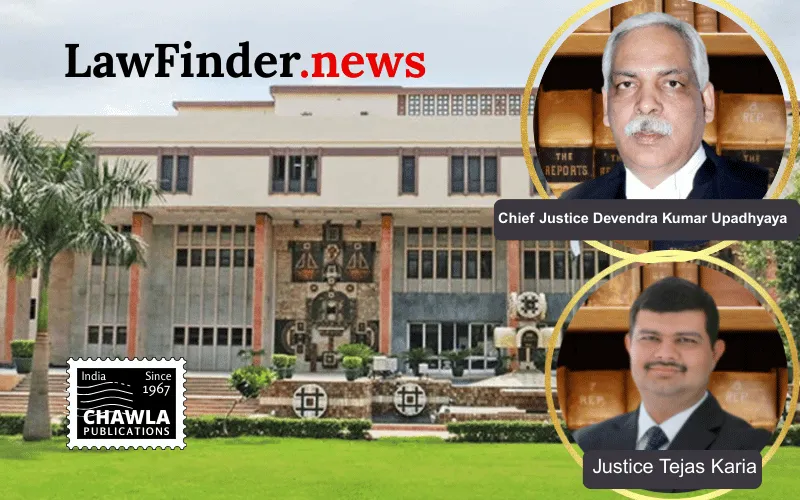
A Division Bench comprising Chief Justice Devendra Kumar Upadhyaya and Justice Tejas Karia allowed the appeal filed by Anita, widow of a deceased bank employee, and quashed both the bank’s rejection order dated September 10, 2024, and the Single Judge’s order dated February 13, 2025.
The court noted that Anita’s husband, Ashok Kumar, had served the bank as a peon and died in September 2022. After his death, Anita began receiving family pension and a pension from the bank employees’ welfare society. She later applied for compassionate appointment, but the bank rejected her claim on the ground that her monthly income exceeded the eligibility limit under the bank’s compassionate appointment scheme.
The bank had calculated her family income by adding:
- notional monthly interest on the terminal benefits received after her husband’s death,
- income from supposed investments,
- family pension, and
- welfare society pension.
On this basis, the bank concluded that her income crossed 60% of her late husband’s last drawn salary and therefore she was ineligible under Clause 5.1(c) of the scheme.
The High Court disagreed. It held that while compassionate appointment is not a matter of right and must be governed by the employer’s scheme, the scheme must be interpreted in a manner consistent with its object — to provide immediate relief to families facing financial distress after the death of the earning member.
The Bench found no material to show that the widow had actually invested the terminal benefits in income-generating assets. It said the bank could not assume that the entire corpus had been kept invested and would continue generating income throughout her lifetime. The court observed that once terminal benefits are paid to the family, the employer cannot control how the money is used, and the family cannot be expected to keep such funds unused merely to preserve eligibility for compassionate employment.
The court also rejected the bank’s approach of treating family pension and welfare society pension as a bar to appointment. Citing Supreme Court rulings in Govind Prakash Verma v. LIC of India and Canara Bank v. M. Mahesh Kumar, the court reiterated that pensionary and service-related benefits cannot be treated as substitutes for compassionate appointment.
After excluding the unsustainable components from the income calculation, the court held that Anita’s family income fell below the threshold prescribed under the scheme, making her eligible for compassionate appointment. The court therefore directed Punjab and Sind Bank to grant her compassionate appointment within two months.
Bottom Line :
Compassionate appointment - Bank cannot deny compassionate appointment by adding notional interest on terminal benefits and by treating family pension/Welfare Society pension as disqualifying income - “Notional income” under scheme cannot include imaginary income from corpus which family is not obliged to invest - Widow held eligible under scheme and bank directed to grant compassionate appointment.
Statutory provision(s): Clause 5.1(c) of PSB Jeevan Sahara: Comprehensive Scheme for Appointment on Compassionate Grounds and Payment of Ex-Gratia Amount in Lieu of Appointment on Compassionate Grounds
Anita v. Punjab and Sind Bank, (Delhi)(DB) : Law Finder Doc id # 2984400