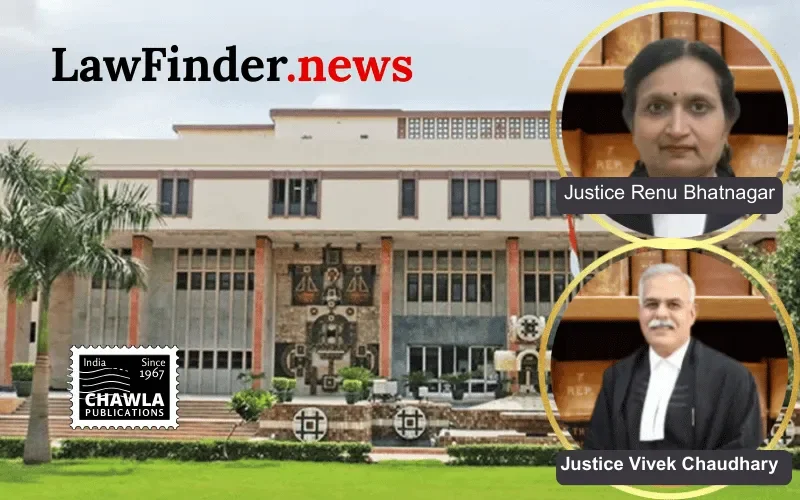
Division Bench holds Rule 4 of Delhi High Court (Original Side) Rules, 2018 as procedural and directory, aligning with Supreme Court precedent on CPC Order VIII Rule 1, and calls for reconsideration of earlier mandatory interpretations and Registrar's powers.
In a significant judgment dated October 8, 2026, a Division Bench of the Delhi High Court comprising Justices Vivek Chaudhary and Renu Bhatnagar has referred important legal questions to a Larger Bench concerning the interpretation of Rule 4 of Chapter VII of the Delhi High Court (Original Side) Rules, 2018 ("DHC Rules"). The case arose from an appeal filed by the legal representatives of the late Yogesh Taneja challenging the dismissal of their Chamber Appeal by a Single Judge, which had upheld the Joint Registrar's order closing the right to file a written statement beyond the prescribed time limit.
The core issue before the Court was whether the Court possesses the power to extend the time for filing a written statement beyond the total period of 120 days as stipulated under Rule 4 of the DHC Rules. The appellant's counsel argued that Rule 4, being procedural in nature, should be liberally construed, in line with the Supreme Court's interpretation of a similar provision under Order VIII Rule 1 of the Code of Civil Procedure, 1908 ("CPC"), which has been held to be directory rather than mandatory.
Rule 4 of the DHC Rules prescribes an initial period of 30 days to file a written statement, with a discretionary extension of up to 90 days by the Court, "but not thereafter." The Single Judge and some earlier Division Bench decisions had interpreted this language as mandatory, forbidding any extension beyond 120 days in total. The respondent relied heavily on these precedents, including Ram Sarup Lugani (2020), Delhi Gymkhana Club Ltd. (2024), and Manhar Sabharwal (2024).
However, the Division Bench carefully analyzed the language and scheme of Rule 4 in comparison with Order VIII Rule 1 CPC, which similarly prescribes 30 days and a further extension not exceeding 90 days for filing a written statement. The Supreme Court, in landmark judgments such as Kailash v. Nanhku (2005), Salem Advocate Bar Association (2005), and Rani Kusum (2005), had held that the time limit under Order VIII Rule 1 CPC is directory, not mandatory, allowing courts discretion to extend time in exceptional cases to advance justice rather than scuttle it.
The Bench observed that the DHC Rules do not contain any provision superseding Order VIII Rule 10 CPC, which confers wide discretion on courts to make such orders as deemed fit even if a written statement is not filed within prescribed time. Hence, Rule 4 of the DHC Rules must be read harmoniously with Order VIII Rule 10 CPC, reinforcing its directory nature.
The Court also examined the powers of the Registrar under Rule 4, concluding that the Registrar's power to close the right to file a written statement after the prescribed or court-extended period is purely ministerial, not judicial. Therefore, the correctness of allowing Chamber Appeals against such Registrar orders, as held in Rahul Gupta (2013), was questioned.
Due to conflicting views in earlier Division Bench rulings, the Court referred the following questions to a Larger Bench:
1. Whether the Supreme Court's judgments declaring Order VIII Rule 1 CPC to be directory should apply to Rule 4 of the DHC Rules, and whether the earlier Division Bench decisions holding Rule 4 as mandatory are incorrect.
2. Whether only the Court (and not the Registrar) has the power to extend the time for filing the written statement under Rule 4, with the Registrar's role being ministerial.
3. Whether the law laid down in Rahul Gupta regarding appeals against Registrar's orders conflicts with the Supreme Court's ruling in State of Orissa v. Commissioner of Land Records (1998) and warrants overruling.
The Court's decision highlights the tension between procedural rigidity and the need for judicial flexibility to ensure fair adjudication. It signals a potential shift towards a more liberal interpretation of procedural rules relating to pleadings on the Original Side of the Delhi High Court, in consonance with Supreme Court jurisprudence.
Legal practitioners and litigants before the Delhi High Court (Original Side) will keenly await the Larger Bench's ruling, which promises to clarify the scope of courts' discretion in extending time for filing written statements, and the extent of Registrar's powers and the availability of appeals.
Bottom Line:
Delhi High Court (Original Side) Rules, 2018, Chapter VII Rule 4 - Filing of written statement - Division Bench held that Rule 4 is procedural and prima facie directory, comparable to Order VIII Rule 1 CPC - Since Rule 10 CPC continues to apply and Supreme Court has treated Order VIII Rule 1 as directory, earlier Delhi High Court Division Bench rulings treating Rule 4 as mandatory were doubted - Questions referred to Larger Bench on whether time beyond 120 days can be extended, whether Registrar's power is merely ministerial, and whether Chamber Appeal jurisprudence in Rahul Gupta requires reconsideration.
Statutory provision(s):
Delhi High Court (Original Side) Rules, 2018 Chapter VII Rule 4, Code of Civil Procedure, 1908 Order VIII Rule 1, Order VIII Rule 10, Section 129 CPC, Section 7 Delhi High Court Act