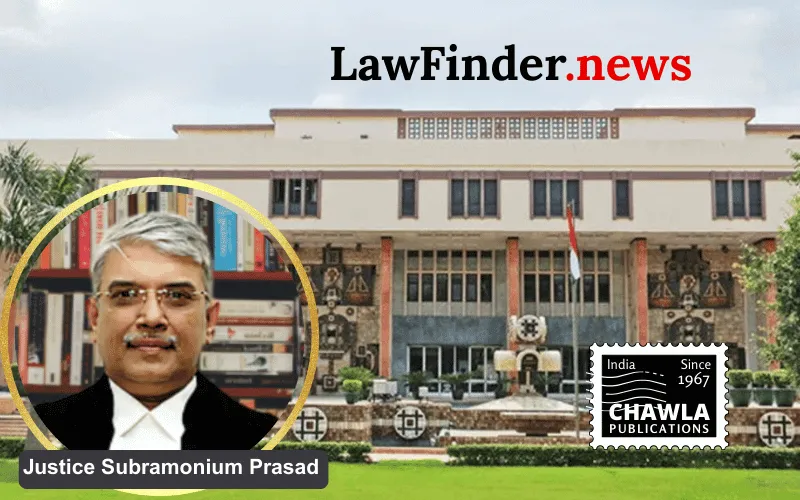
Conflicting Judicial Opinions on Limitation Periods for Written Statements During Mediation to be Resolved
In a significant development, the Delhi High Court has referred to a larger bench the contentious issue of whether the time spent in mediation should be excluded when calculating the limitation period for filing written statements or replications. This decision comes amidst conflicting judicial opinions on the matter within the court itself, highlighting the need for a definitive resolution.
The case at hand, Vedpal Singh v. Satishpal & Ors., revolves around a chamber appeal filed by the plaintiff, Vedpal Singh, challenging an order by the learned Joint Registrar dated May 5, 2026. This order accounted for the time spent in mediation when determining the limitation period for filing a written statement, a decision contested by the plaintiff.
The central question posed in this appeal is whether the period spent in mediation should be excluded from the time specified under Chapter VII of the Delhi High Court (Original Side) Rules, 2018, for filing a written statement. According to Rule 4 of these rules, a written statement must be filed within 30 days of receiving the summons, with a possible extension of up to 120 days upon demonstrating sufficient cause. However, the rules do not explicitly provide for excluding time spent in mediation from this period.
The court acknowledged divergent views on the issue. Some judgments, such as those in Harjyot Singh v. Manpreet Kaur and Amit Tara and Others v. Deepak Tara and Others, have held that the mediation period cannot be excluded from the mandatory filing period. In contrast, other rulings, including Bharat Singh v. Karan Singh and Others, support the exclusion of mediation time, emphasizing the importance of mediation in amicably resolving disputes.
Justice Subramonium Prasad, presiding over the current case, noted the necessity of an authoritative pronouncement to reconcile these conflicting opinions. The court highlighted that mediation is a crucial mechanism for dispute resolution, particularly in the context of India's push towards a 'Vivad Mukt Bharat' (Dispute-Free India). Forcing parties to file written statements during ongoing mediation could undermine the spirit of the mediation process, which aims for mutually satisfactory resolutions.
The decision to refer the matter to a larger bench underscores the court's commitment to providing clarity on this critical procedural question. The larger bench will address whether the time spent in mediation should indeed be excluded from the limitation periods prescribed by the Delhi High Court Rules, potentially impacting numerous cases where mediation is pursued as a dispute resolution mechanism.
Bottom line:-
The question of whether the time spent in mediation should be excluded while computing the limitation period prescribed for filing the written statement/replication under Chapter VII of the Delhi High Court (Original Side) Rules, 2018, referred to a larger bench for authoritative pronouncement.
Statutory provision(s):
Civil Procedure Code, 1908 Section 89, Delhi High Court (Original Side) Rules, 2018 - Chapter VII, Rule 4
Vedpal Singh v. Satishpal, (Delhi) : Law Finder Doc id # 2933901