Court holds SC/ST Act bars pre-arrest bail where FIR and video content prima facie disclose caste-based humiliation of an SC MP in public view
The Delhi High Court has dismissed the anticipatory bail plea of Ajeet Bharti in a case alleging caste-based abuse and humiliation of an MP from the Scheduled Caste community through a publicly circulated social media video.
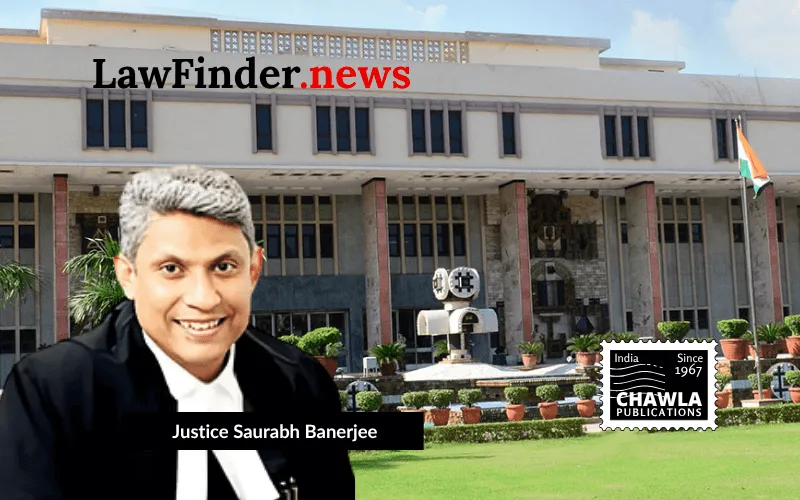
Justice Saurabh Banerjee held that the bar under Sections 18 and 18A(2) of the Scheduled Castes and the Scheduled Tribes (Prevention of Atrocities) Act, 1989 applies when the FIR and supporting material disclose a prima facie offence under the Act. The Court said it could not conduct a mini-trial at the stage of anticipatory bail and must confine itself to a plain reading of the FIR and the material placed before it.
The case arose from FIR No. 30/2026 registered at Police Station North Avenue in Delhi. The complainant, Delhi State President of a political party, alleged that Bharti uploaded and circulated an audio-visual video titled “SB79: Reservation Hatao Andolan Nautanki & More/ Saptahik Bakaiti” on 22 August 2026. According to the prosecution, the video had around 23,100 views and contained repeated caste slurs, derogatory remarks and humiliating statements directed at Chandrashekhar Azad, Member of Parliament from Nagina and a member of the SC community, as well as at Dr. B.R. Ambedkar and the SC/ST communities.
The Court examined the video transcript and found that the remarks were not stray or casual, but repeatedly linked the named individual to caste-based slurs and notions of caste hierarchy. It noted that the applicant had publicly referred to the MP using caste names and had suggested that he would need to “make himself worthy enough” to ask for the hand of a “savarna” woman, which the Court said reflected an invocation of upper-caste superiority.
Justice Banerjee observed that in the age of the internet, content uploaded on a public digital platform is accessible to all and satisfies the requirement of being “within public view” even without the physical presence of the victim. On that basis, the Court held that offences under Sections 3(1)(r) and 3(1)(s) of the SC/ST Act were prima facie made out.
The Court also rejected the argument that the statements were made in response to online provocation, stating that such provocation was not shown to have come from the named victim and, in any event, could not justify caste-based humiliation. It further noted that no clarification, retraction or apology had been issued.
Relying on Supreme Court rulings including Shajan Skaria v. State of Kerala, Kiran v. Rajkumar Jivraj Jain, and State of M.P. v. Ram Krishna Balothia, the High Court reiterated that anticipatory bail is unavailable in SC/ST Act cases where the allegations disclose a prima facie offence. Since such a case was made out, the Court held that the anticipatory bail application was not maintainable and dismissed it.
Bottom Line :
Anticipatory bail in offences under the SC/ST Act is barred by Sections 18 and 18A(2) of the Act unless, on a plain reading of the FIR, no prima facie offence is made out. Where caste-based slurs and humiliating remarks against an SC Member of Parliament were made in a publicly accessible social media video, offences under Sections 3(1)(r) and 3(1)(s) of the SC/ST Act were prima facie disclosed and the anticipatory bail application was not maintainable.
Statutory provision(s): Sections 18, 18A(2), 3(1)(r), 3(1)(s), 3(2)(va), 3(1)(u), 3(1)(v), 3(1)(w) of the Scheduled Castes and the Scheduled Tribes (Prevention of Atrocities) Act, 1989, Section 67 of the Information Technology Act, 2000, Sections 196(1)(c), 351(3) of the Bharatiya Nyaya Sanhita, 2023, Section 482 of the Bharatiya Nagarik Suraksha Sanhita, 2023
Ajeet Bharti v. State of NCT of Delhi, (Delhi) : Law Finder Doc id # 2984993