Court Emphasizes Strict Adherence to Limitation Law, Holding That Negligence and Inaction Cannot Justify Inordinate Delay
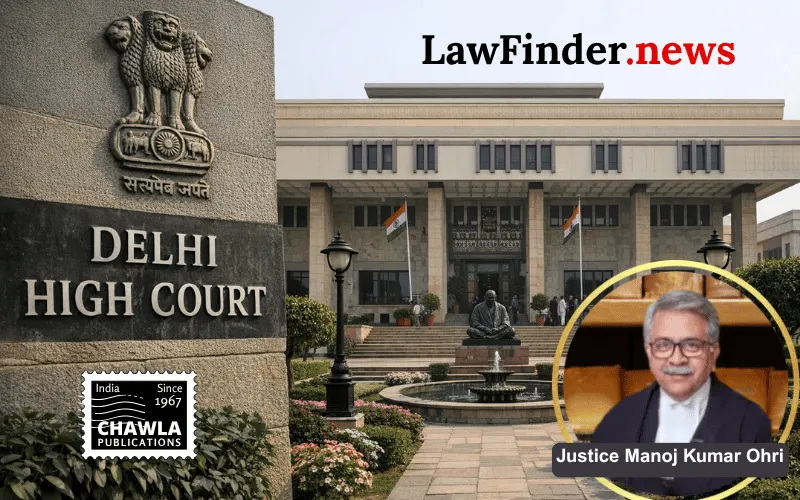
In a significant ruling on September 1, 2026, the Delhi High Court, presided over by Justice Manoj Kumar Ohri, dismissed an application seeking condonation of an extraordinary delay of 6,290 days (over 17 years) in filing for the restoration of an appeal. The appeal in question was originally dismissed in default on July 25, 2002, due to the appellant's failure to appear on the listed hearing dates.
The appellant, Krishan Lal, contended that the delay resulted from losing contact with his previous counsel, severe financial hardship, and the absence of notice prior to dismissal. However, the Court underscored that such reasons do not amount to "sufficient cause" under Section 5 of the Limitation Act, 1963, which governs condonation of delays. The Court reiterated the well-established principle that the law of limitation is founded on public policy aimed at bringing finality to litigation.
Drawing upon authoritative precedents, including the Supreme Court's decision in Basawaraj v. Special Land Acquisition Officer (2013) and the recent judgment in Pathapati Subba Reddy v. Special Deputy Collector (2024), the Court emphasized that "sufficient cause" requires an adequate and bona fide explanation that precludes negligence, inaction, or lack of due diligence. The Court rejected the appellant's plea that mere personal hardships or breakdown in communication with counsel could justify such an astronomical delay.
The judgment highlighted the doctrine of dura lex sed lex - the law is hard, but it is the law - asserting that courts cannot override statutory provisions of limitation even if it causes hardship to litigants. The Court also clarified that while Section 5 of the Limitation Act allows some discretion to condone delays, this discretion must be exercised judiciously and not in cases marked by prolonged negligence.
Given the absence of any satisfactory explanation for the delay, the Court declined to condone the delay and consequently dismissed the application for restoration of the appeal as barred by limitation. This ruling serves as a stern reminder to litigants about the importance of diligently pursuing their legal remedies within prescribed time limits and not relying on equitable grounds when statutory requirements are unmet.
Bottom Line:
Law of Limitation - Condonation of delay is permissible only if "sufficient cause" is shown. Courts have no authority to condone inordinate delays caused by negligence, inaction, or lack of diligence.
Statutory provision(s):
Limitation Act, 1963 Section 3, Section 5
Krishan Lal v. Inderjeet Singh, (Delhi) : Law Finder Doc Id # 2981935