Court sets aside District Judge's decision, reinforcing the integrity of statutory arbitration under MSMED Act.
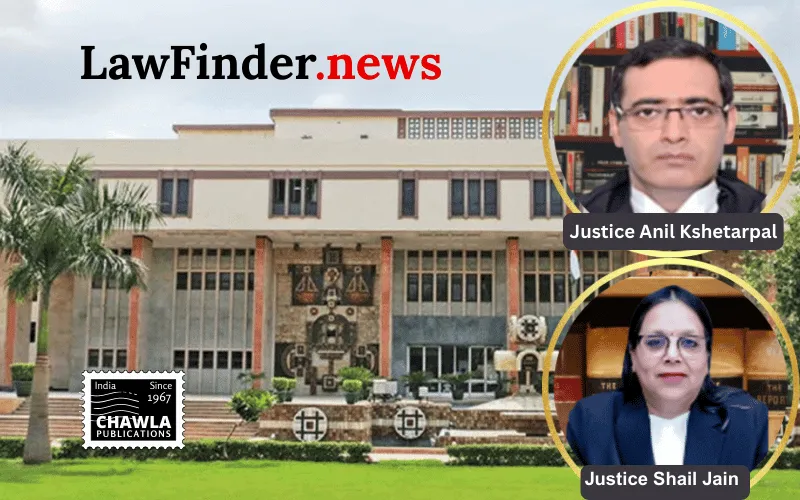
In a significant ruling, the Delhi High Court has restored an arbitral award that was previously set aside by the District Judge, Central District, Tis Hazari Courts, in a dispute involving M/s Airport Handling Services and the Indian Institute of Technology, Kanpur. The case, under the Arbitration and Conciliation Act, 1996, and the Micro, Small and Medium Enterprises Development Act, 2006, revolved around whether a service-condition restriction under Rule 11(3) of the Consumer Protection Model Rules could invalidate an arbitration award due to de jure ineligibility or inability.
The Bench, comprising Mr. Anil Kshetarpal and Ms. Shail Jain, clarified the legal distinction between de jure ineligibility under Section 12(5) of the Arbitration and Conciliation Act, which is confined to categories specified in the Seventh Schedule, and de jure inability under Section 14(1)(a), which is broader in scope. The court emphasized that not all legal disabilities equate to ineligibility under Section 12(5).
The controversy arose when the District Judge set aside an arbitral award on the grounds that the arbitrator, who was the President of the Delhi State Consumer Disputes Redressal Commission, was allegedly de jure unable to act due to service conditions. The High Court, however, found that the service-condition restrictions could not be transposed into statutory ineligibility under Section 12(5) since they were not listed in the Seventh Schedule.
The High Court underscored that the absence of an express written waiver under the proviso to Section 12(5) was immaterial in this case. The court noted that the arbitration proceedings were statutory, arising under the MSMED Act, and recognized by the DAC Arbitration Rules, 2023, as a distinct category, reinforcing the mandate of the appointed arbitrator.
Furthermore, the court highlighted the participation of the respondent in the arbitration proceedings without raising objections under Section 16(2) of the A&C Act, which played a significant role in the court's decision. The judgment also considered previous rulings, including the Supreme Court's interpretation in Bhadra International (India) Pvt. Ltd. v. Airports Authority of India, which delineates between the two legal concepts of de jure ineligibility and inability.
By setting aside the District Judge's decision and restoring the arbitral award, the Delhi High Court reaffirmed the statutory framework's integrity governing arbitration processes, especially under the MSMED Act. This ruling is expected to have a profound impact on how service conditions are interpreted in relation to statutory arbitration mandates in India.
Bottom Line :
Arbitration - MSMED Act statutory arbitration - Service-condition restriction applicable to President of State Consumer Commission cannot, by itself, be treated as statutory ineligibility under Section 12(5) read with Seventh Schedule of Arbitration and Conciliation Act - Absence of express written waiver under proviso to Section 12(5) is irrelevant where alleged disability does not fall within Seventh Schedule - Award wrongly set aside on ground of de jure inability - Award restored.
Statutory provision(s): Arbitration and Conciliation Act, 1996 Sections 12(5), 14(1)(a), 34, 37; Micro, Small and Medium Enterprises Development Act, 2006 Section 18; Consumer Protection (Conditions of Service of President and Members of the State Commission or District Commission) Model Rules, 2020 Rule 11(3).