Court holds private insurer amenable to writ jurisdiction under Article 226; directs payment of 50% insured sum with interest and compensation for wrongful repudiation of claim
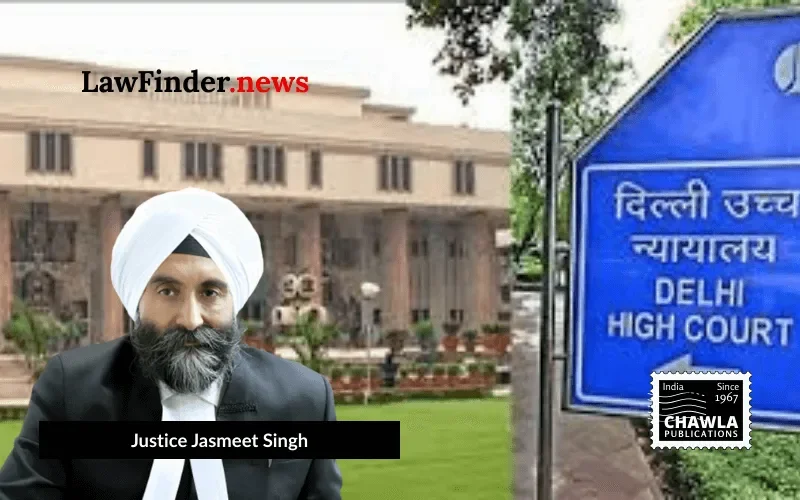
In a significant judgment dated 18 November 2026, the Delhi High Court, presided over by Justice Jasmeet Singh, held that death due to cardiac arrest falls within the ambit of “Myocardial Infarction” under a home loan insurance policy issued by M/s HDFC Ergo General Insurance Company Limited. The Court quashed the insurer’s repudiation letter and the Insurance Ombudsman’s award dismissing the claim, directing the insurer to pay 50% of the insured sum along with interest and compensation for interest paid on the home loan due to wrongful repudiation.
The case arose after Smt. Sushma Tyagi, the widow of late Sh. Anand Kumar Tyagi, sought insurance claim benefits following her husband’s death from cardiac arrest on 20 April 2021. The insurance policy, “Home Credit Assure,” was taken jointly by her husband and his brother to secure a home loan of Rs. 50 lakh. Despite submitting the claim on 29 June 2021, the insurer rejected it on 3 July 2021, stating that cardiac arrest was not covered under the critical illnesses specified, particularly excluding it from “Myocardial Infarction.”
Smt. Tyagi approached the Insurance Ombudsman, whose award dated 26 September 2023 also dismissed her complaint. She then filed a writ petition under Article 226 of the Constitution challenging both the repudiation and the Ombudsman’s award.
The Court first addressed the maintainability of the writ petition against a private insurer. Relying on Supreme Court precedents including Life Insurance Corporation of India v. Asha Goel and the recent Ajay Vijh v. Indian Banks Assn., it observed that private entities performing public functions—such as insurance companies acting as social safety nets—are amenable to judicial review under Article 226. Thus, the insurer’s objection that it was not “State” under Article 12 was rejected, and the petition held maintainable.
On the core issue of contract interpretation, the Court analyzed the policy’s definition of “Myocardial Infarction,” which included “the first occurrence of heart attack or myocardial infarction, meaning death of a portion of the heart muscle as a result of inadequate blood supply.” The insurer argued that cardiac arrest and myocardial infarction were distinct medical conditions. However, the Court noted that both conditions involve disruption of blood supply to the heart and are commonly referred to as “heart attack” in lay terms.
The Court relied on medical comparisons and past decisions, notably the Madras High Court’s judgment in Jasmine Ebenezer Arthur v. HDFC Ergo General Insurance Company Limited, where cardiac arrest was held to fall within myocardial infarction coverage. Applying the rule of contra proferentem—which mandates resolving ambiguities in insurance contracts in favor of the insured—the Court held that “Myocardial Infarction” must be interpreted to include cardiac arrest.
Regarding the Ombudsman’s award, the Court found that it was vitiated by breach of natural justice principles. The petitioner was allegedly coerced into signing a blank mediation form without proper hearing, violating the audi alteram partem rule. The Court emphasized that quasi-judicial bodies like the Insurance Ombudsman must follow natural justice and adjudicate complaints fully if mediation fails.
Consequently, the Court set aside both the repudiation and the Ombudsman’s award. It directed the insurer to pay the petitioner 50% of the insured sum amounting to Rs. 27,97,445 along with 9% interest from the date of repudiation to actual payment. Additionally, the insurer was ordered to compensate the petitioner Rs. 5,08,176 for interest paid on the home loan installments corresponding to the deceased’s insured interest, recognizing the financial hardship caused by wrongful repudiation.
This judgment reinforces the principle that insurance contracts must be interpreted liberally in favor of the insured in cases of ambiguity, especially concerning critical illness coverage. It also establishes that private insurers carrying out public functions are subject to writ jurisdiction, expanding access to judicial remedies for aggrieved policyholders.
Bottom Line:
Interpretation of insurance policy clauses must favor the insured in cases of ambiguity, in line with the principle of contra proferentem. Cardiac arrest may fall under "Myocardial Infarction" coverage in an insurance policy if the terms are ambiguous and the conditions are related.
Statutory provision(s): Article 226 of the Constitution of India, Article 12 of the Constitution of India, Insurance Ombudsman Rules, 2017, Consumer Protection Act, 2019