Court reiterates limited scope of judicial interference under Arbitration and Conciliation Act, 1996; emphasizes finality of arbitral tribunal's contractual interpretation unless perverse or patently illegal
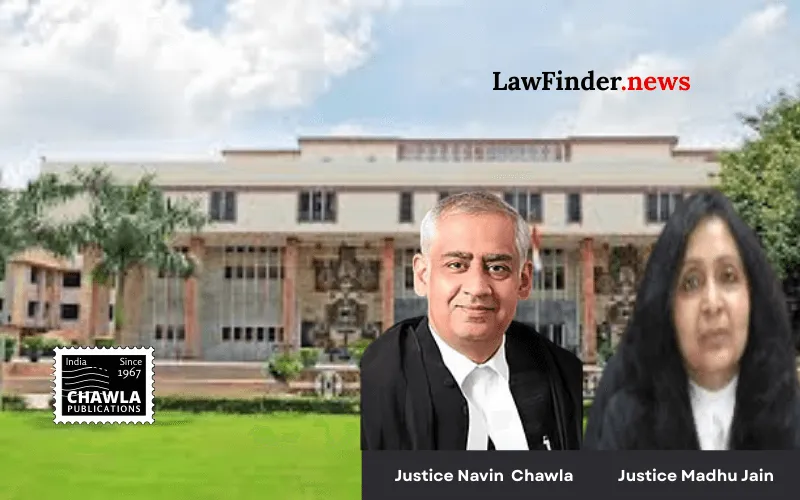
In a significant judgment delivered on September 1, 2026, the Division Bench of the Delhi High Court, comprising Justices Navin Chawla and Madhu Jain, allowed an appeal filed by Otsuka Chemical (India) Pvt. Ltd. against the order of the Single Judge that had set aside an arbitral award passed by a Sole Arbitrator in a commercial dispute with Trans Engineers India Pvt. Ltd.
The dispute arose out of a turnkey contract relating to the expansion of Otsuka Chemical’s manufacturing plant, specifically the 'Lion Project' for the manufacture of a chemical compound "GCLE." Trans Engineers was engaged for consultancy and construction stages involving supply, erection, and commissioning of various equipment, piping, instrumentation, and electrical materials based on Piping and Instrumentation Diagrams (P&IDs).
The core issue concerned whether additional work performed by Trans Engineers beyond the P&IDs dated 26.07.2016 entitled them to extra payment over the lump sum contract price of Rs. 71 crores. Trans Engineers claimed entitlement for additional work executed due to revisions in P&IDs and issued 26 proforma invoices amounting to over Rs. 28 crores.
The learned Sole Arbitrator, after detailed examination of the contractual documents, offers, purchase orders, and witness testimonies, dismissed the claims of Trans Engineers and the counter-claims of Otsuka Chemical, passing a "NIL" award. The Arbitrator held that the P&IDs of 26.07.2016 were base drawings subject to revisions, but the respondent failed to prove the additional work was major or that proper procedures for claiming extra payment had been followed. The Arbitrator noted the absence of written instructions, variation orders, and mutually agreed prices for the alleged extra work, and drew an adverse inference from the non-production of 'as-built' drawings or contemporaneous invoices. The Arbitrator also found most of the claimed "extra" equipment was either reflected in the original P&IDs or the offer documents.
The respondent challenged the award under Section 34 of the Arbitration and Conciliation Act, 1996 before the Single Judge, who set aside the arbitral award, holding that the P&IDs dated 26.07.2016 formed the contractual baseline and any additional work was payable. The Single Judge criticized the Arbitrator for misreading the contract and for relying on P&IDs dated 20.08.2016 which were not on record, and drew adverse inferences against the appellant based on settlement offers and the appellant's conduct.
Aggrieved by this order, the appellant filed the present appeal before the Division Bench.
The Delhi High Court allowed the appeal, holding that the Single Judge exceeded the limited scope of judicial interference under Section 34. The Court emphasized the settled legal position that the arbitral tribunal is the final authority on contractual interpretation and fact-finding, and courts can interfere only if the award is perverse, patently illegal, or contrary to the fundamental policy of Indian law.
The Court noted that the learned Sole Arbitrator had taken a plausible and possible view of the contract by considering the offer dated 30.08.2016, P&IDs dated 20.08.2016, purchase orders, minutes of meeting, and conduct of the parties. The Arbitrator’s conclusion that the respondent had failed to prove major additional work and complied with contractual procedures for claiming extra payment was not perverse or unsupported by evidence.
Further, the Court observed that the Single Judge had re-appreciated evidence and acted as a court of appeal, thereby exceeding jurisdiction under Section 34. The Court rejected the reliance on belated claims, settlement offers, or the absence of dispute before arbitration invocation as sufficient grounds to set aside the award.
The Division Bench reiterated that under Explanation 1 and 2 to Section 34(2)(b)(ii), an award can be set aside only if it violates fundamental policy of Indian law or shocks the conscience of the court, and under Section 34(2A), patent illegality must go to the root of the matter and not be a mere erroneous application of law or reappreciation of evidence.
Citing recent Supreme Court precedents including OPG Power Generation Pvt. Ltd. v. Enexio Power Cooling Solutions India Pvt. Ltd. (2024), Reliance Infrastructure Ltd. v. State of Goa (2024), and Jan De Nul Dredging India Pvt. Ltd. v. Tuticorin Port Trust (2026), the Court emphasized the circumscribed judicial role in arbitral award challenges.
In conclusion, the Court held that the Single Judge’s order setting aside the arbitral award was unsustainable and set it aside, restoring the "NIL" award passed by the Sole Arbitrator. Both parties were directed to bear their own costs.
This judgment underscores the judiciary’s firm stance on respecting the finality of arbitral awards and the limited grounds for judicial interference under the Arbitration and Conciliation Act, 1996, thereby reinforcing arbitration as an effective dispute resolution mechanism in India.
Bottom Line:
Arbitration and Conciliation Act, 1996 - Limited scope of judicial intervention under Sections 34 and 37 - Court cannot reappreciate evidence or substitute its view unless the award is perverse, patently illegal, or contrary to the fundamental policy of Indian law.
Statutory provision(s):
Arbitration and Conciliation Act, 1996 - Sections 34, 34(2)(b)(ii), 34(2A), 37