Appellant Ajay Kumar Tomar convicted under Sections 302/397 IPC for killing Amarjeet Singh Chadha and Harender Singh @ Sunny; Life imprisonment sentence maintained citing absence of "rarest of rare" circumstances
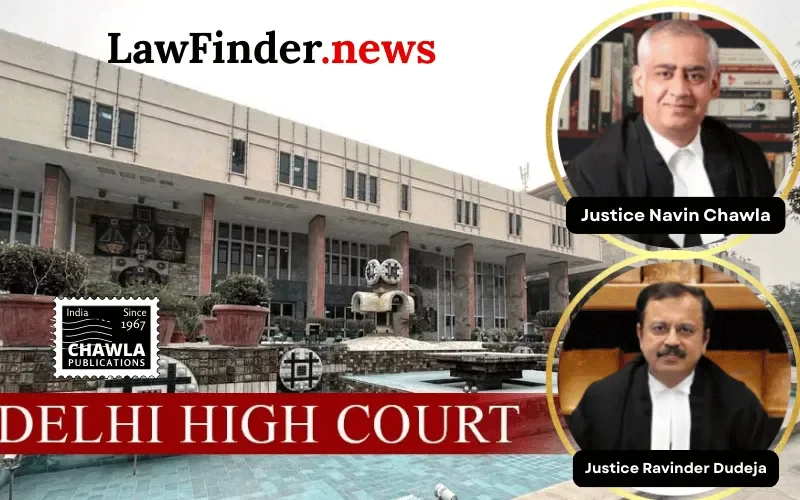
In a landmark judgment delivered on November 17, 2026, the Delhi High Court (Division Bench comprising Justices Navin Chawla and Ravinder Dudeja) upheld the conviction of Ajay Kumar Tomar, a police officer impersonating as such, for the brutal double murder of Amarjeet Singh Chadha and Harender Singh @ Sunny, along with robbery. The appellant was sentenced to life imprisonment by the Trial Court, and this sentence was confirmed by the High Court, rejecting calls for the death penalty from the State and the victim's family.
Background:
On the night of September 24, 2011, Amarjeet Singh Chadha was shot multiple times by Ajay Kumar Tomar, who had stopped Amarjeet's Alto car near Railway Hospital in Delhi, impersonating a police officer. Following the shooting and robbery of Amarjeet's gold chains and lockets, the appellant fled the scene. During a police chase, the appellant fired at Harender Singh @ Sunny, fatally injuring him. Both victims succumbed to their injuries.
Evidence and Trial:
The prosecution's case was supported by a combination of direct eyewitness accounts, medical and ballistic reports, fingerprint evidence, and recovery of stolen items and firearms from the appellant. Key eyewitnesses included PW-1 Mohit, who was present during the shooting of Amarjeet Singh, and PW-22 Vikas, who witnessed the shooting of Sunny.
The medical evidence showed three close-range gunshot wounds on Amarjeet Singh, each sufficient to cause death, and a fatal gunshot wound to Sunny's neck. Ballistic analysis linked the recovered firearms and cartridges to the appellant. Fingerprint experts also matched chance prints from the victim's vehicle to the appellant's fingerprints.
The appellant's attempts to challenge the credibility of witnesses, question the timing of FIR registration, and the validity of recoveries were dismissed by the Court as either peripheral discrepancies or investigative lapses that did not undermine the core evidence establishing his guilt.
Sentencing and Legal Reasoning:
While acknowledging the heinous nature of the crime and the breach of public trust by the appellant, the Court noted the absence of exceptional brutality or depravity that would place the case in the "rarest of rare" category warranting the death penalty. The judgment reiterated the settled legal principle from Supreme Court precedents such as Bachan Singh v. State of Punjab and Machhi Singh v. State of Punjab that life imprisonment is the rule and death penalty an exception, to be imposed only when there is no possibility of reformation.
The Court found that despite the gravity of the offenses, the appellant's case did not cross the exceptionally high threshold for capital punishment. The possibility of reformation and rehabilitation was not ruled out. Therefore, the sentence of life imprisonment with fines as imposed by the Trial Court was upheld.
Conclusion:
The Delhi High Court dismissed the appeals filed by the appellant against conviction and sentence and also rejected the State's and victim's appeals seeking enhancement of punishment. The comprehensive judgment highlights the Court's careful balancing of aggravating and mitigating circumstances in capital cases, underscoring that the death penalty must be reserved for the rarest of rare cases.
This judgment serves as a stern reminder that abuse of public office, especially by law enforcement officials, will attract stringent legal consequences, but also reflects the judiciary's cautious approach in awarding the ultimate punishment.
Bottom Line:
Conviction under Sections 302/397 IPC for double murder and robbery upheld. Death penalty not imposed as case does not fall under "rarest of rare" category.
Statutory provision(s):
Sections 302, 397, 394, 392, 170, 171, 468, 25, 27, 59 Arms Act, 419, 420, 468, 471 Indian Penal Code, 1860; Sections 25, 27, 54, 59 Arms Act, 1959; Section 313 Cr.P.C.
Harvinder Singh @ Vimpy Chaddha v. State of NCT of Delhi, (Delhi)(DB) : Law Finder Doc Id # 3129753