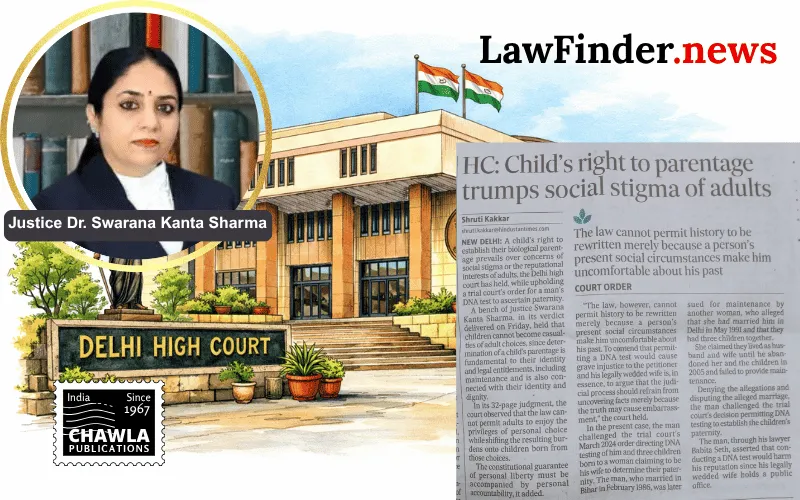
Court Prioritizes Children's Right to Know Parentage Over Adult Reputational Concerns in Landmark Maintenance Case
In a significant ruling, the Delhi High Court has upheld the Family Court's directive for a DNA test to ascertain the paternity of three children claiming Ravi Kumar as their father. The case delves into the intricate intersection of personal autonomy, legal responsibility, and the rights of children to know their biological origins, particularly when born from relationships outside traditional marriages.
The petitioner, Ravi Kumar, challenged the Family Court's decision, arguing that the order for DNA testing was premature and intended to tarnish his reputation and that of his legally wedded wife, Kumkum Devi. Kumar claimed that he was never married to the respondent, Geeta Devi, and denied paternity of the children. Despite these assertions, the court found substantial prima facie evidence, including photographs and public documents, suggesting a relationship between Kumar and Geeta Devi, justifying the need for a DNA test.
Justice Dr. Swarana Kanta Sharma emphasized that children's rights to identity and dignity outweigh the reputational concerns of adults. The judgment highlighted that children have the right to know their parentage, even if born outside a legally valid marriage, asserting that the law prioritizes the rights of children over adults' desire to avoid embarrassment.
The court meticulously examined the evidence, including testimonies and documents indicating Kumar's association with the children and Geeta Devi. It was noted that the DNA test application was initiated by the children themselves, seeking clarity on their biological parentage, a factor that the court deemed crucial.
In reinforcing the decision, the court referenced legal precedents, underscoring that while DNA tests cannot be ordered routinely, they are justified in cases where paternity is directly in issue, and other evidence is insufficient. The ruling reflects a judicial balancing act, weighing privacy against the legitimate rights of children in maintenance disputes.
The judgment is set against the backdrop of evolving legal recognition of adult relationships outside traditional marriages, asserting that while personal choices are respected, they come with accountability, especially when they impact children's rights.
The court's decision to uphold the DNA test order is seen as a pivotal moment in family law, potentially guiding future cases where children's rights to know their origins intersect with adult reputational concerns.
Bottom Line:
DNA test can be directed to ascertain paternity in maintenance cases under Section 125 Cr.P.C., especially when a prima facie case is established, and the issue of paternity lies at the heart of the controversy.
Statutory provision(s): Section 125 of the Code of Criminal Procedure, 1973, Section 45 of the Indian Evidence Act, 1872, Section 112 of the Indian Evidence Act.
Ravi Kumar v. Geeta Devi, (Delhi) : Law Finder Doc id # 2934530