Court finds appellant's actions amounted to "own wrong," upholding the Family Court's refusal to grant divorce under Section 13(1A) of the Hindu Marriage Act.
In a significant ruling, the Delhi High Court dismissed the appeal filed by Yash Khanna seeking a divorce decree from his wife Bhawna. The court upheld the decision of the Family Court, which had denied the divorce on grounds that Khanna’s conduct constituted taking advantage of his own wrong, as outlined under Section 23(1)(a) of the Hindu Marriage Act, 1955.
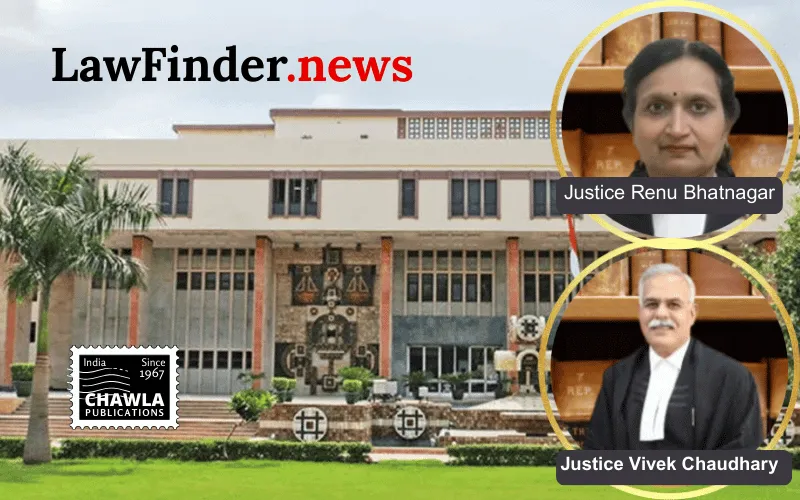
The division bench, comprising Justices Vivek Chaudhary and Renu Bhatnagar, examined the circumstances surrounding the marriage, which was solemnized in 2008 at Arya Samaj Mandir, Delhi. Despite a decree for restitution of conjugal rights in favor of Bhawna, the couple failed to resume cohabitation. Khanna subsequently filed for divorce under Section 13(1A) and Section 13(1)(ib) of the Hindu Marriage Act, which was dismissed by the Family Court, a decision now upheld by the High Court.
Central to the court's decision was Khanna's refusal to reconcile with his wife despite her demonstrated willingness to resume marital life. The court noted that Bhawna had made efforts to rejoin Khanna, including initiating execution proceedings for the decree of restitution of conjugal rights, which were thwarted by Khanna’s refusal to cooperate.
Khanna's argument that the marriage was void due to his being under the influence of a sedative during the ceremony was also rejected. The court pointed out that the issue of marriage validity had been settled against Khanna in prior proceedings, and his actions did not meet the criteria for a void marriage under the Hindu Marriage Act.
The judgment emphasized the necessity of statutory compliance with Section 23(1)(a), which prohibits granting relief if the petitioner is found to be taking advantage of their own wrongdoing. The court found Khanna's actions, including his denial of marriage validity and refusal to reconcile, constituted such wrongdoing, precluding him from obtaining a divorce decree.
The court also addressed Khanna's claim that paying maintenance of Rs. 10,000 per month absolved him of wrongdoing, stating that maintenance is a statutory obligation and does not influence the grounds for divorce.
In rejecting the appeal, the court reiterated that irretrievable breakdown of marriage is not a recognized ground for divorce under the Hindu Marriage Act, underscoring the importance of legal compliance over personal sentiments.
This ruling reaffirms the court's commitment to ensuring that divorce decrees are not granted to those exploiting their own misconduct, setting a precedent for similar cases.
Bottom Line :
Hindu Marriage Act, 1955 - A decree for divorce under Section 13(1A) cannot be granted if the petitioner is found to be taking advantage of his or her own wrong under Section 23(1)(a).
Statutory provision(s): Section 13(1A), Section 13(1)(ib), Section 23(1)(a) of the Hindu Marriage Act, 1955
Yash Khanna v. Bhawna, (Delhi)(DB) : Law Finder Doc id # 2962503