Court rejects challenge to Section 93 of CGST Act, says penalty proceedings can begin after taxpayer’s death; leaves factual disputes to appeal and seeks full account of Rs. 15.40 lakh retained by department.
The Delhi High Court has held that the Central Goods and Services Tax Act, 2017 permits tax, interest, or penalty proceedings to be initiated and determined even after the death of the person concerned, provided the statutory conditions under Section 93 are satisfied.
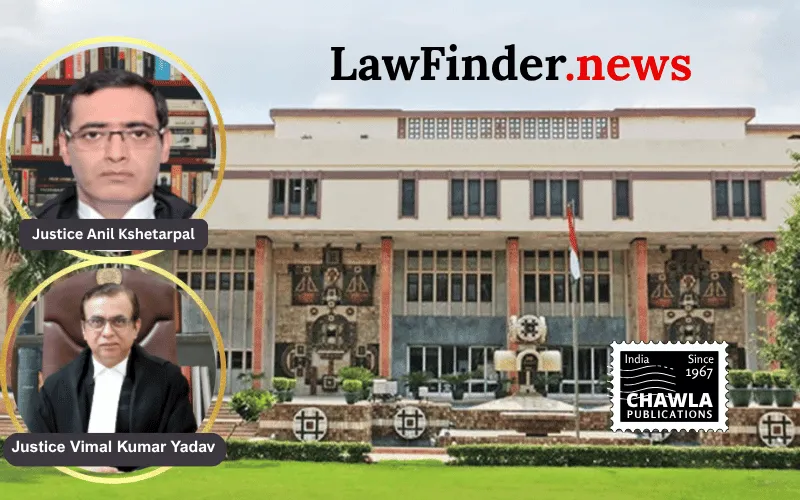
A division bench of Justices Anil Kshetarpal and Vimal Kumar Yadav delivered the ruling while hearing a writ petition filed by Jaiwanti, widow of late Ankit Dabas, who challenged a show cause notice and an order-in-original issued against her as the legal representative of her deceased husband. The notice, issued more than three years after his death, proposed penalties for alleged GST violations linked to fraudulent input tax credit and refund claims.
The petitioner argued that Section 93 only allows completion of proceedings already initiated during the lifetime of the deceased, and that fresh proceedings after death were impermissible. She also challenged the constitutional validity of Section 93(1)(b), contending that a legal heir cannot effectively defend allegations based on the personal knowledge of the deceased.
Rejecting this interpretation, the Court held that the text of Section 93 expressly covers cases where tax, interest, or penalty “is determined after his death.” The judges said the provision does not require that a show cause notice must have been issued during the deceased’s lifetime. The Court clarified that Section 93 is not itself a penal provision, but a mechanism that enables enforcement of liabilities arising from the deceased’s conduct through the legal representative, subject to the limits laid down in the statute.
The Court also upheld the constitutional validity of Section 93(1)(b), observing that the provision has a rational connection with the object of preserving liabilities arising from a deceased person’s conduct and allowing recovery from the estate where the business has been discontinued. It noted that the legal representative is not deemed to have committed the alleged wrong, and the statute still requires the department to prove the contravention and satisfy the conditions for representative liability.
At the same time, the Court made it clear that it was not deciding several factual issues raised by the petitioner, including whether the notice was properly served, whether the alleged contravention was proved, whether the conditions of Section 93(1)(b) were satisfied, and whether the penalty was correctly computed. Those issues, the Court said, should be examined in a statutory appeal under Section 107 of the CGST Act. The petitioner was granted liberty to file such an appeal within four weeks, and the appellate authority was directed to entertain it on merits without rejecting it as time-barred.
The Court also noted an inconsistency in the operative part of the impugned order, where one clause imposed a penalty of Rs. 1,50,000 on the petitioner while another clause stated that no penalty was being imposed. However, the Court left this issue open for the appellate forum.
Separately, the Court dealt with Rs. 15,40,000 in cash allegedly found during a search at the residence of late Ankit Dabas and later kept in fixed deposit by the department. The petitioner disputed the legality of its retention. The Court directed the respondents to furnish a complete account of the amount, including the present status of the money, fixed deposit details, interest earned, and any withdrawal or appropriation made. The department must also specify the exact statutory basis for retaining or appropriating the amount. If no lawful basis is shown, the amount must be released to the petitioner as legal representative, along with the interest actually earned.
The judgment is significant for clarifying that GST liability can, in appropriate cases, be pursued against a legal heir after the taxpayer’s death, but only within the framework of Section 93 and subject to procedural safeguards. At the same time, the Court emphasized that factual disputes and the merits of the penalty order remain open for appeal.
Bottom Line :
CGST Act, 2017 - Section 93 permits initiation and determination of tax, interest or penalty proceedings against legal representative even after death of person liable, subject to statutory conditions - Section 93(1)(b) held constitutionally valid - Questions relating to service of notice, satisfaction of conditions under Section 93(1)(b), merits of penalty and contradictory operative part of order left open for statutory appeal - Department directed to disclose full account and legal basis for retention/appropriation of Rs.15,40,000/-.
Statutory provision(s): Section 93(1)(b), Section 122(3)(a), Section 126(3), Section 107, Section 169, Section 20 of the IGST Act, 2017, Article 14, Article 226 of the Constitution of India
Jaiwanti v. Union of India, (Delhi)(DB) : Law Finder Doc id # 2985908