Court clarifies that unregistered agreement to sell does not confer proprietary rights; paying guest arrangement held to be a license, not tenancy, exempt from Delhi Rent Control Act
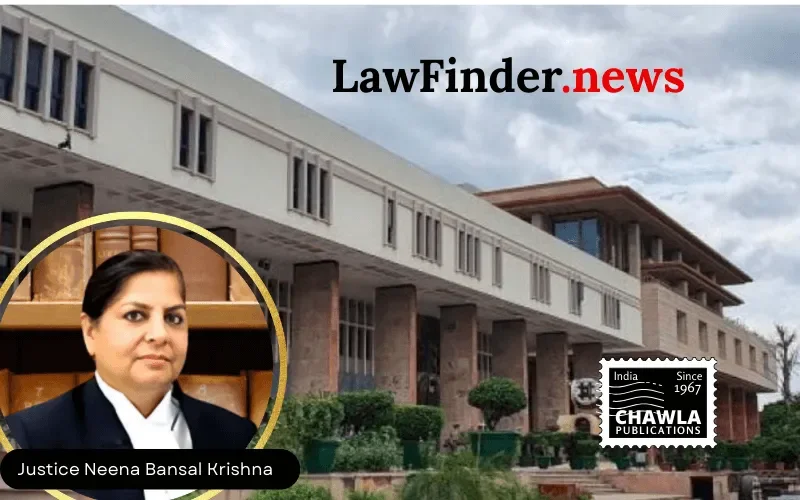
In a significant judgment dated November 20, 2026, the Delhi High Court, presided over by Justice Neena Bansal Krishna, dismissed the Regular Second Appeal filed by Payal challenging a decree for possession in favor of Pooja Gupta, the owner of a Paying Guest (PG) accommodation in Shakarpur, Delhi. The judgment clarifies key legal principles regarding possession suits under Order 12, Rule 6 of the Civil Procedure Code (CPC), the nature of paying guest arrangements, and the status of unregistered agreements to sell immovable property.
The case arose from a civil suit filed by Pooja Gupta seeking possession, recovery of arrears of rent, damages, and mandatory injunction in respect of Room No. 406 in her PG accommodation. Payal, the appellant, had been residing there as a licensee. The dispute centered around the proprietary rights of the parties and whether Payal’s occupation was protected under tenancy laws.
The trial court had decreed possession under Order 12, Rule 6 CPC based on admissions made by Payal both in the instant proceedings and in her earlier suit, where she had acknowledged the ownership of Pooja Gupta and her husband over the PG property. The court emphasized that such admissions, even if made outside the pleadings, are admissible for passing a decree under Order 12, Rule 6 CPC provided they are clear, categorical, and unequivocal.
Payal contended that she had an oral rental arrangement with the caretaker of the PG and had paid Rs. 2,00,000 to Pooja Gupta under an unregistered agreement to purchase the rooms. However, the Court reiterated settled law that an unregistered agreement to sell does not confer ownership or proprietary interest in immovable property as per Section 54 of the Transfer of Property Act, 1882. Therefore, possession under such an agreement cannot be protected under Section 53A of the Act.
The Court also distinguished the nature of the arrangement between the parties as a license rather than a tenancy. Citing Supreme Court precedents, it held that a paying guest accommodation, where rooms or beds are allotted on a sharing basis and the owner retains control, is a license. As such, the Delhi Rent Control Act, 1958, which protects tenants, does not apply. The licensee is obligated to vacate upon termination of the license, and filing of the suit itself constitutes notice of termination.
Further, the Court addressed procedural objections, including the dismissal of an application under Order 7, Rule 11 CPC and the condonation of delay in filing the appeal. It clarified that the existence of triable issues at an earlier stage does not preclude passing a decree on admissions under Order 12, Rule 6 CPC after considering all pleadings and admissions. It also set aside the lower court’s refusal to condone delay, emphasizing that substantive rights should not be defeated on technical grounds.
The judgment underlines the legal principle that admissions made outside the pleadings, including in earlier suits, can be relied upon for passing a decree under Order 12, Rule 6 CPC if they are unequivocal. It also confirms that a licensee cannot claim proprietary rights based on unregistered agreements or mere possession and must vacate once the license is terminated.
This ruling provides clarity on the legal nature of paying guest accommodations and reinforces the procedural safeguards regarding decrees based on admissions, balancing the interests of property owners and occupants.
Bottom Line:
Possession of property - Decree under Order 12, Rule 6 CPC can be passed based on clear, categorical, and unequivocal admissions made by the defendant in pleadings or other proceedings, even outside the pleadings.
Statutory provision(s):
Order 12 Rule 6 CPC, Order 7 Rule 11 CPC, Section 54 Transfer of Property Act, 1882, Section 53A Transfer of Property Act, 1882, Delhi Rent Control Act, 1958, Section 100 CPC, Section 5 Limitation Act, 1963, Section 122 Bharatiya Sakshya Adhiniyam, 2023 (erstwhile Section 116 Indian Evidence Act, 1872)