Court emphasizes Supreme Court directives and judicial discipline; directs Railways to comply with orders and pay costs for delay in regularization
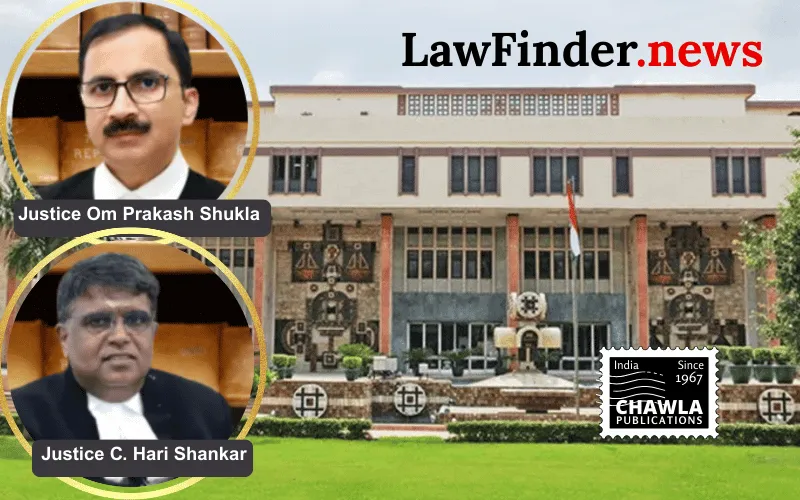
In a significant judgment dated 8th September 2026, the Delhi High Court (Division Bench comprising Justices C. Hari Shankar and Om Prakash Shukla) dismissed writ petitions filed by the Union of India challenging the Central Administrative Tribunal's order that directed the regularization of commission vendors and bearers working in Indian Railways. The case underscores the persistent judicial insistence on protecting the rights of low-paid workers and enforcing compliance with Supreme Court mandates.
Background:
The commission vendors and bearers, employed on a commission basis by the Railways, have long sought regularization of their services. This demand dates back to a Railway Board Circular issued on 13th December 1976 that recommended progressive absorption of such workers into permanent cadres. Despite repeated Supreme Court orders dating from 1987 onwards-including landmark directions in the cases of Mahesh v. Union of India (1987) and South Eastern Railway Congress v. Railway Board (1997)-the Railways failed to regularize these workers adequately.
The dispute came before the Central Administrative Tribunal (CAT) in Original Applications (OA) 4140/2013 and 173/2014, where the Tribunal ordered regularization of the petitioners within 90 days and directed payment of minimum pay scales and allowances retrospectively from November 2000. The Tribunal also imposed a cost of ₹1 lakh on the Railways for protracted non-compliance.
Legal Contentions and Court's Analysis:
The Railways contended that only those commission vendors who were found eligible in the screening process were regularized, and the respondents who were unsuccessful or not screened could not claim regularization. The respondents, on the other hand, argued that their entitlement to regularization was settled by binding Supreme Court precedents and could not be denied by the Railways.
The Delhi High Court meticulously analyzed the sequence of Supreme Court rulings and the Railway Board's own circulars. The Court referenced pivotal judgments such as Jaggo v. Union of India (2024), Shripal v. Nagar Nigam (2025), Vinod Kumar v. Union of India (2024), and Dharam Singh v. State of UP (2025), which reaffirm the principle that employees engaged through a process mirroring regular recruitment, performing essential duties continuously, acquire a substantive right to regularization. The Court also noted the binding nature of Supreme Court judgments under Articles 141 and 144 of the Constitution.
Rejecting the Railways' attempt to contest entitlement based on screening outcomes, the Court held that the respondents were entitled to regularization as per the Railway Board Circular of 1976 and subsequent Supreme Court directions. The Court expressed deep regret that despite decades of litigation and judicial directives, the Railways had failed to comply adequately, causing undue hardship to these low-paid workers.
Outcome and Directions:
The High Court upheld the Tribunal's order in its entirety, including the direction to regularize the services of the applicants within four weeks and pay the costs imposed. The Court warned that failure to comply with the orders would result in revival of contempt proceedings against the Railways.
Significance:
This judgment reaffirms the judiciary's commitment to uphold the rights of contractual and commission-based workers against administrative apathy. It underscores the principle that long-term continuous service under a recruitment process akin to regular employment confers a substantive right to regularization. The decision also emphasizes judicial discipline and the constitutional obligation of subordinate authorities to comply with Supreme Court directions without delay.
Bottom Line:
Regularization of commission vendors/bearers in Railways - Failure to comply with repeated judicial orders including Supreme Court directives for regularization - Tribunal's decision upheld.
Statutory provision(s):
Article 141 Constitution of India, Article 144 Constitution of India, Railway Board Circular dated 13.12.1976, Railway Board Circular dated 01.12.2005
Union of India v. Mithai Lal, (Delhi)(DB) : Law Finder Doc Id # 2974429