New Delhi, Sep 17 The Supreme Court on Thursday agreed to hear on September 21 a plea against deletion of names from the electoral rolls under the Special Intensive Revision (SIR) exercise in Delhi.
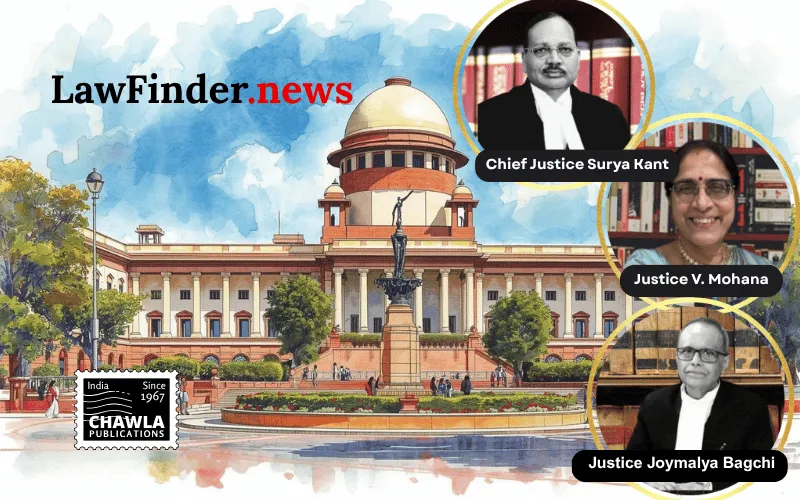
A bench of Chief Justice of India (CJI) Surya Kant and Justices Joymalya Bagchi and V Mohana said it will hear the matter on Monday as other matters related to the SIR are also listed next week.
Advocate Prashant Bhushan, appearing in the court for petitioners Anjali Bhardwaj and Amrita Johri, submitted that the Election Commission (EC) has issued notices to 33 lakh of the 47 lakh people whose names have been deleted from the electoral rolls during the SIR exercise in the national capital.
The petitioners have also sought a disclosure of the criteria, definitions, algorithmic parameters and operational guidelines governing the classification of voters under the "Logical Discrepancies" category.
"What they have done is that they have not disclosed the names of the people who have been issued notices or on what grounds they have been deleted. They have not disclosed which people the notices have been issued to, what are the logical discrepancies and how are they unmapped," Bhushan submitted.
The plea filed under Article 32 of the Constitution has alleged violations of the fundamental rights guaranteed under Articles 14, 19 and 21, besides the constitutional rights under Articles 325 and 326.
The petitioners have sought directions for the publication of a consolidated, searchable list of all the voters against whom notices have been issued during the SIR process in Delhi, along with their addresses and the specific reasons or categories for each notice.
The plea further seeks directions requiring authorities to specify the precise discrepancy and material facts forming the basis of each notice, so that the voters can effectively participate in the hearing process.
It has also sought to restrain the deletion of names from the electoral rolls following proceedings based on vague notices that do not disclose the relevant factual particulars.
The petition states that 33,12,919 voters were identified for the issuance of notices on the grounds of "No Mapping" or "Logical Discrepancies". Of them, 13,79,785 were identified as having no mapping, while 19,33,134 were classified under logical discrepancies.
Bhushan alleged that the Delhi chief electoral officer's (CEO) website has only disclosed the number of electors in these categories and has not provided the names or other details of the affected voters.
The petitioners have contended that the failure to publish the names of the voters against whom the notices have been issued is contrary to the EC's communication dated May 14.
The plea has also contended that the term "Logical Discrepancies" has not been defined and that the EC's May 14 communication does not prescribe specific criteria or parameters for determining when a voter would fall within that category.
The plea has submitted that the original SIR order dated June 24, 2025, also did not mention such a flagging or algorithmic process.
The petitioners have alleged that no document or instruction specifying the definition and criteria has been placed on the Delhi CEO's website.
On August 31, the EC published a draft electoral rolls under which 47 lakh voters were deleted from the list of 1.45 crore total voters.
Around one in three voters in Delhi was removed from the draft electoral rolls published as part of the Special Intensive Revision of the voter list.
The poll panel had said more than 43.32 lakh voters were found to have shifted or were absent during the SIR, over 2.82 lakh voters were found to have died, while more than 1.41 lakh were enrolled at multiple places.