Supreme Court Orders CBI Probe into Custodial Death, Awards Rs. 25 Lakh Interim Compensation, SC Directs Investigation into Custodial Death of Shravan Suryavanshi, Ensures Accountability and Justice
In a landmark judgment, the Supreme Court of India has directed the Central Bureau of Investigation (CBI) to investigate the custodial death of Shravan Suryavanshi, emphasizing the need for accountability among state officials. The apex court has also awarded an interim compensation of Rs. 25 lakh to the legal heirs of the deceased, ensuring that justice is served and deterrence is established against custodial violence.
The case arose from an appeal by Lahra Bai Tamre, the widow of Shravan Suryavanshi, and their children, challenging a decision by the Chhattisgarh High Court. The High Court had previously awarded a meager compensation of Rs. 1 lakh without ordering an investigation into the circumstances of Suryavanshi's death while in custody.
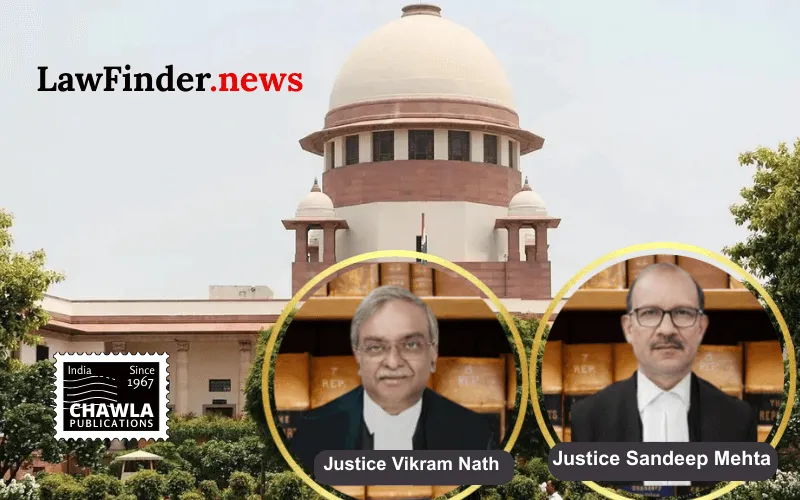
The Supreme Court, presided over by Justices Vikram Nath and Sandeep Mehta, noted that Suryavanshi had suffered violence during his detention, leading to his untimely demise. The post-mortem report revealed multiple injuries, including a significant head injury, which were allegedly inflicted during his custody. Despite a judicial inquiry confirming these findings, no FIR was registered, nor was any investigation initiated by the state authorities.
Criticizing the inaction and indifference of state officials, the Supreme Court underscored the necessity of a thorough investigation to uphold justice and prevent recurrence of such incidents. The court directed the CBI to file an FIR and conduct an expeditious inquiry into the custodial death, ensuring that those responsible are prosecuted.
The court also expressed dissatisfaction with the inadequate compensation awarded by the High Court, highlighting the need for compensation to have a deterrent effect. It ordered the state of Chhattisgarh to pay Rs. 25 lakh as interim relief to the petitioners, acknowledging the gravity of their loss and the deceased's role as the family's sole breadwinner.
This judgment reaffirms the judiciary's commitment to safeguarding fundamental rights and holding state machinery accountable for violations. The Supreme Court's directive for a CBI probe underscores the seriousness of custodial deaths and the imperative for transparent investigations to ensure justice and uphold the rule of law.
Statutory provision(s): Article 21 of the Constitution of India, 1950; Article 226 of the Constitution of India, 1950; Section 176 of the Criminal Procedure Code, 1973 Lahra Bai Tamre v. State of Chhattisgarh, (SC) : Law Finder Doc id # 2960155
Sub Headline: Insufficient Evidence and Delay in FIR Lead to Reversal of Conviction for Accused in 2006 Gujarat Drowning Incident
In a significant ruling, the Supreme Court of India has acquitted Taher Vajiyuddin Rangwala and another accused of murder charges related to the 2006 drowning incident in Gujarat. The court found the evidence insufficient to support the prosecution's claim of homicidal death, accepting the defense's argument of accidental drowning.
The case involved the alleged murder of a friend who drowned in a river, with the prosecution relying heavily on circumstantial evidence, including the motive, the theory of last seen together, and the conduct of the accused. However, the Supreme Court, in its judgment delivered by Justices J.B. Pardiwala and K. Vinod Chandran, emphasized the lack of corroborative evidence and the significant delay in registering the First Information Report (FIR), which occurred nearly four months post-incident.
The prosecution alleged that the deceased was taken to the river under the guise of a volleyball game, where he was murdered. However, the post-mortem report and medical testimony suggested death due to asphyxia caused by accidental drowning. The court highlighted that the injuries on the deceased's body could have resulted from jumping into the river or being dragged by the water current, rather than any violent act by the accused.
Furthermore, the court noted the prosecution's failure to establish a clear motive, as the alleged motive of a relationship and prior quarrel was not substantiated. The Supreme Court underscored that motive alone cannot be the basis for conviction without direct or corroborative evidence.
The court also observed procedural lapses, such as the delay in FIR registration, which weakened the prosecution's case. The alleged murder was not reported immediately, and suspicions against the accused arose only after several months.
The Supreme Court criticized the reliance on the accused's conduct, such as their failure to inform the family of the deceased and their subsequent actions post-incident, as insufficient to establish guilt. The court stated that human behavior in panic situations is unpredictable and not necessarily indicative of criminal intent.
Ultimately, the Supreme Court found the defense's account of accidental drowning more plausible than the prosecution's theory of murder. The court reversed the convictions imposed by the Trial Court and confirmed by the High Court, ordering the immediate release of the accused if they were still in custody.
This judgment underscores the importance of a thorough and timely investigation and the need for conclusive evidence in criminal cases, especially when the charge is as serious as murder.
Bottom Line:
Conviction under Sections 302, 34, 201 read with Section 120B of IPC reversed - Evidence insufficient to prove homicidal death - Defense of accidental drowning found more plausible than murder - Delay in FIR registration and lack of corroborative evidence undermined prosecution's case.
Statutory provision(s): Indian Penal Code, 1860 Sections 302, 34, 201, 120B; Criminal Procedure Code, 1973
Taher Vajiyuddin Rangwala v. State of Gujarat, (SC) : Law Finder Doc id # 2961048