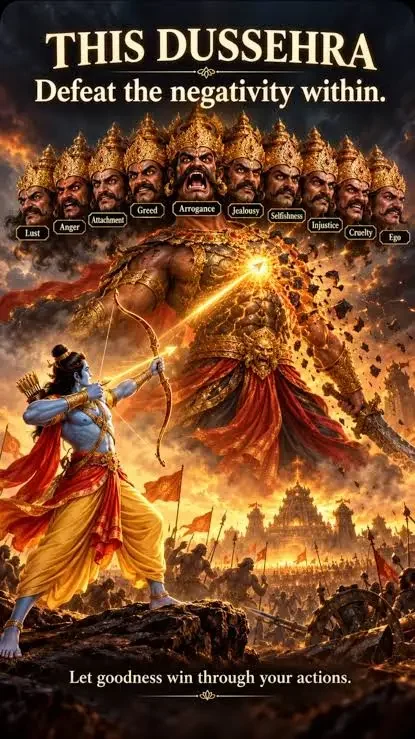
Every year, as Dussehra approaches, towering effigies of Ravana are erected and set ablaze amid cheers, fireworks and celebrations. The ritual symbolises the victory of good over evil, of righteousness over arrogance, and of Lord Rama’s ideals over the unrighteous conduct of Ravana. Yet, amidst these celebrations, an important question deserves our attention: Are we remembering Ravana merely as a villain, or are we understanding the profound lessons his life has to offer?
In my considered view, Dussehra should not be understood merely as the burning of Ravana’s effigy. It should be celebrated as the burning of Ravana’s arrogance, ego and misuse of power.
Ravana: A Personality of Extraordinary Intellect
Indian tradition presents Ravana as a complex personality. He was not merely asking who opposed Lord Rama; he was also regarded as a formidable scholar, a devotee of Lord Shiva, a gifted musician and a ruler of immense capability.
The Shiva Tandava Stotram, traditionally attributed to Ravana, stands as a celebrated hymn in praise of Lord Shiva. Its powerful rhythm, poetic brilliance and devotional intensity continue to inspire devotees across generations. The very composition associated with Ravana reminds us that even a character condemned for his actions can be remembered for his intellectual and artistic accomplishments.
Ravana is also traditionally associated with scholarship in astrology and other branches of learning. The text commonly known as Ravana Samhita is associated with his name and is regarded in traditional astrological literature as an important work. These associations contribute to the image of Ravana as a personality whose intellectual achievements cannot simply be dismissed.
His ten heads, too, invite a deeper interpretation. Although they are part of the traditional depiction of Ravana, they can also be understood symbolically as representing exceptional knowledge, multiple dimensions of learning and mastery over diverse subjects. This is a symbolic interpretation rather than an established historical explanation, but it offers a meaningful way to reflect on the character.
The central lesson is striking: a person may possess immense knowledge and extraordinaryabilities,yetstillfallifwisdomisnotaccompaniedbyhumilityand self-restraint.
When Knowledge Becomes the Servant of Ego
Ravana’s tragedy, as conveyed through the Ramayana tradition, was not simply that he possessed power. It was that his power and learning failed to restrain his pride.
His abduction of Sita, his refusal to heed sound counsel and his determination to persist despite warnings ultimately brought about his downfall. His knowledge did not save him because he failed to allow wisdom to govern his conduct.
This is where Ravana’s story becomes relevant to every generation. In contemporary society, a person may be highly educated,professionallysuccessful,financiallypowerfulorpoliticallyinfluential.Yet,if such accomplishments produce arrogance, disregard for others and a belief that one is above moral principles, those very achievements can become the foundation of one's downfall.
Ravana, therefore, offers a lesson far greater than the destruction of a mythological villain. He reminds us that intelligence without character, power without responsibility and knowledge without humility can never guarantee greatness.
Ramleelas Must Preserve the Dignity of the Characters
Another aspect that deserves serious consideration is the manner in which Ravana is sometimes portrayed in public Ramleelas.
Incertainperformances,heispresentedasacrude,comicorindulgentfigure,surroundedbydepictions of drinking, frivolous entertainment or dancers presented merely to suggest moral depravity. Such portrayals may attract momentary amusement, but they risk reducing a complex character to a caricature.
A religious and cultural performance should do more than entertain. It should educate, inspire and preserve the moral depth of the epic it presents.
Ravana need not be glorified,nor should his grave wrong doing be diluted. His conduct towards Sita and his refusal to respect her autonomy must remain central to the moral judgment of his character. But condemning his actions does not require us to erase his scholarship, his devotion to Lord Shiva or the formidable personality described in traditional accounts.
Indeed, a dignified portrayal of Ravana would make the ultimate message of the Ramayana even more powerful. If Ravana is shown as intelligent, learned, capable and powerful, the audience can better understand the magnitude of his tragic failure.His defeat then becomes not merely the destruction of an evil-looking king, but the downfall of a gifted individual who allowed arrogance to overpower his better qualities.
Ramleela organisers should therefore consider portraying Ravana as a learned and commanding king rather than routinely relying on scenes of drinking, vulgarity or frivolous dancing to establish his character. His pride, his decisions, his refusal to listen to wise counsel and his moral transgressions provide more than sufficient material to explain his downfall.
The purpose of depicting Ravana should be to expose the danger of arrogance, not to turn his character into a subject of cheap ridicule.
What Should We Burn on Dussehra Today?
Perhaps the most meaningful way to celebrate Dussehra would be to identify the Ravana within ourselves.
Let us burn the arrogance that prevents us from accepting our mistakes. Let us burn the ego that stops usfromrespectingothers.Letusburnthegreedthatmakesusforgetourduties,theangerthatdestroys relationships, and the misuse of knowledge and authority that causes suffering.
Let us also teach our children that greatness is not measured merely by intelligence, wealth, status or professional achievement. True greatness lies in character, compassion, self-discipline and respect for the dignity of others.
The comparison between Rama and Ravana should not be reduced to a simplistic contest between a perfect-looking hero and a grotesque villain. Their traditional narrative invites reflection on the choices that distinguish righteousness from unrighteousness. Lord Rama represents the ideal of dharma, while Ravana'sdownfallwarnsusoftheconsequencesofallowingpersonaldesireandpridetooverridemoral responsibility.
The burning of Ravana's effigy will have deeper meaning when the message of the occasion continues long after the flames have died down.
Let Dussehra Become a Festival of Self-Reflection
Ravana's story carries a paradox worth remembering: the possession of knowledge does not necessarily make a person wise, and the possession of power does not necessarily make a person great.
His traditional association with scholarship and devotion,alongside the grave wrongs attributed to him in theRamayana,makeshischaracteracompellingreminderthathumanexcellencemustbegovernedby ethical conduct.
We should neither glorify Ravana's wrongdoing nor deny the intellectual and cultural traditions associated with his name. We should learn from both his accomplishments and his failures.
This Dussehra, as the effigies burn, let us ask ourselves whether we are also prepared to burn the arrogance within us. Let our Ramleelas communicate this deeper message to the next generation. Let our celebrations encourage knowledge with humility, strength with restraint and achievement with compassion.
Dussehra should not merely be the festival of burning Ravana. It should be the festival of burning Ravana's arrogance.
Fortheultimatevictoryisnotachievedwhenaneffigyturnstoashes;itisachievedwhenegogivesway to humility, pride gives way to wisdom, and power bows before dharma.