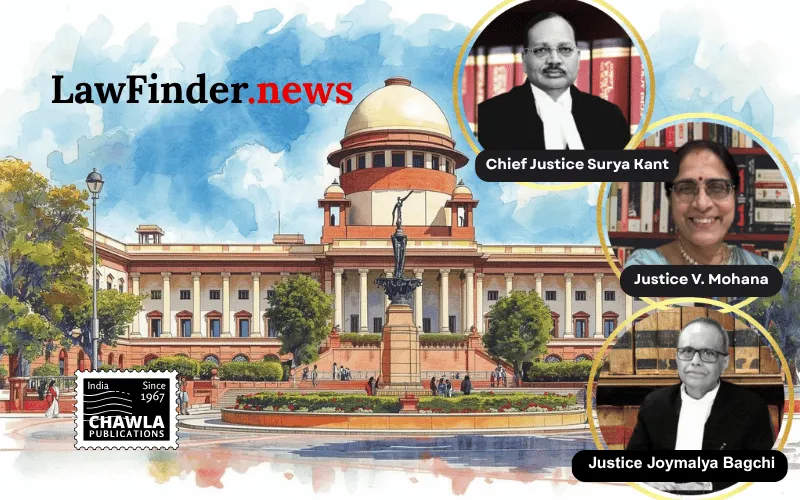
New Delhi, Aug 21 In a significant verdict, the Supreme Court has held that its 48-year-old expansive worker-friendly interpretation of the term "industry" under the now-repealed Industrial Disputes Act of 1947 will continue to govern thousands of pending cases involving hospitals, educational institutions and government departments.
A nine-judge Constitution bench headed by Chief Justice of India (CJI) Surya Kant has also held that its interpretation of the term "industry" will not apply to fresh cases under the Industrial Relations (IR) Code of 2020.
The court, in five separate judgments running into 489 pages, has refused to overrule the landmark 1978 Bangalore Water Supply verdict and narrow the definition of the term "industry".
The judgment, uploaded on the apex court's website on Friday, has ruled that the "Triple Test" formulated nearly 50 years ago remains the correct standard for defining an "industry" under the Industrial Disputes (ID) Act and ensures that pending cases will continue to be governed by the Act's protection.
The nine-judge bench has, however, differed on certain issues. It has, by a 6:3 majority verdict, held that the reference seeking a reconsideration of the 1978 judgment of a seven-judge bench on the definition of "industry" was validly made.
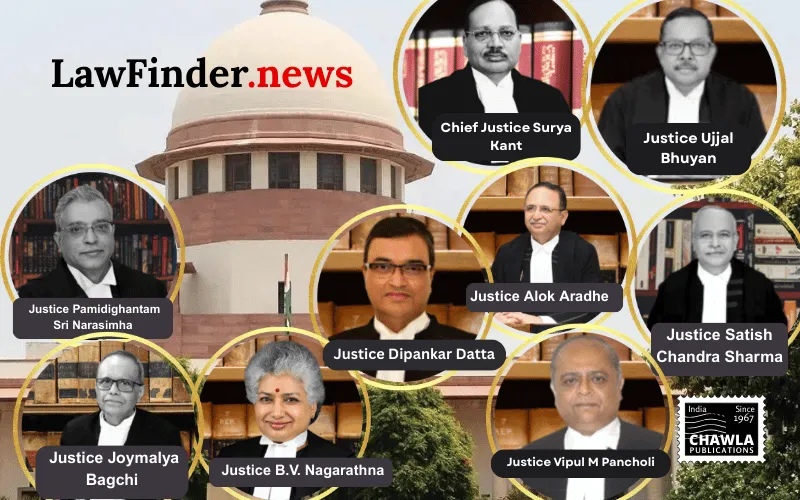
Pronouncing the verdict for himself and Justices Satish Chandra Sharma, Alok Aradhe and Vipul M Pancholi, the CJI, in his 154-page verdict, said, "The present reference has been validly made and rightly entertained. No legitimate doubt can be cast upon its maintainability and the reference is accordingly answered on the merits."
Justices P S Narasimha and Joymalya Bagchi concurred with his views on many issues, including the maintainability of the reference.
However, Justices B V Nagarathna, Dipankar Datta and Ujjal Bhuyan differed with the majority verdict on the maintainability of the reference.
"I am of the opinion that the reference to a nine-judge bench was not necessary in view of my reasoning. Secondly, the reference need not be answered at the present juncture. Even otherwise, on a deep analysis of the judgment of this court in Bangalore Water Supply, I find that it does not call for reconsideration," Justice Nagarathna said in her dissent note on the issue.
Justice Bagchi, in his separate verdict, however, agreed with the CJI and disagreed with Justice Nagarathna on the issue, stating, "The reference was validly made."
Justice Datta, who also wrote a separate verdict for himself and Justice Bhuyan, disagreed with the CJI and five other judges, while concurring with Justice Nagarathna on the reference.
"To be clear: the reference made by ... was not necessary and serves no practical, jurisprudential or doctrinal purpose. The reference seeks to disturb a quietus that has held the field for nearly half a century.
"We conclude by observing that while the reference requires no answer, it must be said plainly: Bangalore Water Supply does not require reconsideration. Finality in law would be undermined without any corresponding public interest being served. We must remember: institutional credibility lies in respecting finality, not in perpetuating doubt; and, absent compelling justification, none of which exists here, the chapter must be treated as closed," Justice Datta said.
All judges agreed on refraining from examining the definition of "industry" under the IR Code, 2020.
In the majority verdict, the CJI refined the judicial test for determining what constitutes an "industry" under section 2(j) of the ID Act, holding that the absence of a profit motive by itself cannot take an undertaking outside the scope of the legislation.
He said the decisive inquiry must focus on the nature of the activity and the existence of an employer-employee relationship.
The issues in the present litigation arose from a batch of appeals concerning whether the social forestry department of a state government, established as a welfare-oriented initiative for environmental purposes, could be regarded as an "industry" under the ID Act, the verdict said.
The majority verdict examined, among other issues, the correctness of the "Triple Test" laid down by the top court in the 1978 verdict to determine whether an undertaking falls within the statutory definition of "industry".
Under the reformulated test, an undertaking would prima facie qualify as an industry where there is a systematic activity, organised through cooperation between employer and employee, involving the production, distribution or provision of goods or services possessing a discernible commercial character analogous to trade or business and intended to satisfy material human wants and wishes.
The CJI said a profit motive or a gainful objective is not an essential requirement.
An undertaking would not cease to be an industry merely because it operates in the public sector, is charitable in character or motivated by philanthropic considerations, if its actual activities satisfy the statutory test.
"The true focus is functional," the CJI said, emphasising that the nature of the activity and the existence of employer-employee relations are central to the inquiry.
The majority verdict further held that professions, clubs, educational institutions, cooperatives, research institutes, charitable projects and similar organisations cannot be automatically excluded from the ambit of section 2(j) if they satisfy the prescribed test.
"In view of the foregoing, the reformulated Triple Test articulated in this judgment is to be understood as no more than our considered opinion on the proper interpretation of section 2(j) of the ID Act," it said, adding, "It is not intended to displace the governing legal position in respect of pending proceedings."
"Consequently, all matters presently pending before courts, tribunals, labour authorities or other fora under the Industrial Disputes Act may be adjudicated in accordance with the Triple Test laid down in Bangalore Water Supply," it said.
The present clarification shall operate prospectively in that sense and not "reopen, disturb or otherwise affect proceedings that have attained finality", it added.
"Judgments, awards, settlements and determinations that are no longer subject to challenge shall remain undisturbed, notwithstanding the reformulation of the test set out in this judgment. The same also applies to proceedings, appeals and other hearings that are presently in the process of being adjudicated by various fora," it clarified.
The majority verdict also made clear that the opinions expressed and the hypothetical reformulation of the principles laid down in the 1978 judgment "shall not be regarded as the sheet anchor for the interpretation of the IR Code or any of its provisions", or the questions which may arise in the future.
While elaborating the ambit of the term "industry" in the 1978 verdict, the court had formulated the "Triple Test" and under this, an entity is treated as an industry if it satisfies three criteria -- it conducts systematic activity and is not a casual or sporadic project, there is cooperation to signify an organised relationship between the employer and employees, and the entity produces goods or services (excluding purely spiritual or religious activities).
State of Uttar Pradesh v. Jai Bir Singh, (SC)(Constitution Bench) : Law Finder Doc Id # 2964651