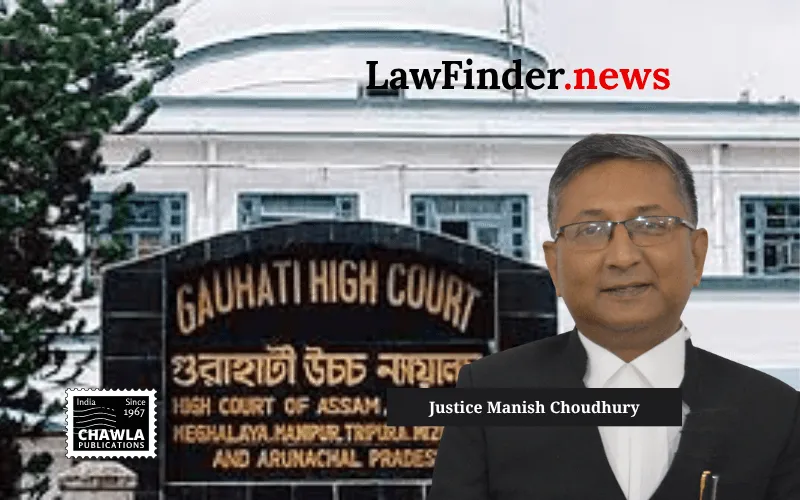
Court Upholds the Necessity of Following Procedures in Bharatiya Nagarik Suraksha Sanhita, 2023 Before Approaching High Court
In a significant ruling, the Gauhati High Court has dismissed a writ petition filed under Article 226 of the Constitution of India, which sought a directive for the registration and investigation of an FIR. The petitioner, Satyabrata Dey, had approached the court seeking an extraordinary jurisdictional order to compel the registration of an FIR by the authorities in Assam. The case, presided over by Justice Manish Choudhury, emphasized the necessity of exhausting alternative remedies provided under the Bharatiya Nagarik Suraksha Sanhita, 2023 (BNSS), before invoking the writ jurisdiction of the High Court.
Satyabrata Dey had alleged irregularities in a tender process conducted by the Lanka Municipal Board, claiming that despite quoting the lowest rate for a supply contract, the tender was awarded to another party at a higher rate. After his earlier writ petition was dismissed, Dey sent an FIR to the Lanka Police Station but did not receive a response. He then approached the High Court directly without exhausting the alternative remedies prescribed under the BNSS.
The court reiterated the established legal principle that the extraordinary jurisdiction under Article 226 should not be invoked without first utilizing the statutory remedies available under Sections 173 and 175 of the BNSS. Justice Choudhury referenced the Supreme Court's position in cases like Sakiri Vasu v. State of Uttar Pradesh, which outlines a procedural hierarchy for addressing grievances related to FIR registration. The BNSS mandates that complaints should first be addressed to the Superintendent of Police, and if unresolved, then to the Magistrate.
The judgment noted that direct invocation of writ jurisdiction without following the sequential statutory remedies burdens the courts and bypasses the legal framework intended to handle such grievances. The court observed that the petitioner had not approached the jurisdictional Judicial Magistrate, which is a necessary step before seeking the court's intervention.
While dismissing the petition as premature, the court granted liberty to the petitioner to pursue remedies under the BNSS by first approaching the Superintendent of Police and subsequently the Magistrate, as prescribed by the legal provisions.
This judgment underscores the importance of adhering to procedural norms in the criminal justice system and reinforces the role of statutory bodies in addressing grievances before judicial intervention is sought.
Bottom Line :
Filing a writ petition under Article 226 of the Constitution of India for directing the registration of an FIR without first exhausting statutory remedies under the Bharatiya Nagarik Suraksha Sanhita, 2023, such as approaching the Superintendent of Police or the Magistrate, is contrary to settled legal principles.
Statutory provision(s): Article 226 of the Constitution of India, Sections 173 and 175(3) of the Bharatiya Nagarik Suraksha Sanhita, 2023
Satyabrata Dey v. State of Assam, (Gauhati) : Law Finder Doc id # 2963289