MLA Chaitarbhai Vasava’s application for suspension of sentence dismissed due to grave antecedents and disregard of court conditions; limited role accused Rikesh Vasava granted bail on parity principle.
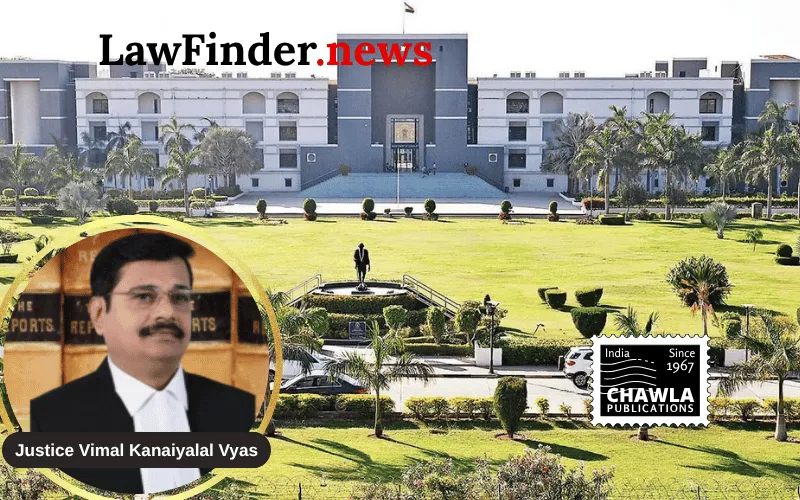
In a significant judgment dated August 24, 2026, the Gujarat High Court, presided over by Justice Vimal K. Vyas, refused to suspend the sentence of sitting MLA Chaitarbhai Damjibhai Vasava, who was convicted along with co-accused for offences including extortion, assault, criminal intimidation, and related charges. The Court, however, granted suspension of sentence and bail to a peripheral accused, Rikeshbhai Fulsingbhai Vasava, citing his limited role in the offence and applying the parity principle.
The conviction and sentencing arose from a case involving illegal encroachment and cultivation of approximately two hectares of forest land inside the Shoolpaneshwar Wildlife Sanctuary, Narmada District. Forest officials lawfully removed the illegal occupation and crops after following prescribed procedures. The accused, including MLA Vasava and others, were charged under multiple Sections of the Indian Penal Code (IPC) and the Arms Act, 1959, including Sections 143, 147, 148, 149, 189, 332, 353, 386, 294(b), 506(2), 201, 34 IPC and Section 25(1-a) of the Arms Act.
The prosecution case detailed two phases of criminal conduct on October 30 and 31, 2023. After forest officials removed illegal cultivation, MLA Vasava allegedly summoned them to his residence where he assaulted one official by slapping him twice and fired a shot in the air through a pistol procured by a co-accused. The officials were further threatened and extorted to pay Rs. 60,000 as compensation for crop damage. On the following day, the MLA’s personal assistant allegedly coerced the officials to pay the amount, which was eventually withdrawn from ATMs and handed over to the accused.
During the trial, the prosecution presented 17 witnesses including the forest officials, bank managers, telecom nodal officers, and police investigators. The trial court convicted the applicants for serious offences and sentenced them to rigorous imprisonment up to seven years with fines.
While the peripheral accused Rikesh Vasava's role was limited to procuring the pistol, the MLA’s conduct was found to be grave due to his extensive criminal antecedents. The records revealed that Vasava was involved in 22 offences, including several committed during court-imposed bail and probation periods. Despite being granted bail on condition not to engage in further criminal activity, he repeatedly violated such conditions, reflecting a disregard for law and order.
The High Court, upon prima facie consideration of the evidence and legal submissions, found no apparent or gross infirmity in the trial court’s judgment against the MLA and his close associate. The Court emphasized that holding public office does not confer immunity from prosecution and highlighted the need to maintain public confidence in the rule of law. The Court noted that suspending the sentence for a public representative who demonstrated such conduct would send a wrong societal message.
However, the Court recognized the limited involvement of Rikesh Vasava and allowed his application for suspension of sentence, imposing conditions including a bond of Rs. 15,000, prohibition on misuse of liberty, maintaining law and order, and restrictions on travel and residence changes.
The State assured full cooperation for expeditious hearing of the appeals filed by the convicts. The Court directed the registry to promptly list the appeals for final disposal.
This judgment reinforces that public officeholders are accountable under the law and that suspension of sentence is not a matter of course but depends on the nature of the offence, antecedents, and conduct of the accused.
Bottom Line:
Extortion - Suspension of sentence not granted to sitting MLA convicted of extortion, assault, criminal intimidation, and related offences due to grave antecedents and disregard of court conditions; limited role accused granted bail on parity.
Statutory provision(s):
Sections 143, 147, 148, 149, 189, 332, 353, 386, 294(b), 506(2), 201, 34 of the Indian Penal Code; Section 25(1-a) of the Arms Act, 1959; Section 430 of the Bharatiya Nagarik Suraksha Sanhita, 2023; Section 164 of the Code of Criminal Procedure; Section 360 of the Code of Criminal Procedure.
Chaitarbhai Damjibhai Vasava v. State of Gujarat, (Gujarat) : Law Finder Doc id # 2966836